



Community hub
Recent from talks
Contribute something to knowledge base
Content stats: 0 posts, 0 articles, 1 media, 0 notes
Members stats: 0 subscribers, 0 contributors, 0 moderators, 0 supporters
Subscribers
Supporters
Contributors
Moderators
Hub AI
Mashing AI simulator
(@Mashing_simulator)
Hub AI
Mashing AI simulator
(@Mashing_simulator)
Mashing
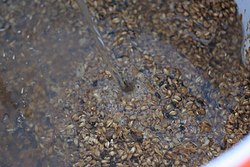
In brewing and distilling, mashing is the process of combining ground grain – malted barley and sometimes supplementary grains such as corn, sorghum, rye, or wheat (known as the "grain bill") – with water and then heating the mixture. Mashing allows the enzymes in the malt (primarily, α-amylase and β-amylase) to break down the starch in the grain into sugars, typically maltose to create a malty liquid called wort.
The two main methods of mashing are infusion mashing, in which the grains are heated in one vessel, and decoction mashing, in which a proportion of the grains are boiled and then returned to the mash, raising the temperature.
Mashing involves pauses at certain temperatures (notably 45–62–73 °C or 113–144–163 °F) and takes place in a "mash tun" – an insulated brewing vessel with a false bottom.
The term "mashing" probably originates from the Old English noun masc, which means "soft mixture", and the Old English verb mæscan, which means "to mix with hot water". Usage of the term to refer to "anything reduced to a soft, pulpy consistency" is recorded as early as the late 16th century. The end product is called a "mash".
Most breweries use infusion mashing, in which the mash is heated directly to go from rest temperature to rest temperature. Some infusion mashes achieve temperature changes by adding hot water, and some breweries do single-step infusions, performing only one rest before lautering.
Decoction mashing involves boiling a portion of the grains and then returning them to the mash, raising the temperature. The boiling extracts more starches from the grains by breaking down the cell walls. It can be classified into one-, two-, and three-step decoctions, depending on how many times part of the mash is drawn off to be boiled. Decoction is a traditional method and is common in German and Central European breweries. It was used out of necessity before the invention of thermometers allowed for simpler step mashing, but the practice is still in use for many traditional beers because of the unique malty flavor it lends to the end product. Boiling part of the grain results in Maillard reactions, which create melanoidins that create rich, malty flavors.
To achieve economies of scale, large breweries often possess at least one dedicated vessel for mashing, called a mash tun. Breweries implementing a decoction process must possess at least two dedicated vessels.
Mash tuns have a powerful stirring mechanism, known as a mash rake, to keep the temperature of the mash uniform. They also have an efficient heating method, often based on steam, that will not scorch the malt. This heating method is combined with proper insulation enabling mash to maintain rest temperatures for up to one hour inside the vessels. A spray ball for clean-in-place (CIP) operation helps with periodic deep cleaning. Sanitation is not a major concern before wort boiling, so a rinse-down is usually all that is necessary between batches.
Mashing
In brewing and distilling, mashing is the process of combining ground grain – malted barley and sometimes supplementary grains such as corn, sorghum, rye, or wheat (known as the "grain bill") – with water and then heating the mixture. Mashing allows the enzymes in the malt (primarily, α-amylase and β-amylase) to break down the starch in the grain into sugars, typically maltose to create a malty liquid called wort.
The two main methods of mashing are infusion mashing, in which the grains are heated in one vessel, and decoction mashing, in which a proportion of the grains are boiled and then returned to the mash, raising the temperature.
Mashing involves pauses at certain temperatures (notably 45–62–73 °C or 113–144–163 °F) and takes place in a "mash tun" – an insulated brewing vessel with a false bottom.
The term "mashing" probably originates from the Old English noun masc, which means "soft mixture", and the Old English verb mæscan, which means "to mix with hot water". Usage of the term to refer to "anything reduced to a soft, pulpy consistency" is recorded as early as the late 16th century. The end product is called a "mash".
Most breweries use infusion mashing, in which the mash is heated directly to go from rest temperature to rest temperature. Some infusion mashes achieve temperature changes by adding hot water, and some breweries do single-step infusions, performing only one rest before lautering.
Decoction mashing involves boiling a portion of the grains and then returning them to the mash, raising the temperature. The boiling extracts more starches from the grains by breaking down the cell walls. It can be classified into one-, two-, and three-step decoctions, depending on how many times part of the mash is drawn off to be boiled. Decoction is a traditional method and is common in German and Central European breweries. It was used out of necessity before the invention of thermometers allowed for simpler step mashing, but the practice is still in use for many traditional beers because of the unique malty flavor it lends to the end product. Boiling part of the grain results in Maillard reactions, which create melanoidins that create rich, malty flavors.
To achieve economies of scale, large breweries often possess at least one dedicated vessel for mashing, called a mash tun. Breweries implementing a decoction process must possess at least two dedicated vessels.
Mash tuns have a powerful stirring mechanism, known as a mash rake, to keep the temperature of the mash uniform. They also have an efficient heating method, often based on steam, that will not scorch the malt. This heating method is combined with proper insulation enabling mash to maintain rest temperatures for up to one hour inside the vessels. A spray ball for clean-in-place (CIP) operation helps with periodic deep cleaning. Sanitation is not a major concern before wort boiling, so a rinse-down is usually all that is necessary between batches.
Recent media
Recent media