



Community hub
Recent from talks
Knowledge base stats:
Talk channels stats:
Members stats:
Maslenitsa
Maslenitsa (Belarusian: Масленіца; Russian: Мaсленица [ˈmas⁽ʲ⁾lʲɪnʲɪt͡sə]; Rusyn: Пущаня; Ukrainian: Масниця), also known as Butter Lady, Butter Week, Crepe week, or Cheesefare Week, is an Eastern Slavic religious and folk holiday which has retained a number of elements of Slavic mythology in its ritual. It is celebrated during the last week before Great Lent; that is, the eighth week before Eastern Orthodox Pascha, equivalent to the West's Sexagesima.
The date of Maslenitsa changes every year, depending on the date of the celebration of Easter. It corresponds to the Western Christian Carnival, except that Orthodox Lent begins on a Monday instead of a Wednesday, and the Orthodox date of Easter can differ greatly from the Western Christian date.
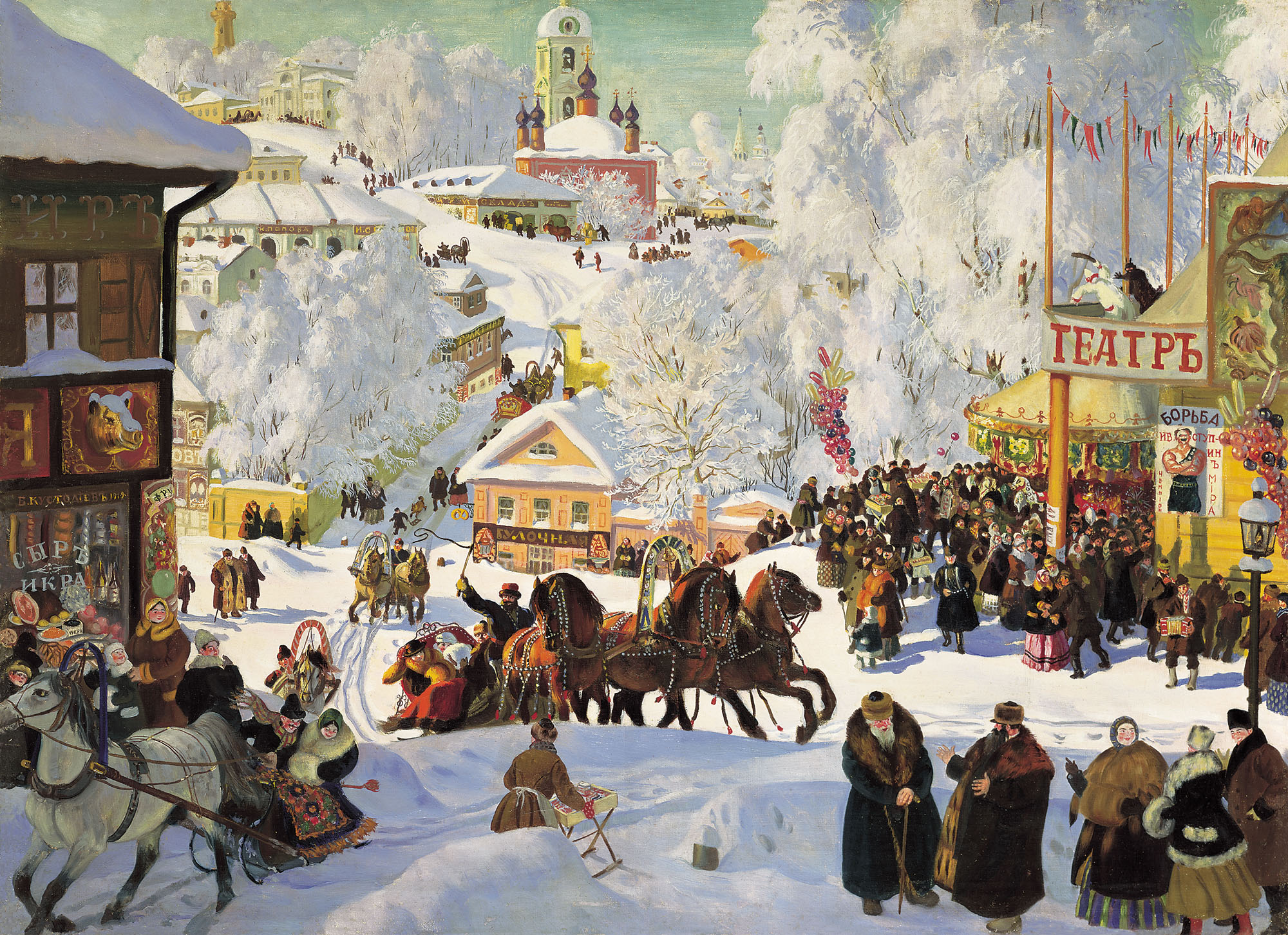
The traditional attributes of the Maslenitsa celebration are the Maslenitsa effigy, sleigh rides, and festivities. Russians bake blini and flatbread, while Belarusians and Ukrainians cook pierogi and syrniki.
According to archeological evidence from the 2nd century AD, Maslenitsa may be the oldest surviving Slavic holiday. In the Christian tradition, Maslenitsa is the last week before the onset of Great Lent.
During the week of Maslenitsa, work is already forbidden to Orthodox Christians, and it is the last week during which work is permitted, leading to its name of "work free week" or "Freedom week".
Since Lent excludes working, parties, secular music, dancing and other distractions from spiritual life, Maslenitsa represents the last chance to take part in social activities that are not appropriate during the more prayerful, sober and introspective Lenten season.
In Ukraine Maslenitsa week was also called Babskyi Tyzhden (Women's Week) or Kolodiy. During this week, men humorously followed women’s wishes. Married women gathered to "birth," "baptize," and "bury" a wooden log (koloda) throughout the week, symbolizing marriage and family traditions. By the end of the week, unmarried men and women had logs tied to their legs as a playful punishment for not marrying before Maslenitsa. This tradition highlighted the importance of marriage in Ukrainian culture. Though this tradition is no longer widely practiced, Kolodiy still remains a symbolic reminder of festive Slavic customs and the value of strong family bonds.
In some regions, each day of Maslenitsa had its traditional activity. Monday may be the welcoming of "Lady Maslenitsa". The community builds the Maslenitsa effigy out of straw, decorated with pieces of rags, and fixed to a pole formerly known as Kostroma. It is paraded around, and the first pancakes may be made and offered to the poor. On Tuesday, young men might search for a fiancée to marry after Lent. On Wednesday, sons-in-law may visit their mother-in-law, who has prepared pancakes and invited other guests for a party. Thursday may be devoted to outdoor activities. People may take time off work and spend the day sledding, ice skating, conducting snowball fights and with sleigh rides. On Friday, sons-in-law may invite their mothers-in-law for dinner. Saturday may be a gathering of a young wife with her sisters-in-law to work on a good relationship.
Hub AI
Maslenitsa AI simulator
(@Maslenitsa_simulator)
Maslenitsa
Maslenitsa (Belarusian: Масленіца; Russian: Мaсленица [ˈmas⁽ʲ⁾lʲɪnʲɪt͡sə]; Rusyn: Пущаня; Ukrainian: Масниця), also known as Butter Lady, Butter Week, Crepe week, or Cheesefare Week, is an Eastern Slavic religious and folk holiday which has retained a number of elements of Slavic mythology in its ritual. It is celebrated during the last week before Great Lent; that is, the eighth week before Eastern Orthodox Pascha, equivalent to the West's Sexagesima.
The date of Maslenitsa changes every year, depending on the date of the celebration of Easter. It corresponds to the Western Christian Carnival, except that Orthodox Lent begins on a Monday instead of a Wednesday, and the Orthodox date of Easter can differ greatly from the Western Christian date.
The traditional attributes of the Maslenitsa celebration are the Maslenitsa effigy, sleigh rides, and festivities. Russians bake blini and flatbread, while Belarusians and Ukrainians cook pierogi and syrniki.
According to archeological evidence from the 2nd century AD, Maslenitsa may be the oldest surviving Slavic holiday. In the Christian tradition, Maslenitsa is the last week before the onset of Great Lent.
During the week of Maslenitsa, work is already forbidden to Orthodox Christians, and it is the last week during which work is permitted, leading to its name of "work free week" or "Freedom week".
Since Lent excludes working, parties, secular music, dancing and other distractions from spiritual life, Maslenitsa represents the last chance to take part in social activities that are not appropriate during the more prayerful, sober and introspective Lenten season.
In Ukraine Maslenitsa week was also called Babskyi Tyzhden (Women's Week) or Kolodiy. During this week, men humorously followed women’s wishes. Married women gathered to "birth," "baptize," and "bury" a wooden log (koloda) throughout the week, symbolizing marriage and family traditions. By the end of the week, unmarried men and women had logs tied to their legs as a playful punishment for not marrying before Maslenitsa. This tradition highlighted the importance of marriage in Ukrainian culture. Though this tradition is no longer widely practiced, Kolodiy still remains a symbolic reminder of festive Slavic customs and the value of strong family bonds.
In some regions, each day of Maslenitsa had its traditional activity. Monday may be the welcoming of "Lady Maslenitsa". The community builds the Maslenitsa effigy out of straw, decorated with pieces of rags, and fixed to a pole formerly known as Kostroma. It is paraded around, and the first pancakes may be made and offered to the poor. On Tuesday, young men might search for a fiancée to marry after Lent. On Wednesday, sons-in-law may visit their mother-in-law, who has prepared pancakes and invited other guests for a party. Thursday may be devoted to outdoor activities. People may take time off work and spend the day sledding, ice skating, conducting snowball fights and with sleigh rides. On Friday, sons-in-law may invite their mothers-in-law for dinner. Saturday may be a gathering of a young wife with her sisters-in-law to work on a good relationship.