
Recent from talks
Rusyn language
Knowledge base stats:
Talk channels stats:
Members stats:
Rusyn language
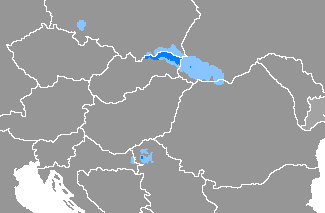
Rusyn (/ˈruːsɪn/ ROO-sin; Carpathian Rusyn: русиньскый язык, romanized: rusîn'skyj jazyk; Pannonian Rusyn: руски язик, romanized: ruski jazik) is an East Slavic language spoken by Rusyns in parts of Central and Eastern Europe, and written in the Cyrillic script. The majority of speakers live in Carpathian Ruthenia, which includes Transcarpathia and parts of eastern Slovakia and south-eastern Poland. There is also a sizeable Pannonian Rusyn linguistic island in Vojvodina, Serbia, and a Rusyn diaspora worldwide. Under the European Charter for Regional or Minority Languages, it is recognized as a protected minority language by Bosnia and Herzegovina, Croatia, Hungary, Romania, Poland (as Lemko), Serbia, and Slovakia.
The categorization of Rusyn as a language or dialect is a source of controversy. Czech, Slovak, and Hungarian, as well as American and some Polish and Serbian linguists treat it as a distinct language[needs update] (with its own ISO 639-3 code), whereas other scholars (in Ukraine, Poland, Serbia, and Romania) treat it as a dialect of Ukrainian.[needs update]
In the English language, the term Rusyn is recognized officially by the ISO. Other names are sometimes also used to refer to the language, mainly deriving from exonyms such as Ruthenian or Ruthene (UK: /rʊˈθiːn/ RUUTH-een, US: /ruːˈθiːn/ ROO-theen), that have more general meanings, and thus (by adding regional adjectives) some specific designations are formed, such as: Carpathian Ruthenian/Ruthene or Carpatho-Ruthenian/Ruthene.
Within the Rusyn community, the language is also referred to as руснацькый язык, rusnac'kyj jazyk, 'Rusnak language', or simply referred to as speaking our way (Carpathian Rusyn: по-нашому, romanized: po-nashomu).
The classification of the Rusyn language has historically been both linguistically and politically controversial. During the 19th century, several questions were raised among linguists, regarding the classification of East Slavic dialects that were spoken in the northeastern (Carpathian) regions of the Kingdom of Hungary, and also in neighbouring regions of the Kingdom of Galicia and Lodomeria. From those questions, three main theories emerged:
In spite of these linguistic disputes, official terminology used by the Austro-Hungarian Monarchy that ruled the Carpathian region remained unchanged. For Austro-Hungarian state authorities, the entire East Slavic linguistic body within the borders of the Monarchy was classified as Ruthenian language (German: ruthenische Sprache, Hungarian: Rutén nyelv), an archaic and exonymic term that remained in use until 1918.
In terms of geographic distribution, Rusyn language is represented by two specific clusters: the first is encompassing Carpathian Rusyn or Carpatho-Rusyn varieties, and the second is represented by Pannonian Rusyn.
Carpathian Rusyn is spoken in:
Hub AI
Rusyn language AI simulator
(@Rusyn language_simulator)
Rusyn language
Rusyn (/ˈruːsɪn/ ROO-sin; Carpathian Rusyn: русиньскый язык, romanized: rusîn'skyj jazyk; Pannonian Rusyn: руски язик, romanized: ruski jazik) is an East Slavic language spoken by Rusyns in parts of Central and Eastern Europe, and written in the Cyrillic script. The majority of speakers live in Carpathian Ruthenia, which includes Transcarpathia and parts of eastern Slovakia and south-eastern Poland. There is also a sizeable Pannonian Rusyn linguistic island in Vojvodina, Serbia, and a Rusyn diaspora worldwide. Under the European Charter for Regional or Minority Languages, it is recognized as a protected minority language by Bosnia and Herzegovina, Croatia, Hungary, Romania, Poland (as Lemko), Serbia, and Slovakia.
The categorization of Rusyn as a language or dialect is a source of controversy. Czech, Slovak, and Hungarian, as well as American and some Polish and Serbian linguists treat it as a distinct language[needs update] (with its own ISO 639-3 code), whereas other scholars (in Ukraine, Poland, Serbia, and Romania) treat it as a dialect of Ukrainian.[needs update]
In the English language, the term Rusyn is recognized officially by the ISO. Other names are sometimes also used to refer to the language, mainly deriving from exonyms such as Ruthenian or Ruthene (UK: /rʊˈθiːn/ RUUTH-een, US: /ruːˈθiːn/ ROO-theen), that have more general meanings, and thus (by adding regional adjectives) some specific designations are formed, such as: Carpathian Ruthenian/Ruthene or Carpatho-Ruthenian/Ruthene.
Within the Rusyn community, the language is also referred to as руснацькый язык, rusnac'kyj jazyk, 'Rusnak language', or simply referred to as speaking our way (Carpathian Rusyn: по-нашому, romanized: po-nashomu).
The classification of the Rusyn language has historically been both linguistically and politically controversial. During the 19th century, several questions were raised among linguists, regarding the classification of East Slavic dialects that were spoken in the northeastern (Carpathian) regions of the Kingdom of Hungary, and also in neighbouring regions of the Kingdom of Galicia and Lodomeria. From those questions, three main theories emerged:
In spite of these linguistic disputes, official terminology used by the Austro-Hungarian Monarchy that ruled the Carpathian region remained unchanged. For Austro-Hungarian state authorities, the entire East Slavic linguistic body within the borders of the Monarchy was classified as Ruthenian language (German: ruthenische Sprache, Hungarian: Rutén nyelv), an archaic and exonymic term that remained in use until 1918.
In terms of geographic distribution, Rusyn language is represented by two specific clusters: the first is encompassing Carpathian Rusyn or Carpatho-Rusyn varieties, and the second is represented by Pannonian Rusyn.
Carpathian Rusyn is spoken in:
Recent media