
Recent from talks
Massachusett language
Knowledge base stats:
Talk channels stats:
Members stats:
Massachusett language
The Massachusett language is an Algonquian language of the Algic language family that was formerly spoken by several peoples of eastern coastal and southeastern Massachusetts. In its revived form, it is spoken in four Wampanoag communities. The language is also known as Natick or Wôpanâak (Wampanoag), and historically as Pokanoket, Indian or Nonantum.
The language is most notable for its community of literate Native Americans and for the number of translations of religious texts into the language. John Eliot's translation of the Christian Bible in 1663 using the Natick dialect, known as Mamusse Wunneetupanatamwe Up-Biblum God, was the first printed in the Americas, the first Bible translated by a non-native speaker, and one of the earliest examples of a Bible translation into a previously unwritten language. Literate Native American ministers and teachers taught literacy to the elites and other members of their communities, influencing a widespread acceptance. This is attested in the numerous court petitions, church records, praying town administrative records, notes on book margins, personal letters, and widespread distribution of other translations of religious tracts throughout the colonial period.
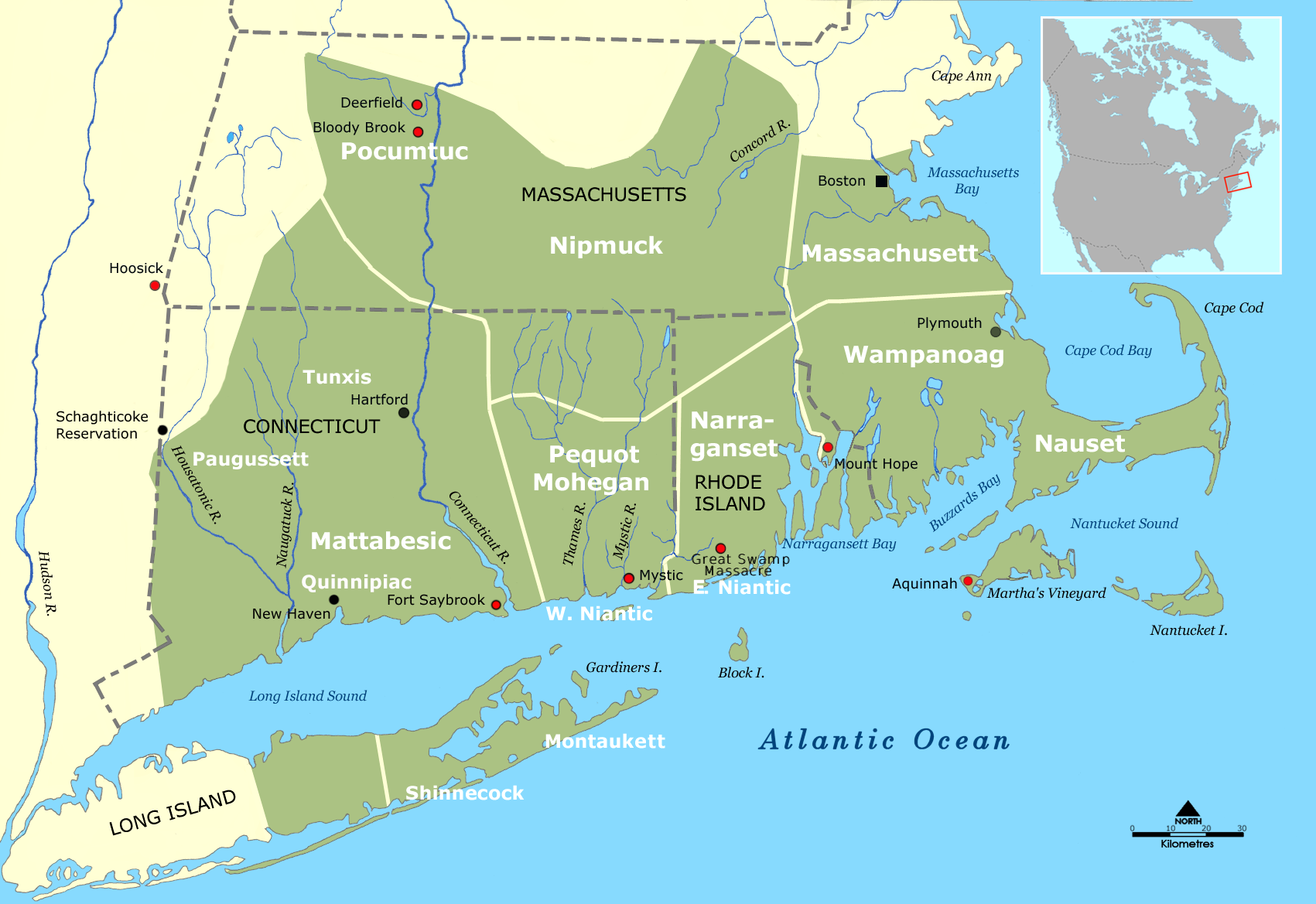
The dialects of the language were formerly spoken by several peoples of southern New England, including all the coastal and insular areas of eastern Massachusetts, as well as southeastern New Hampshire, the southernmost tip of Maine and eastern Rhode Island, and it was also a common second or third language across most of New England and portions of Long Island. The use of the language in the intertribal communities of Christian converts, called praying towns, resulted in its adoption by some groups of Nipmuc and Pennacook.
The revitalization of the language began in 1993 when Jessie Little Doe Baird (Mashpee Wampanoag) launched the Wôpanâak Language Reclamation Project (WLRP). It has successfully reintroduced the revived Wampanoag dialect to the Mashpee, Aquinnah, Assonet, and Herring Pond communities of the Wampanoag of Cape Cod and the Islands, with a handful of children who are growing up as the first native speakers in more than a century.
Massachusett is in the Eastern branch of Algonquian languages, which comprises all the known Algonquian languages spoken from the Canadian Maritimes southward to the Carolinas. Within the Eastern divisions, Massachusett clusters with the Southern New England Algonquian (SNEA) languages. If considered a dialect of SNEA, it is an SNEA 'N-dialect'. Other Eastern language divisions include the Abenakian languages spoken to the immediate north and the Delawaran languages to the west and southwest of the SNEA region. South of the Delawaran languages are the Nanticokan languages of the Chesapeake Bay and Potomac River watershed, the Powhatan languages of coastal Virginia and the Carolina Algonquian languages of the Carolinas. The Eastern languages are the only genetic grouping to have emerged from Algonquian, as all the languages descend from Proto-Eastern Algonquian (PEA), which differentiated likely due to isolation from other Algonquian speakers due to the presence of large pockets of Iroquoian and Siouan languages and the Appalachian Mountains. The Central and Plains, however, are groupings based on areal features and geographical proximity.
The SNEA languages were all mutually intelligible to some extent, existing in a dialect chain or linkage, with the boundaries between quite distinct dialects blurred by a series of transitional varieties. All the SNEA languages, including Massachusett, can be differentiated from other Eastern branch languages by several shared innovations including the merger of PEA *hr and *hx into *hš, palatization of PEA *k to SNEA *ty where it occurs after PEA *ē and some instances of PA *i, palatization of PEA *sk in similar environments to *hč and word-final PEA *r merging into *š.
Within SNEA, Massachusett shares the most similarity to Narragansett and Nipmuc, its immediate neighbors, with a handful of lexical items indicating an east-west division. For example, the word 'fish' is namohs (namâhs) in Massachusett, namens In Nipmuc and Narragansett namaùs, all likely pronounced similarly to /namaːhs/ from Proto-Algonquian *nameᐧʔsa, contrasting with Mohegan-Pequot piyamáq and Quiripi opéramac which derives from a local stem *pere- and an ancient alternative stem for 'fish', *-aᐧmeᐧkwa, likely Proto-Western SNEA *pīramākw /piːramaːkʷ/. Although Nipmuc is close to Massachusett, it is conservative in that it retains more noun and verb finals that are truncated in most environments in other SNEA languages.
The most defining feature of Massachusett in comparison to other SNEA languages is the outcome of /n/ in reflexes of PEA *r, itself a merger of Proto-Algonquian *r and *θ. Massachusett and its dialects always have /n/ and thus its classification as an SNEA N-dialect. This becomes /j/ in the Y-dialects of Narragansett, Eastern and Western Niantic and Mohegan-Pequot, /r/ in the R-dialects of Quiripi and /l/ in the L-dialect Nipmuc language.
Hub AI
Massachusett language AI simulator
(@Massachusett language_simulator)
Massachusett language
The Massachusett language is an Algonquian language of the Algic language family that was formerly spoken by several peoples of eastern coastal and southeastern Massachusetts. In its revived form, it is spoken in four Wampanoag communities. The language is also known as Natick or Wôpanâak (Wampanoag), and historically as Pokanoket, Indian or Nonantum.
The language is most notable for its community of literate Native Americans and for the number of translations of religious texts into the language. John Eliot's translation of the Christian Bible in 1663 using the Natick dialect, known as Mamusse Wunneetupanatamwe Up-Biblum God, was the first printed in the Americas, the first Bible translated by a non-native speaker, and one of the earliest examples of a Bible translation into a previously unwritten language. Literate Native American ministers and teachers taught literacy to the elites and other members of their communities, influencing a widespread acceptance. This is attested in the numerous court petitions, church records, praying town administrative records, notes on book margins, personal letters, and widespread distribution of other translations of religious tracts throughout the colonial period.
The dialects of the language were formerly spoken by several peoples of southern New England, including all the coastal and insular areas of eastern Massachusetts, as well as southeastern New Hampshire, the southernmost tip of Maine and eastern Rhode Island, and it was also a common second or third language across most of New England and portions of Long Island. The use of the language in the intertribal communities of Christian converts, called praying towns, resulted in its adoption by some groups of Nipmuc and Pennacook.
The revitalization of the language began in 1993 when Jessie Little Doe Baird (Mashpee Wampanoag) launched the Wôpanâak Language Reclamation Project (WLRP). It has successfully reintroduced the revived Wampanoag dialect to the Mashpee, Aquinnah, Assonet, and Herring Pond communities of the Wampanoag of Cape Cod and the Islands, with a handful of children who are growing up as the first native speakers in more than a century.
Massachusett is in the Eastern branch of Algonquian languages, which comprises all the known Algonquian languages spoken from the Canadian Maritimes southward to the Carolinas. Within the Eastern divisions, Massachusett clusters with the Southern New England Algonquian (SNEA) languages. If considered a dialect of SNEA, it is an SNEA 'N-dialect'. Other Eastern language divisions include the Abenakian languages spoken to the immediate north and the Delawaran languages to the west and southwest of the SNEA region. South of the Delawaran languages are the Nanticokan languages of the Chesapeake Bay and Potomac River watershed, the Powhatan languages of coastal Virginia and the Carolina Algonquian languages of the Carolinas. The Eastern languages are the only genetic grouping to have emerged from Algonquian, as all the languages descend from Proto-Eastern Algonquian (PEA), which differentiated likely due to isolation from other Algonquian speakers due to the presence of large pockets of Iroquoian and Siouan languages and the Appalachian Mountains. The Central and Plains, however, are groupings based on areal features and geographical proximity.
The SNEA languages were all mutually intelligible to some extent, existing in a dialect chain or linkage, with the boundaries between quite distinct dialects blurred by a series of transitional varieties. All the SNEA languages, including Massachusett, can be differentiated from other Eastern branch languages by several shared innovations including the merger of PEA *hr and *hx into *hš, palatization of PEA *k to SNEA *ty where it occurs after PEA *ē and some instances of PA *i, palatization of PEA *sk in similar environments to *hč and word-final PEA *r merging into *š.
Within SNEA, Massachusett shares the most similarity to Narragansett and Nipmuc, its immediate neighbors, with a handful of lexical items indicating an east-west division. For example, the word 'fish' is namohs (namâhs) in Massachusett, namens In Nipmuc and Narragansett namaùs, all likely pronounced similarly to /namaːhs/ from Proto-Algonquian *nameᐧʔsa, contrasting with Mohegan-Pequot piyamáq and Quiripi opéramac which derives from a local stem *pere- and an ancient alternative stem for 'fish', *-aᐧmeᐧkwa, likely Proto-Western SNEA *pīramākw /piːramaːkʷ/. Although Nipmuc is close to Massachusett, it is conservative in that it retains more noun and verb finals that are truncated in most environments in other SNEA languages.
The most defining feature of Massachusett in comparison to other SNEA languages is the outcome of /n/ in reflexes of PEA *r, itself a merger of Proto-Algonquian *r and *θ. Massachusett and its dialects always have /n/ and thus its classification as an SNEA N-dialect. This becomes /j/ in the Y-dialects of Narragansett, Eastern and Western Niantic and Mohegan-Pequot, /r/ in the R-dialects of Quiripi and /l/ in the L-dialect Nipmuc language.
Recent media