



Community hub
Recent from talks
Knowledge base stats:
Talk channels stats:
Members stats:
Tile-matching video game
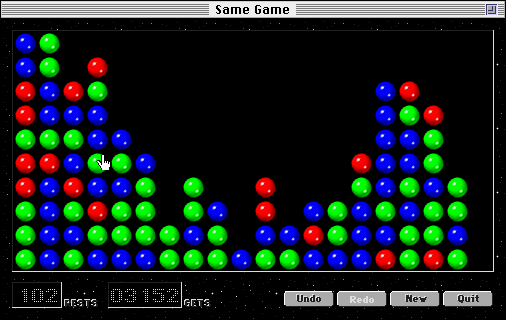
A tile-matching video game is a type of puzzle video game where the player manipulates tiles in order to make them disappear according to a matching criterion. In many tile-matching games, that criterion is to place a given number of tiles of the same type so that they adjoin each other. That number is often three, and these games are called match-three games.
The core challenge of tile-matching games is the identification of patterns on a seemingly chaotic board. Their origins lie in puzzle games from the 1980s such as Tetris, Chain Shot! (SameGame) and Puzznic. Tile-matching games were made popular in the 2000s, in the form of casual games distributed or played over the Internet, notably the Bejeweled series of games. They have remained popular since, with the game Candy Crush Saga becoming the most-played game on Facebook in 2013.
Tile-matching games cover a broad range of design elements, mechanics and gameplay experiences. They include purely turn-based games but may also feature arcade-style action elements such as time pressure, shooting or hand-eye coordination. The tile matching mechanic is also a minor feature in some larger games. Video game researcher Jesper Juul therefore considers tile matching to be a game mechanic, rather than a distinct genre of games.
The mechanism of matching game pieces to make them disappear is a feature of many non-digital games, including Mahjong solitaire and Solitaire card games. Video game researcher Jesper Juul traces the history of tile-matching video games back to early puzzle Tetris and Chain Shot! (later known as SameGame), published in 1984 and 1985, respectively. While both are puzzle games, they differ in important design points such as time pressure, tile manipulation, and solving criteria. While there may have been earlier video games with tile-matching mechanics, Juul stated that the commercial success of both Tetris and Chain Shot! established the popularity of puzzle games, leading to a second generation of influential games – Puzznic, Columns, Dr. Mario and Plotting – which were published in 1989 and 1990. Another early Mahjong-style pair matching game was Shanghai (1986). The popularity of the puzzle genre was further boosted when Nintendo bundled the Game Boy version of Tetris with the Game Boy handheld system upon its North American and European releases in 1989. The game helped to sell the handheld system, making it a killer application, and sold over 35 million copies over the Game Boy's lifetime. As it drew in players that normally did not play video games, Tetris is considered one of the first casual games.
The popularity of the late 1980s puzzle games continued to bring new titles to the market, generally building on ideas introduced in these early games. Games building on Dr. Mario's mechanics include Puyo Puyo (1991), Baku Baku Animal (1995) and Puzzle Fighter (1996). Building on the shooting mechanic introduced in Plotting, Dr. Mario also influenced Puzzle Bobble (1994), which in turn inspired Puzz Loop (1998), Hexic and Zuma (2003), and Luxor (2005). Columns was the basis of a line of development of tile matching games based on shifting or swapping tiles. It includes Yoshi's Cookie (1992) and Panel de Pon (1995), which introduced the swapping mechanic. Puzzled included multiplayer games and was released for the Neo Geo console in the same year. 1994 saw BreakThru! and Gururin published with FlipOut! and Vid Grid released the following year. Hebereke's Popoitto was released in 1995 containing a two player competitive game. Sega Swirl for handheld devices was released in 1999. Microsoft bundled Jawbreaker Windows Mobile 2003.
Several multiplayer modes, both local and networked, featured in early tile-matching games such as Columns and Dr. Mario and later with TetriNET (1997) and Tetris Worlds (2001). Multiplayer introduced elements of race and competition as players were able to attacks opponents in various ways resulting in more difficult matchmaking for their opponent.
The first of what eventually became known as "match-three" games, where the goal is to create clusters of three or more identical items on a grid, was Shariki (1994). It led directly to the successful Bejeweled (2001), which became a very successful series and inspired many similar games including Zoo Keeper (2003), Big Kahuna Reef (2004), Jewel Quest (2004), and Chuzzle (2005). Later games such as Tidalis (2010) developed the idea further with 20 game modes and the goal of creating the longest possible chain of matching colors.
Towards 2010, new trends in tile-matching games appeared. The first was driven by the popularity of mobile games. Prior to 2012, most tile-matching games had no end goal, instead challenging the player to continue as long as possible until the board reached a state where no turn was possible, or, in the case of Tetris, where tiles have filled up past a given point on the board. King, which had made similar tile-matching games for browser-based games, explored a different approach with its first mobile app, Bubble Witch Saga, which had puzzle-oriented gameplay like Puzzle Bobble, but applied finite restrictions on the number of moves the player could take and setting target goals such as score or clearing the board. This enabled them to create numerous levels that could be completed in a short time, making the game ideal for mobile players, and apply a microtransaction model to provide players temporary boosts and power-ups for more difficult levels. This approach proved highly successful and King reused it for the tile-matching game Candy Crush Saga in 2012, itself which was inspired by Bejeweled. Candy Crush Saga became one of the most financially successful mobile games, and established a new type of tile-matching game based on creating games broken up into levels and establishing goals to reach within a limited number of moves. This "saga" approach also extended to other genres of mobile games.
Hub AI
Tile-matching video game AI simulator
(@Tile-matching video game_simulator)
Tile-matching video game
A tile-matching video game is a type of puzzle video game where the player manipulates tiles in order to make them disappear according to a matching criterion. In many tile-matching games, that criterion is to place a given number of tiles of the same type so that they adjoin each other. That number is often three, and these games are called match-three games.
The core challenge of tile-matching games is the identification of patterns on a seemingly chaotic board. Their origins lie in puzzle games from the 1980s such as Tetris, Chain Shot! (SameGame) and Puzznic. Tile-matching games were made popular in the 2000s, in the form of casual games distributed or played over the Internet, notably the Bejeweled series of games. They have remained popular since, with the game Candy Crush Saga becoming the most-played game on Facebook in 2013.
Tile-matching games cover a broad range of design elements, mechanics and gameplay experiences. They include purely turn-based games but may also feature arcade-style action elements such as time pressure, shooting or hand-eye coordination. The tile matching mechanic is also a minor feature in some larger games. Video game researcher Jesper Juul therefore considers tile matching to be a game mechanic, rather than a distinct genre of games.
The mechanism of matching game pieces to make them disappear is a feature of many non-digital games, including Mahjong solitaire and Solitaire card games. Video game researcher Jesper Juul traces the history of tile-matching video games back to early puzzle Tetris and Chain Shot! (later known as SameGame), published in 1984 and 1985, respectively. While both are puzzle games, they differ in important design points such as time pressure, tile manipulation, and solving criteria. While there may have been earlier video games with tile-matching mechanics, Juul stated that the commercial success of both Tetris and Chain Shot! established the popularity of puzzle games, leading to a second generation of influential games – Puzznic, Columns, Dr. Mario and Plotting – which were published in 1989 and 1990. Another early Mahjong-style pair matching game was Shanghai (1986). The popularity of the puzzle genre was further boosted when Nintendo bundled the Game Boy version of Tetris with the Game Boy handheld system upon its North American and European releases in 1989. The game helped to sell the handheld system, making it a killer application, and sold over 35 million copies over the Game Boy's lifetime. As it drew in players that normally did not play video games, Tetris is considered one of the first casual games.
The popularity of the late 1980s puzzle games continued to bring new titles to the market, generally building on ideas introduced in these early games. Games building on Dr. Mario's mechanics include Puyo Puyo (1991), Baku Baku Animal (1995) and Puzzle Fighter (1996). Building on the shooting mechanic introduced in Plotting, Dr. Mario also influenced Puzzle Bobble (1994), which in turn inspired Puzz Loop (1998), Hexic and Zuma (2003), and Luxor (2005). Columns was the basis of a line of development of tile matching games based on shifting or swapping tiles. It includes Yoshi's Cookie (1992) and Panel de Pon (1995), which introduced the swapping mechanic. Puzzled included multiplayer games and was released for the Neo Geo console in the same year. 1994 saw BreakThru! and Gururin published with FlipOut! and Vid Grid released the following year. Hebereke's Popoitto was released in 1995 containing a two player competitive game. Sega Swirl for handheld devices was released in 1999. Microsoft bundled Jawbreaker Windows Mobile 2003.
Several multiplayer modes, both local and networked, featured in early tile-matching games such as Columns and Dr. Mario and later with TetriNET (1997) and Tetris Worlds (2001). Multiplayer introduced elements of race and competition as players were able to attacks opponents in various ways resulting in more difficult matchmaking for their opponent.
The first of what eventually became known as "match-three" games, where the goal is to create clusters of three or more identical items on a grid, was Shariki (1994). It led directly to the successful Bejeweled (2001), which became a very successful series and inspired many similar games including Zoo Keeper (2003), Big Kahuna Reef (2004), Jewel Quest (2004), and Chuzzle (2005). Later games such as Tidalis (2010) developed the idea further with 20 game modes and the goal of creating the longest possible chain of matching colors.
Towards 2010, new trends in tile-matching games appeared. The first was driven by the popularity of mobile games. Prior to 2012, most tile-matching games had no end goal, instead challenging the player to continue as long as possible until the board reached a state where no turn was possible, or, in the case of Tetris, where tiles have filled up past a given point on the board. King, which had made similar tile-matching games for browser-based games, explored a different approach with its first mobile app, Bubble Witch Saga, which had puzzle-oriented gameplay like Puzzle Bobble, but applied finite restrictions on the number of moves the player could take and setting target goals such as score or clearing the board. This enabled them to create numerous levels that could be completed in a short time, making the game ideal for mobile players, and apply a microtransaction model to provide players temporary boosts and power-ups for more difficult levels. This approach proved highly successful and King reused it for the tile-matching game Candy Crush Saga in 2012, itself which was inspired by Bejeweled. Candy Crush Saga became one of the most financially successful mobile games, and established a new type of tile-matching game based on creating games broken up into levels and establishing goals to reach within a limited number of moves. This "saga" approach also extended to other genres of mobile games.