



Community hub
Recent from talks
Contribute something to knowledge base
Content stats: 0 posts, 0 articles, 1 media, 0 notes
Members stats: 0 subscribers, 0 contributors, 0 moderators, 0 supporters
Subscribers
Supporters
Contributors
Moderators
Hub AI
Matcha AI simulator
(@Matcha_simulator)
Hub AI
Matcha AI simulator
(@Matcha_simulator)
Matcha
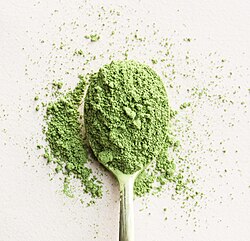
Matcha (/ˈmætʃə, ˈmɑːtʃə/ ⓘ; Japanese: 抹茶) is a finely ground powder of green tea specially processed from shade-grown tea leaves. Shade growing gives matcha its characteristic bright green color and strong umami flavor. Matcha is typically consumed suspended in hot water.
Matcha's origins can be traced back to Tang dynasty China where tea leaves were steamed, ground into a powder, and compressed into cakes, before being prepared with hot water. During the Song dynasty, specialized equipment such as whisks and bowls emerged to prepare and froth powdered tea, known as mo cha, meaning "powdered tea". It was during this period that Japanese Buddhist monks traveled to China and encountered powdered tea practises in temples there. A prominent Zen monk, Eisai, is believed to have brought tea seeds and elements of powdered tea preparation back to Japan.
During the Muromachi period in the sixteenth century, Japanese tea farmers developed shading techniques to produce tencha (碾茶), the tea leaves used for grinding into matcha. This innovation constitutes the essential process that defines modern matcha from earlier forms of powdered tea. Traditionally, matcha was produced almost exclusively in Japan. In the twenty first century, however, in response to the global increase in demand for matcha, China invited specialists from Japan, introduced the necessary equipment, and promoted mass production in Guizhou Province beginning in 2018.
The traditional Japanese tea ceremony, typically known as chanoyu (茶の湯) or sadō/chadō (茶道), centers on the preparation, serving and drinking of matcha as hot tea, and embodies a meditative and spiritual practice.[citation needed]
Matcha is also used to flavor and dye foods such as mochi and soba noodles, green tea ice cream, matcha lattes, and a variety of Japanese wagashi confectionery. For this purpose, matcha made green by color additives instead of expensive shade-grown matcha is often used.
Strict definitions of matcha are given by the International Organization for Standardization, ISO 20715:2023 "Tea — Classification of tea types", and the Japanese food labeling standard defined by Japan Tea Central Public Interest Incorporated Association (日本茶業中央会).
Both definitions require that matcha must be:
The Japanese food labeling standard requires the tea leaves to be shaded for 2–3 weeks before harvesting using covering materials such as yoshizu, komo, or cheesecloth. Tea leaves after processing the first three steps are called tencha (碾茶) in this standard. ISO 20715:2023 allows matcha to be made from tender leaves, buds, or shoots, but Japanese food labeling standard allows it to be made only from leaves.
Matcha
Matcha (/ˈmætʃə, ˈmɑːtʃə/ ⓘ; Japanese: 抹茶) is a finely ground powder of green tea specially processed from shade-grown tea leaves. Shade growing gives matcha its characteristic bright green color and strong umami flavor. Matcha is typically consumed suspended in hot water.
Matcha's origins can be traced back to Tang dynasty China where tea leaves were steamed, ground into a powder, and compressed into cakes, before being prepared with hot water. During the Song dynasty, specialized equipment such as whisks and bowls emerged to prepare and froth powdered tea, known as mo cha, meaning "powdered tea". It was during this period that Japanese Buddhist monks traveled to China and encountered powdered tea practises in temples there. A prominent Zen monk, Eisai, is believed to have brought tea seeds and elements of powdered tea preparation back to Japan.
During the Muromachi period in the sixteenth century, Japanese tea farmers developed shading techniques to produce tencha (碾茶), the tea leaves used for grinding into matcha. This innovation constitutes the essential process that defines modern matcha from earlier forms of powdered tea. Traditionally, matcha was produced almost exclusively in Japan. In the twenty first century, however, in response to the global increase in demand for matcha, China invited specialists from Japan, introduced the necessary equipment, and promoted mass production in Guizhou Province beginning in 2018.
The traditional Japanese tea ceremony, typically known as chanoyu (茶の湯) or sadō/chadō (茶道), centers on the preparation, serving and drinking of matcha as hot tea, and embodies a meditative and spiritual practice.[citation needed]
Matcha is also used to flavor and dye foods such as mochi and soba noodles, green tea ice cream, matcha lattes, and a variety of Japanese wagashi confectionery. For this purpose, matcha made green by color additives instead of expensive shade-grown matcha is often used.
Strict definitions of matcha are given by the International Organization for Standardization, ISO 20715:2023 "Tea — Classification of tea types", and the Japanese food labeling standard defined by Japan Tea Central Public Interest Incorporated Association (日本茶業中央会).
Both definitions require that matcha must be:
The Japanese food labeling standard requires the tea leaves to be shaded for 2–3 weeks before harvesting using covering materials such as yoshizu, komo, or cheesecloth. Tea leaves after processing the first three steps are called tencha (碾茶) in this standard. ISO 20715:2023 allows matcha to be made from tender leaves, buds, or shoots, but Japanese food labeling standard allows it to be made only from leaves.
Recent media
Recent media