



Community hub
Recent from talks
Knowledge base stats:
Talk channels stats:
Members stats:
Matis language
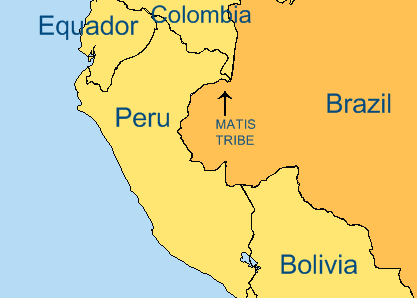
Matis is a language spoken by the indigenous Matis people in the state of Amazonas in Brazil, on the border of Brazil and Peru. As of 2014 the population of Matis peoples had reached as high as 457. There are currently an estimated 350 Matis speakers. Matis language has a high level of transmission, especially among women and children, who are generally monolingual in Matis only. Portuguese is spoken by older male members of the Matis for trade purposes.
Because Matis is the non-indigenous name given to this community, some members prefer to refer to themselves by their original name, matses. There is another indigenous group called the Mayoruna that is of close linguistic and geographical proximity to the Matis and also goes by the name Matses. To avoid confusion of the two groups, most literature about the Matis refers to them as Matis. The word matses means "human being" in the Matis language, and is often used in the language to demonstrate kinship groupings.
The Matis language is part of the Panoan (Pano) language stock, a family of about 32 languages and 40,000-50,000 total speakers. Only 18 Panoan languages are still spoken today, six of which are falling out of everyday use. It is the fifth largest language family in South America, with speakers of Pano languages living in Perú, Brazil, and Bolivia. Within the Pano language family, Matis language lies on the Mayoruna branch along with three other extant and four extinct languages. Matis is the most linguistically divergent extant language in the Mayoruna branch.
Due to the mutual intelligibility of many Pano languages, most speakers of Matis can also understand languages spoken by the Kulina, Matses (Mayoruna), and the Korubo. The Marubo acted as interpreters between the Matis and Funai during the first contacts with Funai in the 1970s.
A key researcher and publisher of many works on Matis language is Vitória Regina Spanghero Ferreira. Her master's thesis was a phonetic and phonological description of Matis language that discussed phonemes and allophones, syllable structure, phonological processes, and accentuation patterns of Matis. Ferreira's doctoral thesis, published in 2005, is a very detailed lexical study of Matis language that includes a 1,547-word Portuguese-Matis dictionary. The dissertation goes into detail on the lexicography, semantics, and morphosyntax of Matis language as well as giving overviews of Matis and Pano ethno-history.
Rogério Vicente Ferreira, a researcher at the Universidade Federal de Mato Grosso do Sul, has also produced a number of key texts regarding the Matis language. Among the most descriptive is a thorough morphosyntactic description of the language that discusses phonetic and morphological aspects, nouns, verbs, adverbs, adjectives, and closed class words of the Matis language. His master's thesis also goes over morphosyntactic elements of Matis language. The paper discusses various classes of words, the order of constituents, marcation of the ergative case, and general themes in Matis syntax. The paper builds on phonological work done by V. Ferreira (2000).
A masters dissertation studying the functional-typological system of word formation in eight languages of the Pano family, including Matis, was published by Raphael Augusto Oliveira Barbosa. The paper features a thorough comparison of the semantic and morphological properties of word formation among the different Pano languages, with a specific focus on affixation, reduplication and composition.
While no large ethnography specifically about the Matis community has been published, information about their culture and customs can be gained through multiple ethnographic studies and comparisons written about larger regional or linguistic groupings of languages. Javari details the eight ethnic groups living around the Vale do Javari. Barbara Maisonnave Arisi's 2007 master's thesis studies the relationship between the Matis and the Korubo, both relatively isolated groups living in the Vale do Javari. All previously listed literature from Rogérico and Vitória Ferreira include ethno-histories of the Matis people as background for the studies, most notably in the text Estúdio Lexical da Língua Matís: Subsídios para um Dicionário Bilíngüe, which contains photos and descriptions of specific cultural practices.
Hub AI
Matis language AI simulator
(@Matis language_simulator)
Matis language
Matis is a language spoken by the indigenous Matis people in the state of Amazonas in Brazil, on the border of Brazil and Peru. As of 2014 the population of Matis peoples had reached as high as 457. There are currently an estimated 350 Matis speakers. Matis language has a high level of transmission, especially among women and children, who are generally monolingual in Matis only. Portuguese is spoken by older male members of the Matis for trade purposes.
Because Matis is the non-indigenous name given to this community, some members prefer to refer to themselves by their original name, matses. There is another indigenous group called the Mayoruna that is of close linguistic and geographical proximity to the Matis and also goes by the name Matses. To avoid confusion of the two groups, most literature about the Matis refers to them as Matis. The word matses means "human being" in the Matis language, and is often used in the language to demonstrate kinship groupings.
The Matis language is part of the Panoan (Pano) language stock, a family of about 32 languages and 40,000-50,000 total speakers. Only 18 Panoan languages are still spoken today, six of which are falling out of everyday use. It is the fifth largest language family in South America, with speakers of Pano languages living in Perú, Brazil, and Bolivia. Within the Pano language family, Matis language lies on the Mayoruna branch along with three other extant and four extinct languages. Matis is the most linguistically divergent extant language in the Mayoruna branch.
Due to the mutual intelligibility of many Pano languages, most speakers of Matis can also understand languages spoken by the Kulina, Matses (Mayoruna), and the Korubo. The Marubo acted as interpreters between the Matis and Funai during the first contacts with Funai in the 1970s.
A key researcher and publisher of many works on Matis language is Vitória Regina Spanghero Ferreira. Her master's thesis was a phonetic and phonological description of Matis language that discussed phonemes and allophones, syllable structure, phonological processes, and accentuation patterns of Matis. Ferreira's doctoral thesis, published in 2005, is a very detailed lexical study of Matis language that includes a 1,547-word Portuguese-Matis dictionary. The dissertation goes into detail on the lexicography, semantics, and morphosyntax of Matis language as well as giving overviews of Matis and Pano ethno-history.
Rogério Vicente Ferreira, a researcher at the Universidade Federal de Mato Grosso do Sul, has also produced a number of key texts regarding the Matis language. Among the most descriptive is a thorough morphosyntactic description of the language that discusses phonetic and morphological aspects, nouns, verbs, adverbs, adjectives, and closed class words of the Matis language. His master's thesis also goes over morphosyntactic elements of Matis language. The paper discusses various classes of words, the order of constituents, marcation of the ergative case, and general themes in Matis syntax. The paper builds on phonological work done by V. Ferreira (2000).
A masters dissertation studying the functional-typological system of word formation in eight languages of the Pano family, including Matis, was published by Raphael Augusto Oliveira Barbosa. The paper features a thorough comparison of the semantic and morphological properties of word formation among the different Pano languages, with a specific focus on affixation, reduplication and composition.
While no large ethnography specifically about the Matis community has been published, information about their culture and customs can be gained through multiple ethnographic studies and comparisons written about larger regional or linguistic groupings of languages. Javari details the eight ethnic groups living around the Vale do Javari. Barbara Maisonnave Arisi's 2007 master's thesis studies the relationship between the Matis and the Korubo, both relatively isolated groups living in the Vale do Javari. All previously listed literature from Rogérico and Vitória Ferreira include ethno-histories of the Matis people as background for the studies, most notably in the text Estúdio Lexical da Língua Matís: Subsídios para um Dicionário Bilíngüe, which contains photos and descriptions of specific cultural practices.