Hubbry Logo
Matrix additionMatrix additionMain
Open search
Matrix addition
Community hub
Matrix addition
logo
8 pages, 0 posts
0 subscribers
Be the first to start a discussion here.
Matrix addition
Matrix addition
from Wikipedia
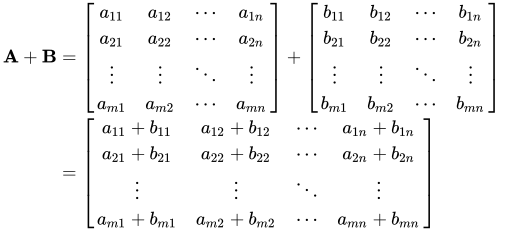
Illustration of the addition of two matrices.

In mathematics, matrix addition is the operation of adding two matrices by adding the corresponding entries together.

For a vector, , adding two matrices would have the geometric effect of applying each matrix transformation separately onto , then adding the transformed vectors.


Definition

[edit]

Two matrices must have an equal number of rows and columns to be added.[1] In which case, the sum of two matrices A and B will be a matrix which has the same number of rows and columns as A and B. The sum of A and B, denoted A + B, is computed by adding corresponding elements of A and B:[2][3]
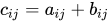
Or more concisely (assuming that A + B = C):[4][5]
For example:

Similarly, it is also possible to subtract one matrix from another, as long as they have the same dimensions. The difference of A and B, denoted AB, is computed by subtracting elements of B from corresponding elements of A, and has the same dimensions as A and B. For example:

See also

[edit]

Notes

[edit]

References

[edit]
[edit]
Revisions and contributorsEdit on WikipediaRead on Wikipedia
from Grokipedia
Matrix addition is a fundamental operation in linear algebra that combines two matrices of identical dimensions by adding the corresponding elements in each position, resulting in a new matrix of the same size. For two m×nm \times n matrices A=(aij)A = (a_{ij}) and B=(bij)B = (b_{ij}), the sum C=A+BC = A + B is defined such that cij=aij+bijc_{ij} = a_{ij} + b_{ij} for all i=1,,mi = 1, \dots, m and j=1,,nj = 1, \dots, n. This operation inherits key properties from scalar addition, including commutativity (A+B=B+AA + B = B + A) and associativity ((A+B)+C=A+(B+C)(A + B) + C = A + (B + C)), making it well-suited for algebraic manipulations in vector spaces and systems of equations. Additionally, matrix addition is closed under the set of all m×nm \times n matrices over a given field, such as the real numbers, ensuring the result remains a valid matrix. In practice, matrix addition underpins broader matrix arithmetic, including scalar multiplication and transposition, and serves as a building block for solving linear systems, transformations in , and in . Unlike matrix multiplication, which requires compatible dimensions and is non-commutative, addition is straightforward and applies uniformly to conformable matrices, highlighting its role in introductory linear algebra.

Fundamentals

Definition

Matrix addition is an operation in linear algebra that combines two matrices to produce a third matrix, provided the matrices have identical dimensions. Specifically, addition is defined only for matrices that are both of size m×nm \times n, where mm represents the number of rows and nn the number of columns. The process of matrix addition is performed element-wise, analogous to the addition of scalars but applied component by component across the matrices. For two m×nm \times n matrices A=(aij)A = (a_{ij}) and B=(bij)B = (b_{ij}), their sum C=A+BC = A + B is the matrix whose entries are given by cij=aij+bijc_{ij} = a_{ij} + b_{ij} for all i=1i = 1 to mm and j=1j = 1 to nn. This assumes the fundamental structure of a matrix as an ordered rectangular of elements arranged in rows and columns. The concept of matrix addition originated in the foundational work of , who developed the theory of matrices in his memoir, where he first described matrices as entities that could be added alongside other operations.

Notation and Compatibility

In matrix addition, the operation is denoted using the standard plus symbol (+), where the sum of two matrices A\mathbf{A} and B\mathbf{B} is written as A+B=C\mathbf{A} + \mathbf{B} = \mathbf{C}, with matrices conventionally represented by uppercase letters in boldface or font to distinguish them from scalars. This notation aligns with the element-wise nature of the addition, ensuring clarity in algebraic expressions. For the addition to be defined, the matrices must be compatible, meaning they share identical dimensions—specifically, the same number of rows mm and columns nn, so both are m×nm \times n matrices. If the dimensions differ, the operation is undefined, as there are no corresponding entries to sum. In advanced contexts like , this compatibility extends to infinite-dimensional settings, where linear operators on vector spaces (such as Hilbert spaces) can be added provided they share the same domain and , with addition defined on the operators. A common pitfall arises from conflating addition's strict same-dimension requirement with matrix multiplication's compatibility rule, which allows multiplication when the first matrix's columns match the second's rows, potentially leading to erroneous attempts to add incompatible matrices.

Properties

Algebraic Properties

Matrix addition exhibits several fundamental algebraic properties that establish it as an operation within the structure of linear algebra. For two matrices AA and BB of the same dimensions m×nm \times n, their sum A+BA + B is defined by adding corresponding entries: (A+B)ij=Aij+Bij(A + B)_{ij} = A_{ij} + B_{ij} for all i=1,,mi = 1, \dots, m and j=1,,nj = 1, \dots, n. One key property is closure: the sum of two m×nm \times n matrices is always another m×nm \times n matrix, preserving the dimensions under the entry-wise operation. This follows directly from the definition, as each entry of the resulting matrix is a valid scalar sum from the underlying field (such as the real or complex numbers). Matrix addition is commutative, meaning A+B=B+AA + B = B + A for any compatible matrices AA and BB. To see this, consider the (i,j)(i,j)-th entry: (A+B)ij=Aij+Bij=Bij+Aij=(B+A)ij(A + B)_{ij} = A_{ij} + B_{ij} = B_{ij} + A_{ij} = (B + A)_{ij}, relying on the commutativity of in the base field. It is also associative: for compatible matrices AA, BB, and CC, (A+B)+C=A+(B+C)(A + B) + C = A + (B + C). The proof proceeds entry-wise: the (i,j)(i,j)-th entry of the left side is ((A+B)+C)ij=(A+B)ij+Cij=(Aij+Bij)+Cij((A + B) + C)_{ij} = (A + B)_{ij} + C_{ij} = (A_{ij} + B_{ij}) + C_{ij}, which equals Aij+(Bij+Cij)A_{ij} + (B_{ij} + C_{ij}) by associativity in the field, matching the right side. These properties—closure, commutativity, and associativity—position matrix addition as the addition operation in an abelian group structure on the set of all m×nm \times n matrices over a field, isomorphic to the vector space Fmn\mathbb{F}^{mn} where F\mathbb{F} is the field. This alignment with field axioms for addition ensures that matrices behave like vectors under summation, facilitating their use in broader algebraic frameworks without introducing scalar multiplication details here.

Additive Inverse

The additive inverse of a matrix A=(aij)A = (a_{ij}), an m×nm \times n matrix over a field such as the real numbers R\mathbb{R} or complex numbers C\mathbb{C}, is the matrix A=(aij)-A = (-a_{ij}), where each entry is negated, satisfying A+(A)=OA + (-A) = O for the zero matrix OO. This negation operation is equivalent to scalar multiplication by 1-1, so A=(1)A-A = (-1)A, ensuring the inverse exists uniquely for every matrix of fixed dimensions. The OO, an m×nm \times n matrix with all entries equal to zero, acts as the in matrix addition, meaning A+O=O+A=AA + O = O + A = A for any m×nm \times n matrix AA. This property holds because adding zero to each entry of AA leaves the entries unchanged, mirroring the role of zero in scalar addition. Matrix subtraction is defined as the addition of the : for compatible m×nm \times n matrices A=(aij)A = (a_{ij}) and B=(bij)B = (b_{ij}), the difference A[B](/page/Subtraction)A - [B](/page/Subtraction) is the matrix whose (i,j)(i,j)-th entry is aijbija_{ij} - b_{ij}. To derive this, note that [B](/page/Negation)=(bij)-[B](/page/Negation) = (-b_{ij}), so (AB)ij=(A+(B))ij=aij+(bij)=aijbij,(A - B)_{ij} = (A + (-B))_{ij} = a_{ij} + (-b_{ij}) = a_{ij} - b_{ij}, which confirms that reduces to after , preserving the entry-wise nature of the operations. The set of all m×nm \times n matrices over a field FF (e.g., R\mathbb{R} or C\mathbb{C}) forms an under , with the as the and each matrix having its as described. This group structure is commutative due to the entry-wise , ensuring the operation is well-defined and satisfies all group axioms for fixed dimensions.

Examples and Applications

Computational Examples

To illustrate the process of matrix addition, consider the following 2×2 matrices: A=(1234),B=(5678).A = \begin{pmatrix} 1 & 2 \\ 3 & 4 \end{pmatrix}, \quad B = \begin{pmatrix} 5 & 6 \\ 7 & 8 \end{pmatrix}. The sum A+BA + B is computed by adding the corresponding entries element-wise: A+B=(1+52+63+74+8)=(681012).A + B = \begin{pmatrix} 1 + 5 & 2 + 6 \\ 3 + 7 & 4 + 8 \end{pmatrix} = \begin{pmatrix} 6 & 8 \\ 10 & 12 \end{pmatrix}. This operation requires that both matrices have the same dimensions to ensure each entry has a counterpart for addition./02%3A_Matrix_Arithmetic/2.01%3A_Matrix_Addition_and_Scalar_Multiplication) Matrix addition also applies to rectangular matrices, provided they share identical dimensions. For example, take these 2×3 matrices: C=(123456),D=(789101112).C = \begin{pmatrix} 1 & 2 & 3 \\ 4 & 5 & 6 \end{pmatrix}, \quad D = \begin{pmatrix} 7 & 8 & 9 \\ 10 & 11 & 12 \end{pmatrix}. Adding them entry-wise yields: C+D=(1+72+83+94+105+116+12)=(81012141618),C + D = \begin{pmatrix} 1 + 7 & 2 + 8 & 3 + 9 \\ 4 + 10 & 5 + 11 & 6 + 12 \end{pmatrix} = \begin{pmatrix} 8 & 10 & 12 \\ 14 & 16 & 18 \end{pmatrix}, which retains the original 2×3 shape./02%3A_II._Linear_Algebra/01%3A_Matrices/1.02%3A_Addition_and_Multiplication_of_Matrices) The serves as the , meaning that adding it to any matrix leaves the original unchanged. For the matrix AA above, the 2×2 zero matrix is O=(0000),O = \begin{pmatrix} 0 & 0 \\ 0 & 0 \end{pmatrix}, and A+O=AA + O = A. This holds because each entry of AA is added to zero. Addition is undefined for matrices of incompatible dimensions, as there are no corresponding entries to pair. For instance, attempting to add the 2×2 matrix AA to a 3×3 matrix such as E=(123456789)E = \begin{pmatrix} 1 & 2 & 3 \\ 4 & 5 & 6 \\ 7 & 8 & 9 \end{pmatrix}
Add your contribution
Related Hubs
User Avatar
No comments yet.