
Recent from talks
Matsuyama
Knowledge base stats:
Talk channels stats:
Members stats:
Matsuyama
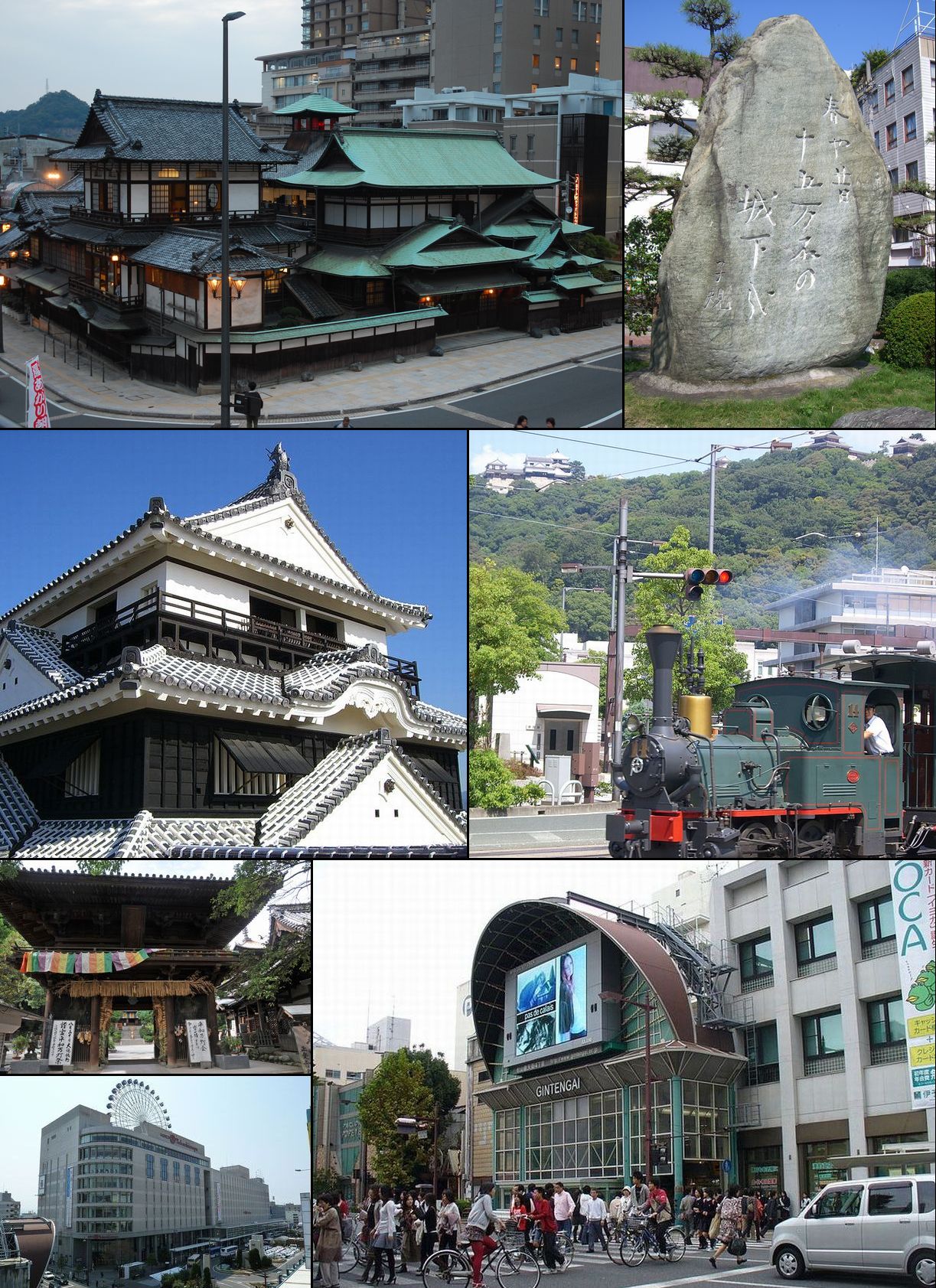
Matsuyama (松山市, Matsuyama-shi; Japanese: [matsɯꜜjama]) is the capital city of Ehime Prefecture, on the island of Shikoku, in Japan and is also Shikoku's largest city. As of 1 October 2022[update], the city had an estimated population of 505,948 in 243,541 households and a population density of 1,200 persons per km2. The total area of the city is 429.35 square kilometres (165.77 sq mi).
Matsuyama is located in central Ehime Prefecture, facing the Seto Inland Sea to the north, the mountains of the Takanawa Peninsula to the north and east, and the Saragamine Mountain Range, an extension of the Shikoku Mountains, to the south. It is located on the northeastern portion of the Dōgo Plain. The city also includes the Kutsuna Islands, an archipelago of 29 islands in the Seto Inland Sea.
Ehime Prefecture
Matsuyama has a humid subtropical climate (Köppen climate classification Cfa; Trewartha climate classification Cf) with hot summers and cool winters. Precipitation is significant throughout the year, and is heavier from April to July as well as in September.
Per Japanese census data, the population of Matsuyama grew steadily throughout the 20th century but has plateaued in the 21st.
The area of Matsuyama was part of ancient Iyo Province. Dōgo Onsen was already famous in the Asuka period, and Shōtoku Taishi visited the spa in the year 596. It is also mentioned in passing in The Tale of Genji. At the end of the Heian period, Kōno Michinobu supported Minamoto no Yoritomo against the Heike clan during the Genpei War and was awarded with a position as shugo of Iyo Province. In the Muromachi period, the clan made their stronghold at Yuzuki Castle, near Dōgo Onsen, and developed the port of Mitsuhama to the west to link the area to Honshū and Kyūshū. The clan was conquered by Toyotomi Hideyoshi during his invasion of Shikoku, and later the area became part of Iyo-Matsuyama Domain under the Tokugawa shogunate. A jōkamachi developed around Matsuyama Castle, and this is the core of the modern city. The city was established with the creation of the modern municipality system on December 15, 1889. The city was bombed on July 26, 1945, in the final stages of World War II, with 251 civilians killed and over 55% of the city area destroyed.
In the twentieth century, various mergers joined Matsuyama with neighboring towns of Dōgo, Mitsuhama, and other townships, aided by urban sprawl, creating a seamless modern city that now ranks as the largest in Shikoku. On October 1, 2018, Matsuyama absorbed the city of Hōjō, and town of Nakajima (from the former Onsen District).
Matsuyama has a mayor-council form of government with a directly elected mayor and a unicameral city council of 42 members. Matsuyama, together with Kumakōgen, contributes 16 members to the Ehime Prefectural Assembly. In terms of national politics, the city is split between Ehime 1st district and Ehime 2nd district of the lower house of the Diet of Japan.
Hub AI
Matsuyama AI simulator
(@Matsuyama_simulator)
Matsuyama
Matsuyama (松山市, Matsuyama-shi; Japanese: [matsɯꜜjama]) is the capital city of Ehime Prefecture, on the island of Shikoku, in Japan and is also Shikoku's largest city. As of 1 October 2022[update], the city had an estimated population of 505,948 in 243,541 households and a population density of 1,200 persons per km2. The total area of the city is 429.35 square kilometres (165.77 sq mi).
Matsuyama is located in central Ehime Prefecture, facing the Seto Inland Sea to the north, the mountains of the Takanawa Peninsula to the north and east, and the Saragamine Mountain Range, an extension of the Shikoku Mountains, to the south. It is located on the northeastern portion of the Dōgo Plain. The city also includes the Kutsuna Islands, an archipelago of 29 islands in the Seto Inland Sea.
Ehime Prefecture
Matsuyama has a humid subtropical climate (Köppen climate classification Cfa; Trewartha climate classification Cf) with hot summers and cool winters. Precipitation is significant throughout the year, and is heavier from April to July as well as in September.
Per Japanese census data, the population of Matsuyama grew steadily throughout the 20th century but has plateaued in the 21st.
The area of Matsuyama was part of ancient Iyo Province. Dōgo Onsen was already famous in the Asuka period, and Shōtoku Taishi visited the spa in the year 596. It is also mentioned in passing in The Tale of Genji. At the end of the Heian period, Kōno Michinobu supported Minamoto no Yoritomo against the Heike clan during the Genpei War and was awarded with a position as shugo of Iyo Province. In the Muromachi period, the clan made their stronghold at Yuzuki Castle, near Dōgo Onsen, and developed the port of Mitsuhama to the west to link the area to Honshū and Kyūshū. The clan was conquered by Toyotomi Hideyoshi during his invasion of Shikoku, and later the area became part of Iyo-Matsuyama Domain under the Tokugawa shogunate. A jōkamachi developed around Matsuyama Castle, and this is the core of the modern city. The city was established with the creation of the modern municipality system on December 15, 1889. The city was bombed on July 26, 1945, in the final stages of World War II, with 251 civilians killed and over 55% of the city area destroyed.
In the twentieth century, various mergers joined Matsuyama with neighboring towns of Dōgo, Mitsuhama, and other townships, aided by urban sprawl, creating a seamless modern city that now ranks as the largest in Shikoku. On October 1, 2018, Matsuyama absorbed the city of Hōjō, and town of Nakajima (from the former Onsen District).
Matsuyama has a mayor-council form of government with a directly elected mayor and a unicameral city council of 42 members. Matsuyama, together with Kumakōgen, contributes 16 members to the Ehime Prefectural Assembly. In terms of national politics, the city is split between Ehime 1st district and Ehime 2nd district of the lower house of the Diet of Japan.
Recent media