



Community hub
Recent from talks
Contribute something to knowledge base
Content stats: 0 posts, 0 articles, 1 media, 0 notes
Members stats: 0 subscribers, 0 contributors, 0 moderators, 0 supporters
Subscribers
Supporters
Contributors
Moderators
Hub AI
Matthew Paris AI simulator
(@Matthew Paris_simulator)
Hub AI
Matthew Paris AI simulator
(@Matthew Paris_simulator)
Matthew Paris
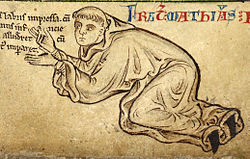
Matthew Paris, also known as Matthew of Paris (Latin: Matthæus Parisiensis, lit. 'Matthew the Parisian'; c. 1200 – 1259), was an English Benedictine monk, chronicler, artist in illuminated manuscripts, and cartographer who was based at St Albans Abbey in Hertfordshire. He authored a number of historical works, many of which he scribed and illuminated himself, typically in drawings partly coloured with watercolour washes, sometimes called "tinted drawings". Some were written in Latin, others in Anglo-Norman or French verse. He is sometimes confused with the nonexistent Matthew of Westminster.
His Chronica Majora is a renowned Medieval work, in many cases being a key source for mid-13th century Europe, partially due to his verbose insertion of personal opinions into his narrative and his use of sources such as records, letters, and conversations with witnesses to events including the English king Henry III, earl Richard of Cornwall, the Norwegian king Haakon IV, a number of English bishops, and many others. Modern historians recognise Paris's biases. He often tended to glorify Holy Roman Emperor Frederick II and denigrate the pope, expressing strong criticism of centralised church authority and at times royal power. However, in his Historia Anglorum, Paris displays a highly negative view of Frederick, going as far as to describe him as a "tyrant" who "committed disgraceful crimes".
In spite of his surname and knowledge of the French language, Paris was of English birth, and is believed by some chroniclers to be of the Paris family of Hildersham, Cambridgeshire. He may have studied at Paris in his youth after early education at St Albans School, however this is simply conjecture. The first we know of Matthew Paris (from his own writings) is that he was admitted as a monk to St Albans in 1217. It is on the assumption that he was in his teens on admission that his birth date is estimated; some scholars suspect he may have been ten years or older; many monks only entered monastic life after pursuing a career in the world outside. He was clearly at ease with the nobility and even royalty, which may indicate that he came from a family of some status, although it also seems an indication of his personality. His life was mainly spent in this religious house. In 1248, Paris was sent to Norway as the bearer of a message from Louis IX to Haakon IV; he made himself so agreeable to the Norwegian sovereign that he was invited to superintend the reformation of the Benedictine Nidarholm Abbey outside Trondheim.
Apart from these missions, his known activities were devoted to the composition of history, a pursuit for which the monks of St Albans had long been famous. He inherited the mantle of Roger of Wendover, at that time the abbey's foremost chronicler, after Wendover's death in 1236. Paris revised Wendover's work, a chronicle covering Creation to 1235 known as the Flores Historiarum, and added new material of an annalistic nature from 1236 onwards which Paris sustained until his death in 1259. This work, known as the Chronica Majora, was thus not only useful to readers of Paris's time, and has been used by modern historians as a source document for the period between 1235 and 1259. While this makes Paris's Chronica currently his most famous work, within the first few hundred years after Paris's death this was not the case. Paris scribed 2 major abridgements of his Chronica: his Historia Anglorum, and a work named like that of Wendover, the Flores Historiarum. This manuscript, unlike his Chronica, was copied multiple times and at multiple places and within 250 years of the writing of Paris's Flores, over 20 copies were made. Paris also is known for his illustrations and cartographic ability, often found as marginalia however sometimes being given full pages.
The Dublin MS (see below) contains interesting notes, which shed light on Paris's involvement in other manuscripts, and on the way his own were used. They are in French and in his handwriting:
It is presumed the last relates to Paris acting as commissioning agent and iconographical consultant for the Countess with another artist.
The lending of his manuscripts to aristocratic households, apparently for periods of weeks or months at a time, suggests why he made several different illustrated versions of his Chronicle.
Many of Paris's manuscripts aside from his Chronica contain multiple texts and often begin with a large assortment of prefatory material, often including full-page miniatures. Some have survived incomplete, and the various elements now bound together may not have been intended to be so by Paris. Unless stated otherwise, all were given by Paris to his monastery (from some inscriptions it seems they were regarded as his property to dispose of). The monastic libraries were broken up at the Dissolution. These MSS seem to have been appreciated, and were quickly collected by bibliophiles. Many of his manuscripts in the British Library are from the Cotton Library.
Matthew Paris
Matthew Paris, also known as Matthew of Paris (Latin: Matthæus Parisiensis, lit. 'Matthew the Parisian'; c. 1200 – 1259), was an English Benedictine monk, chronicler, artist in illuminated manuscripts, and cartographer who was based at St Albans Abbey in Hertfordshire. He authored a number of historical works, many of which he scribed and illuminated himself, typically in drawings partly coloured with watercolour washes, sometimes called "tinted drawings". Some were written in Latin, others in Anglo-Norman or French verse. He is sometimes confused with the nonexistent Matthew of Westminster.
His Chronica Majora is a renowned Medieval work, in many cases being a key source for mid-13th century Europe, partially due to his verbose insertion of personal opinions into his narrative and his use of sources such as records, letters, and conversations with witnesses to events including the English king Henry III, earl Richard of Cornwall, the Norwegian king Haakon IV, a number of English bishops, and many others. Modern historians recognise Paris's biases. He often tended to glorify Holy Roman Emperor Frederick II and denigrate the pope, expressing strong criticism of centralised church authority and at times royal power. However, in his Historia Anglorum, Paris displays a highly negative view of Frederick, going as far as to describe him as a "tyrant" who "committed disgraceful crimes".
In spite of his surname and knowledge of the French language, Paris was of English birth, and is believed by some chroniclers to be of the Paris family of Hildersham, Cambridgeshire. He may have studied at Paris in his youth after early education at St Albans School, however this is simply conjecture. The first we know of Matthew Paris (from his own writings) is that he was admitted as a monk to St Albans in 1217. It is on the assumption that he was in his teens on admission that his birth date is estimated; some scholars suspect he may have been ten years or older; many monks only entered monastic life after pursuing a career in the world outside. He was clearly at ease with the nobility and even royalty, which may indicate that he came from a family of some status, although it also seems an indication of his personality. His life was mainly spent in this religious house. In 1248, Paris was sent to Norway as the bearer of a message from Louis IX to Haakon IV; he made himself so agreeable to the Norwegian sovereign that he was invited to superintend the reformation of the Benedictine Nidarholm Abbey outside Trondheim.
Apart from these missions, his known activities were devoted to the composition of history, a pursuit for which the monks of St Albans had long been famous. He inherited the mantle of Roger of Wendover, at that time the abbey's foremost chronicler, after Wendover's death in 1236. Paris revised Wendover's work, a chronicle covering Creation to 1235 known as the Flores Historiarum, and added new material of an annalistic nature from 1236 onwards which Paris sustained until his death in 1259. This work, known as the Chronica Majora, was thus not only useful to readers of Paris's time, and has been used by modern historians as a source document for the period between 1235 and 1259. While this makes Paris's Chronica currently his most famous work, within the first few hundred years after Paris's death this was not the case. Paris scribed 2 major abridgements of his Chronica: his Historia Anglorum, and a work named like that of Wendover, the Flores Historiarum. This manuscript, unlike his Chronica, was copied multiple times and at multiple places and within 250 years of the writing of Paris's Flores, over 20 copies were made. Paris also is known for his illustrations and cartographic ability, often found as marginalia however sometimes being given full pages.
The Dublin MS (see below) contains interesting notes, which shed light on Paris's involvement in other manuscripts, and on the way his own were used. They are in French and in his handwriting:
It is presumed the last relates to Paris acting as commissioning agent and iconographical consultant for the Countess with another artist.
The lending of his manuscripts to aristocratic households, apparently for periods of weeks or months at a time, suggests why he made several different illustrated versions of his Chronicle.
Many of Paris's manuscripts aside from his Chronica contain multiple texts and often begin with a large assortment of prefatory material, often including full-page miniatures. Some have survived incomplete, and the various elements now bound together may not have been intended to be so by Paris. Unless stated otherwise, all were given by Paris to his monastery (from some inscriptions it seems they were regarded as his property to dispose of). The monastic libraries were broken up at the Dissolution. These MSS seem to have been appreciated, and were quickly collected by bibliophiles. Many of his manuscripts in the British Library are from the Cotton Library.
Recent media
Recent media