


Community hub
Recent from talks
Contribute something
Nothing was collected or created yet.
Max Mason
View on Wikipedia

Key Information


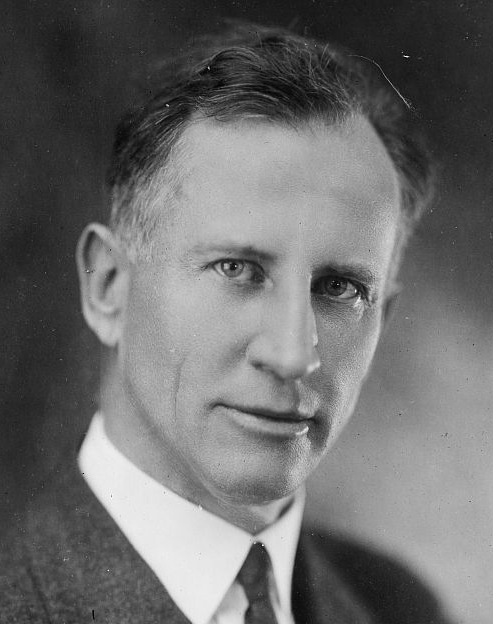
Charles Max Mason (26 October 1877–22 March 1961), better known as Max Mason, was an American mathematician. He served the 4th president of the University of Chicago from 1925 to 1928 and as the third president of the Rockefeller Foundation from 1929 to 1936.[1][2]
Mason's mathematical research interests included differential equations, the calculus of variations, and electromagnetic theory.[3]
Education
[edit]- B.Litt., 1898, University of Wisconsin-Madison
- Ph.D., Mathematics, University of Göttingen, 1903.
- Dissertation: "Randwertaufgaben bei gewöhnlichen Differentialgleichungen" (Boundary value functions with ordinary differential equations)
- Advisor: Hilbert
Career
[edit]- Massachusetts Institute of Technology (MIT), 1903–1904, Instructor of Mathematics.
- Yale University, 1904–1908, Assistant Professor of Mathematics.
- University of Wisconsin–Madison, 1908–1909, University of Wisconsin–Madison, Associate Professor of Mathematics.
- University of Wisconsin–Madison, 1909–1925, Professor of Physics.
- National Research Council, 1917–1919, Submarine Committee. (Invented a submarine detection device, which was the basis for sonar detectors used in World War II.)
- University of Chicago, 1925–1928, President.
- Rockefeller Foundation, 1928–1929, Director, Natural Sciences Division.
- Rockefeller Foundation, 1929–1936, President.
- Palomar Observatory (California), 1936–1949, Chairman of the team directing the construction of the observatory.[4]
On 2 May 1945, he appeared on Edgar Bergen's radio show to chat about the new observatory and trade jokes with Charlie McCarthy.[5] In 1948, he, along with Lee A. DuBridge, William A. Fowler, Linus Pauling, and Bruce H. Sage, was awarded the Medal for Merit by President Harry S. Truman.[6]
Notes and references
[edit]- ^ "Max Mason". Physics Today. 14 (5): 76. May 1961. doi:10.1063/1.3057580.
- ^ Weaver, Warren (1964). "Max Mason 1877–1961" (PDF). National Academy of Sciences. Archived (PDF) from the original on October 22, 2018. Retrieved September 13, 2017.
- ^ O'Connor, J. J.; Robertson, E. F. (August 2005). "Max Mason (1877 - 1961) - Biography - MacTutor History of Mathematics". University of St Andrews. Archived from the original on January 21, 2022. Retrieved March 21, 2022.
- ^ "Vast Hope in 'Big Eye'". The Morning Kansas City Star. Vol. 111, no. 134. Associated Press. June 4, 1948. p. 6. Retrieved March 21, 2022 – via Newspapers.com.
- ^ "Radio This Week". The Kansas City Star. Vol. 68, no. 221. April 25, 1948. p. 11D. Retrieved March 21, 2022 – via Newspapers.com.
- ^ "Presidential Medal for Merit. February 2, 1948. - Published Papers and Official Documents - Linus Pauling and the International Peace Movement". Oregon State University. Archived from the original on July 18, 2018. Retrieved February 26, 2022.
External links
[edit]- Max Mason at the Mathematics Genealogy Project
- "Max Mason". University of Chicago Library. Archived from the original on April 17, 2016. Retrieved March 22, 2022.
Archival collections
[edit]- "Guide to the Max Mason Papers 1882–1961". University of Chicago Library. Archived from the original on March 8, 2022. Retrieved March 22, 2022.
- "Guide to the University of Chicago Office of the President, Mason Administration Records 1910–1929". University of Chicago Library. Archived from the original on March 2, 2022. Retrieved March 22, 2022.
- Max Mason papers, 1898-1961, Niels Bohr Library & Archives
- Max Mason papers, 1750-1815, Royal Observatory Edinburgh
- Charles Mason papers, 1750-1815, American Philosophical Society
| International | |
|---|---|
| National | |
| Academics | |
| People | |
| Other | |

   | This article about an American mathematician is a stub. You can help Wikipedia by adding missing information. |