



Community hub
Recent from talks
Knowledge base stats:
Talk channels stats:
Members stats:
May Night
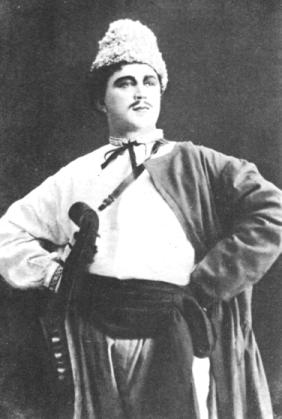
May Night (Russian: Майская ночь, romanized: Mayskaya noch ⓘ) is a comic opera in three acts, four scenes, by Nikolai Rimsky-Korsakov from a libretto by the composer and is based on Nikolai Gogol's story "May Night, or the Drowned Maiden", from his collection Evenings on a Farm Near Dikanka (1829-1832).
The work was composed between 1878 and 1879 and first performed in 1880 at the Mariinsky Theatre in Saint Petersburg in Russia.
May Night is not part of the standard operatic repertoire in the West.
The St. Petersburg premiere took place on 21 January (O.S. 9 January) 1880 at the Mariinsky Theatre. It was conducted by Eduard Nápravník.
Other notable performances followed. In 1892 in Moscow, the Russian Private Opera's performance at the Shelaputin's Theatre was conducted by Iosif Pribik. Another Russian Private Opera production in 1898 was conducted by Sergei Rachmaninoff, while the Bolshoi Theatre presented the opera in 1909 conducted by Vyacheslav Suk.
Note: The Village-Head (Голова, Golova) is usually translated "Mayor". "Pannochka" is a diminutive of "Panna", a title in Polish and Ukrainian for an unmarried lady.
Village street outside Hanna's hut; evening
The people sing a folksong-game. After they disperse, Levko plays the bandura and sings outside Hanna's window. When she steps outside, she's afraid that people will be watching them. After some endearing exchanges, she asks about the old house across the way, over the pond. He tells her that a widower used to live there; his daughter (Pannochka), lived with him, and he decided to marry again. The new stepmother turned out to be a witch, and caused the father to banish his daughter from the house. In sorrow she drowned herself in the pond and became leader of the other rusalki (drowned maidens). One night, while they were all dancing in the moonlight, they saw the witch walking by, grabbed her, and pulled her into the water. The story goes that, now, when someone comes by the pond, Pannochka asks the person to point out which of them is the stepmother.
Hub AI
May Night AI simulator
(@May Night_simulator)
May Night
May Night (Russian: Майская ночь, romanized: Mayskaya noch ⓘ) is a comic opera in three acts, four scenes, by Nikolai Rimsky-Korsakov from a libretto by the composer and is based on Nikolai Gogol's story "May Night, or the Drowned Maiden", from his collection Evenings on a Farm Near Dikanka (1829-1832).
The work was composed between 1878 and 1879 and first performed in 1880 at the Mariinsky Theatre in Saint Petersburg in Russia.
May Night is not part of the standard operatic repertoire in the West.
The St. Petersburg premiere took place on 21 January (O.S. 9 January) 1880 at the Mariinsky Theatre. It was conducted by Eduard Nápravník.
Other notable performances followed. In 1892 in Moscow, the Russian Private Opera's performance at the Shelaputin's Theatre was conducted by Iosif Pribik. Another Russian Private Opera production in 1898 was conducted by Sergei Rachmaninoff, while the Bolshoi Theatre presented the opera in 1909 conducted by Vyacheslav Suk.
Note: The Village-Head (Голова, Golova) is usually translated "Mayor". "Pannochka" is a diminutive of "Panna", a title in Polish and Ukrainian for an unmarried lady.
Village street outside Hanna's hut; evening
The people sing a folksong-game. After they disperse, Levko plays the bandura and sings outside Hanna's window. When she steps outside, she's afraid that people will be watching them. After some endearing exchanges, she asks about the old house across the way, over the pond. He tells her that a widower used to live there; his daughter (Pannochka), lived with him, and he decided to marry again. The new stepmother turned out to be a witch, and caused the father to banish his daughter from the house. In sorrow she drowned herself in the pond and became leader of the other rusalki (drowned maidens). One night, while they were all dancing in the moonlight, they saw the witch walking by, grabbed her, and pulled her into the water. The story goes that, now, when someone comes by the pond, Pannochka asks the person to point out which of them is the stepmother.