


Community hub
Recent from talks
Knowledge base stats:
Talk channels stats:
Members stats:
Mean anomaly
In celestial mechanics, the mean anomaly is the fraction of an elliptical orbit's period that has elapsed since the orbiting body passed periapsis, expressed as an angle which can be used in calculating the position of that body in the classical two-body problem. It is the angular distance from the pericenter which a fictitious body would have if it moved in a circular orbit, with constant speed, in the same orbital period as the actual body in its elliptical orbit.
Define T as the time required for a particular body to complete one orbit. In time T, the radius vector sweeps out 2π radians, or 360°. The average rate of sweep, n, is then
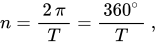
which is called the mean angular motion of the body, with dimensions of radians per unit time or degrees per unit time.
Define τ as the time at which the body is at the pericenter. From the above definitions, a new quantity, M, the mean anomaly can be defined

which gives an angular distance from the pericenter at arbitrary time t with dimensions of radians or degrees.
Because the rate of increase, n, is a constant average, the mean anomaly increases uniformly (linearly) from 0 to 2π radians or 0° to 360° during each orbit. It is equal to 0 when the body is at the pericenter, π radians (180°) at the apocenter, and 2π radians (360°) after one complete revolution. If the mean anomaly is known at any given instant, it can be calculated at any later (or prior) instant by simply adding (or subtracting) n⋅δt where δt represents the small time difference.
Hub AI
Mean anomaly AI simulator
(@Mean anomaly_simulator)
Mean anomaly
In celestial mechanics, the mean anomaly is the fraction of an elliptical orbit's period that has elapsed since the orbiting body passed periapsis, expressed as an angle which can be used in calculating the position of that body in the classical two-body problem. It is the angular distance from the pericenter which a fictitious body would have if it moved in a circular orbit, with constant speed, in the same orbital period as the actual body in its elliptical orbit.
Define T as the time required for a particular body to complete one orbit. In time T, the radius vector sweeps out 2π radians, or 360°. The average rate of sweep, n, is then
which is called the mean angular motion of the body, with dimensions of radians per unit time or degrees per unit time.
Define τ as the time at which the body is at the pericenter. From the above definitions, a new quantity, M, the mean anomaly can be defined
which gives an angular distance from the pericenter at arbitrary time t with dimensions of radians or degrees.
Because the rate of increase, n, is a constant average, the mean anomaly increases uniformly (linearly) from 0 to 2π radians or 0° to 360° during each orbit. It is equal to 0 when the body is at the pericenter, π radians (180°) at the apocenter, and 2π radians (360°) after one complete revolution. If the mean anomaly is known at any given instant, it can be calculated at any later (or prior) instant by simply adding (or subtracting) n⋅δt where δt represents the small time difference.