
Recent from talks
Medical gown
Knowledge base stats:
Talk channels stats:
Members stats:
Medical gown
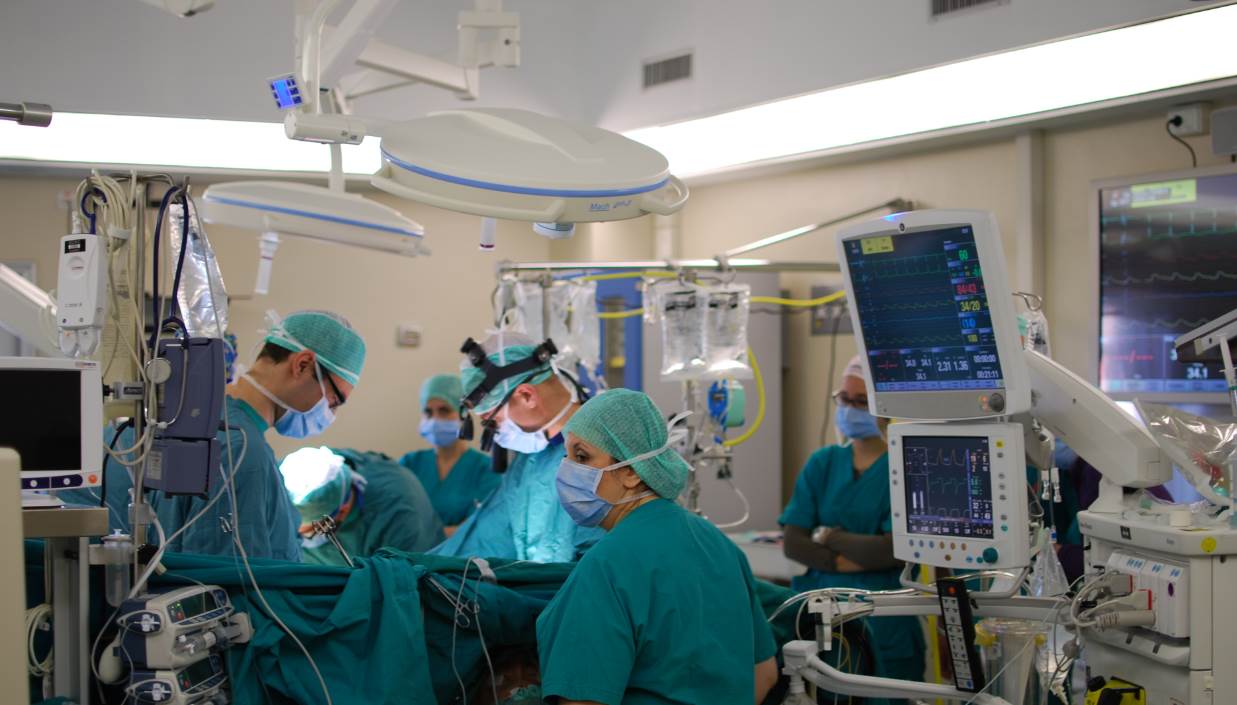
Medical gowns are hospital gowns worn by medical professionals as personal protective equipment (PPE) in order to provide a barrier between patient and professional. Whereas patient gowns are flimsy often with exposed backs and arms, PPE gowns, as seen below in the cardiac surgeon photograph, cover most of the exposed skin surfaces of the professional medics.
In several countries, PPE gowns for use in the COVID-19 pandemic became in appearance more like cleanroom suits as knowledge of the best practices filtered up through the national bureaucracies. For example, the European norm-setting bodies CEN and CENELEC on 30 March 2020 in collaboration with the European Commissioner for the Internal Market made freely-available the relevant standards documents in order "to tackle the severe shortage of protective masks, gloves and other products currently faced by many European countries. Providing free access to the standards will facilitate the work of the many companies wishing to reconvert their production lines in order to manufacture the equipment that is so urgently needed."
The concept of PPE in regards to medical professionals was seen as early as the 17th century Plague doctor's outfit.
During the Ebola crisis of 2014, the WHO published a rapid advice guideline on PPE coveralls.
The different levels of various gown types are categorized as follows:
In the United States, medical gowns are medical devices regulated by the Food and Drug Administration. FDA divides medical gowns into three categories. A surgical gown is intended to be worn by health care personnel during surgical procedures. Surgical isolation gowns are used when there is a medium to high risk of contamination and a need for larger critical zones of protection. Non-surgical gowns are worn in low or minimal risk situations.
Surgical and surgical isolation gowns are regulated by the FDA as a Class II medical device that require a 510(k) premarket notification, but non-surgical gowns are Class I devices exempt from premarket review. Surgical gowns only require protection of the front of the body due to the controlled nature of surgical procedures, while surgical isolation gowns and non-surgical gowns require protection over nearly the entire gown.
In 2004, the FDA recognized ANSI/AAMI PB70:2003 standard on protective apparel and drapes for use in health care facilities. Surgical gowns must also conform to the ASTM F2407 standard for tear resistance, seam strength, lint generation, evaporative resistance, and water vapor transmission. Because surgical gowns are considered to be a surface-contacting device with intact skin, FDA recommends that cytotoxicity, sensitization, and irritation or intracutaneous reactivity is evaluated.
Hub AI
Medical gown AI simulator
(@Medical gown_simulator)
Medical gown
Medical gowns are hospital gowns worn by medical professionals as personal protective equipment (PPE) in order to provide a barrier between patient and professional. Whereas patient gowns are flimsy often with exposed backs and arms, PPE gowns, as seen below in the cardiac surgeon photograph, cover most of the exposed skin surfaces of the professional medics.
In several countries, PPE gowns for use in the COVID-19 pandemic became in appearance more like cleanroom suits as knowledge of the best practices filtered up through the national bureaucracies. For example, the European norm-setting bodies CEN and CENELEC on 30 March 2020 in collaboration with the European Commissioner for the Internal Market made freely-available the relevant standards documents in order "to tackle the severe shortage of protective masks, gloves and other products currently faced by many European countries. Providing free access to the standards will facilitate the work of the many companies wishing to reconvert their production lines in order to manufacture the equipment that is so urgently needed."
The concept of PPE in regards to medical professionals was seen as early as the 17th century Plague doctor's outfit.
During the Ebola crisis of 2014, the WHO published a rapid advice guideline on PPE coveralls.
The different levels of various gown types are categorized as follows:
In the United States, medical gowns are medical devices regulated by the Food and Drug Administration. FDA divides medical gowns into three categories. A surgical gown is intended to be worn by health care personnel during surgical procedures. Surgical isolation gowns are used when there is a medium to high risk of contamination and a need for larger critical zones of protection. Non-surgical gowns are worn in low or minimal risk situations.
Surgical and surgical isolation gowns are regulated by the FDA as a Class II medical device that require a 510(k) premarket notification, but non-surgical gowns are Class I devices exempt from premarket review. Surgical gowns only require protection of the front of the body due to the controlled nature of surgical procedures, while surgical isolation gowns and non-surgical gowns require protection over nearly the entire gown.
In 2004, the FDA recognized ANSI/AAMI PB70:2003 standard on protective apparel and drapes for use in health care facilities. Surgical gowns must also conform to the ASTM F2407 standard for tear resistance, seam strength, lint generation, evaporative resistance, and water vapor transmission. Because surgical gowns are considered to be a surface-contacting device with intact skin, FDA recommends that cytotoxicity, sensitization, and irritation or intracutaneous reactivity is evaluated.
Recent media