


Community hub
Recent from talks
Contribute something
Nothing was collected or created yet.
Cleanroom suit
View on Wikipedia
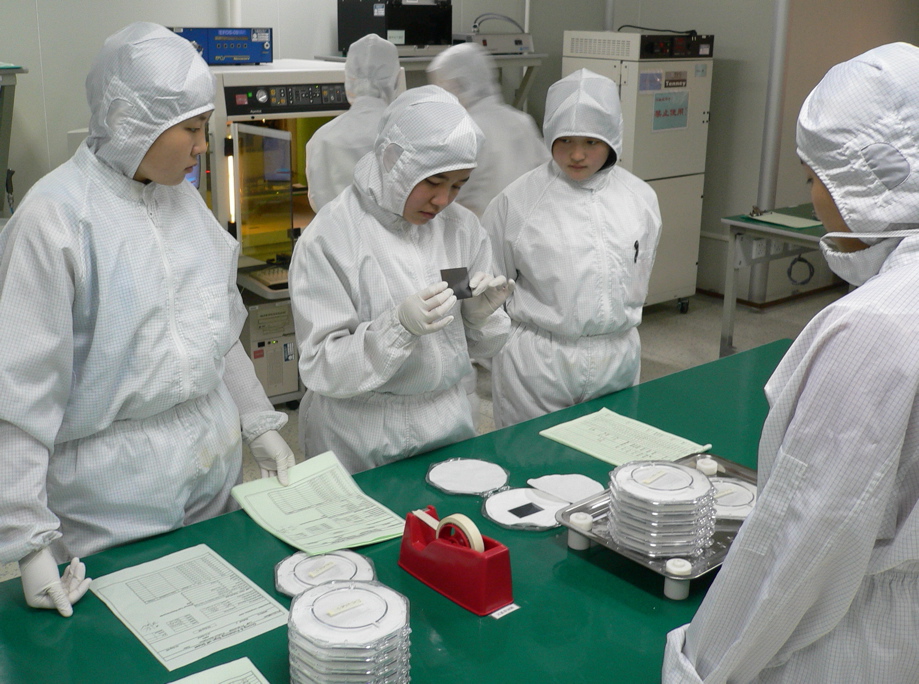
A cleanroom suit, clean room suit, or bunny suit,[1][2] is an overall garment worn in a cleanroom, an environment with a controlled level of contamination. One common type is an all-in-one coverall worn by semiconductor and nanotechnology line production workers, technicians, and process / equipment engineers. Similar garments are worn by people in similar roles creating sterile products for the medical device, biopharmaceutical and optical instrument industries.
The suit covers the wearer to prevent skin and hair being shed into a clean room environment. The suit may be in one piece or consist of several separate garments worn tightly together. The suit incorporates both boots and hood, designed to be breathable and lightweight while protecting the wearer. Polypropylene with a polyethylene coating, or Tyvek polyethylene are standard. The materials found in cleanroom suits can also be found on personal protective equipment.
More advanced designs with face covers were introduced in the 1990s (like the Intel fab worker-style suits seen on the Pentium product advertisements).
Suits are usually deposited in a storage bin after being contaminated for dry cleaning, autoclaving and/or repair. Some clothing items, such as nitrile gloves and shoe covers, may be disposed of after every use.[3][4]
The term "bunny suit" is also used for hazmat suits, worn by workers handling high-risk hazardous biological or chemical substances, as well as in the containment areas of nuclear power plants. These suits consist of the main garment, hood, thin cotton gloves, rubber gloves, plastic bags over normal work shoes, and rubber booties.[5] The wrists and ankles are taped down with masking tape. Occasionally a plastic raincoat is also worn. Removal of the garments (into several barrels) is a complicated process which must be performed in an exact sequence. Often a health physicist is present in the work area to observe good anti-contamination practices.[6][7]
-
 Pictorial demonstration of gowning
 -
 Pictorial demonstration of de-gowning


References
[edit]- ^ NASA Jet Propulsion Laboratory, Dynamic Design: The Cleanroom (PDF), retrieved 2011-05-25
- ^ James D. Plummer; Michael D. Deal; Peter B. Griffin (24 July 2000). Silicon VLSI technology: fundamentals, practice and modeling. Prentice Hall. p. 158. ISBN 978-0-13-085037-9. Retrieved 24 February 2012.
- ^ "Tensile Properties and Integrity of Clean Room and Low-Modulus Disposable Nitrile Gloves: A Comparison of Two Dissimilar Glove Types". The Annals of Occupational Hygiene. 2011-12-26. doi:10.1093/annhyg/mer116. ISSN 1475-3162. PMC 3324482. PMID 22201179.
- ^ Allen, Kenneth P.; Csida, Tarrant; Leming, Jeaninne; Murray, Kathleen; Thulin, Joseph (April 2010). "Efficacy of footwear disinfection and shoe cover use in an animal research facility". Lab Animal. 39 (4): 107–111. doi:10.1038/laban0410-107. ISSN 0093-7355. PMID 20305633.
- ^ "Identification" (in German). Mundschutz.
- ^ Pictorial demonstration of gowning
- ^ Gowning & De-Gowning Procedure www.prudentialuniforms.com, accessed 2 February 2020
Cleanroom suit
View on GrokipediaOverview
Definition and Purpose
A cleanroom suit is a full-body garment, also known as a bunny suit, worn over regular clothing to completely cover the wearer and minimize the generation and release of particles from the human body within controlled cleanroom environments.[5] The primary purpose of a cleanroom suit is to prevent contamination by containing and restricting the shedding of skin flakes, hair, respiratory droplets, and fibers from ordinary attire, thereby protecting sensitive manufacturing processes from human-sourced pollutants.[5][1] Cleanrooms are engineered spaces that maintain strictly controlled levels of airborne pollutants, temperature, humidity, and pressure, and the suit serves as a critical barrier that isolates personnel from the products or processes being handled inside.[1] These suits are essential in industries where even microscopic contaminants can compromise product integrity, such as semiconductor fabrication for chip production, where they safeguard delicate circuits from particle-induced defects.[5] In pharmaceuticals and biotechnology, cleanroom suits ensure sterile conditions for drug manufacturing and biological agent handling by minimizing microbial and particulate risks.[1] Similarly, they are vital in optics production to prevent dust from affecting lens and mirror quality, and in nanotechnology research to maintain ultra-pure settings for nanoscale material assembly.[6][7]Historical Development
The development of cleanroom suits traces back to the broader evolution of contamination control technologies during World War II. High-efficiency particulate air (HEPA) filters, initially engineered in the early 1940s as part of the Manhattan Project to contain airborne radioactive contaminants from uranium isotope separation processes, laid the groundwork for controlled environments by enabling effective air filtration.[8] These filters indirectly highlighted the need for personnel protection, as early clean manufacturing efforts in military and industrial settings relied on basic garments like cotton lab coats and shirts to minimize particle shedding in sensitive operations.[9] The modern cleanroom, invented in 1960 by physicist Willis Whitfield at Sandia National Laboratories, marked a pivotal advancement in laminar-flow air systems that drastically reduced airborne particles, necessitating more specialized protective clothing beyond simple lab coats.[10] In the 1960s and 1970s, cleanroom suits evolved with the adoption of full-body coveralls in high-stakes industries; NASA's space program, for instance, integrated these suits during Apollo-era manufacturing to prevent contamination of spacecraft components, while the pharmaceutical sector adopted similar garments for sterile drug production under emerging standards like Federal Standard 209.[11] Key milestones included 1967 guidelines from the American Association for Contamination Control (A2C2) recommending lint-free polyester fabrics and laundering protocols, alongside the introduction of disposable Tyvek nonwovens by DuPont for pharmaceutical use, which addressed particle control needs in sterile environments.[9] By the 1980s and 1990s, the semiconductor industry drove further innovations, shifting toward lightweight, breathable suits to accommodate prolonged wear in fabrication facilities; fabrics like Gore-Tex and static-dissipative polyester with carbon yarns, such as Kanebo's EV-Guard, became standard to mitigate electrostatic discharge risks during microchip production.[9] The "bunny suit"—a baggy, full-coverage garment made of polyester—gained widespread recognition after Intel introduced it in 1973 for its Fab 3 facility and popularized it globally through Pentium processor advertisements in the mid-1990s, symbolizing advanced contamination control in electronics manufacturing.[12] In the 2000s and beyond, cleanroom suits incorporated advanced static-dissipative and antimicrobial materials, with disposable options expanding for cost-effective compliance in nanotechnology applications requiring ultra-low particle levels.[9] Stricter international standards, including ISO 14644 issued in 1999 and subsequent revisions, influenced suit designs by emphasizing particle shedding limits and testing protocols, supporting the global growth of cleanroom usage across over 14 million workers by 2015.[13]Design and Materials
Key Components
The core of a cleanroom suit is the full-body coverall, which serves as the primary garment enveloping the torso, arms, and legs to create a comprehensive barrier against particle generation and ingress.[14] This base layer is typically integrated with a hood that fully covers the head, neck, and shoulders, preventing hair and skin particles from escaping into the controlled environment.[15] Attached booties or boots encase the feet, ensuring that contaminants from external footwear do not transfer to cleanroom surfaces.[16] Gloves provide hand coverage, minimizing contact-related particle shedding during manipulation of sensitive materials or equipment.[14] Additional features enhance the suit's protective capabilities, including face masks or goggles that shield the respiratory system and eyes from airborne particulates while containing exhaled contaminants.[15] Secure zippers or specialized seals at entry points, such as the front or back, allow for controlled access while maintaining a low-permeability closure to minimize particle transfer.[16] Conductive threads woven into the fabric dissipate static electricity, reducing the attraction of dust particles to the suit and preventing electrostatic discharge that could damage electronics.[14] Design considerations prioritize a snug fit to eliminate gaps where contaminants could enter or escape, achieved through tailored sizing standards that accommodate various body types without restricting movement.[14] The suits are engineered to be lightweight and breathable, supporting worker mobility and comfort during extended shifts in temperature-controlled environments.[15] Advanced models may incorporate integrated air supply systems, such as powered air-purifying respirators (PAPRs), which deliver filtered air directly into the suit for enhanced respiratory protection in high-hazard settings.[17] These components collaborate to form a unified protective envelope: the hood seals against the coverall's collar, booties overlap with leg cuffs, and gloves interface with sleeve ends to create overlapping barriers that trap human-generated particles internally while blocking external ones.[15] This integrated assembly, often constructed from durable, low-linting fabrics, ensures sustained functionality over repeated use in contamination-sensitive operations.[14]Materials Used
Cleanroom suits primarily utilize non-woven fabrics designed to minimize particle generation and maintain sterility. Polypropylene, a lightweight spunbonded material, is commonly employed for its low cost and reduced particle shedding, making it suitable for less stringent environments like food processing or basic pharmaceutical packaging.[18][19] Tyvek, a proprietary spunbonded polyethylene fabric developed by DuPont, offers microporous properties that provide breathability while resisting liquid penetration and microbial contamination, ideal for applications requiring barrier protection without excessive heat buildup.[20][21] For advanced applications, such as electronics manufacturing, polyester fabrics incorporating static-dissipative carbon fibers—typically 99% polyester blended with 1% carbon—are used to prevent electrostatic discharge (ESD) that could damage sensitive components.[22][23] Key properties of these materials include non-linting construction to limit fiber release, chemical resistance for handling solvents or cleaners, and autoclavability in reusable variants for steam sterilization without degradation.[24][25] Disposable suits, often made from polypropylene or Tyvek, ensure single-use sterility and eliminate laundering risks but contribute to waste generation, raising environmental concerns due to their non-biodegradable nature. Recent advancements as of 2025 include eco-friendly disposable options, such as biodegradable materials that decompose up to 70% faster than traditional polyolefins, to mitigate these issues.[26] Reusable options, like polyester blends, allow for repeated laundering while maintaining integrity, though they require validated cleaning protocols to avoid cross-contamination.[27][28] Material selection depends on the cleanroom's ISO classification, with tighter weaves or denser non-wovens required for ISO Class 1-3 to achieve sub-micron particle control, whereas ISO Class 7-8 may suffice with standard polypropylene or Tyvek for cost efficiency.[29][30]Types and Variations
Standard Cleanroom Suits
Standard cleanroom suits are full-body garments designed to minimize contamination in controlled environments by covering the wearer's street clothes, skin, and hair, thereby preventing the release of particles, fibers, and microbes. These suits typically consist of basic coveralls equipped with an attached hood, integrated gloves, and booties to ensure complete enclosure from head to toe. They are engineered for use in ISO Class 3 to 8 cleanrooms, where the primary concern is particulate control rather than protection from hazardous substances. They are classified as sterile or nonsterile, with sterile suits used in aseptic processing areas like ISO Class 5 (Grade A/B) cleanrooms and nonsterile in less critical zones like ISO Class 7-8 (Grade C/D).[1][31][15] In applications such as semiconductor wafer fabrication, pharmaceutical packaging, and optical lens assembly, standard cleanroom suits serve as the first line of defense against human-generated contaminants that could compromise product integrity. For instance, in semiconductor manufacturing, these suits help maintain the ultra-low particle levels required for delicate processes like photolithography, while in pharmaceutical packaging, they ensure sterility without introducing external pollutants. These environments prioritize particle control in non-hazardous settings, where the suits' barrier properties suffice without additional chemical resistance.[15][31] Key features of standard cleanroom suits include options for reusable or disposable variants, with reusable models often laundered to sustain performance and disposable ones selected for single-use convenience in higher-volume operations. Color-coding is common, with white typically denoting the highest cleanliness levels due to its association with purity and ease of visual inspection for contaminants. The suits emphasize low particle generation, utilizing materials that shed minimal fibers—often less than typical fabrics—to keep airborne particulates well below thresholds that could affect cleanroom classifications. These suits are typically made from low-linting polyester fabrics to further reduce shedding.[32][33][31] Representative examples include bunny suits, which provide full coverage and are standard in electronics fabrication facilities for ISO Class 5 to 6 cleanrooms, featuring elasticized openings for a secure fit. In less stringent areas like ISO Class 1000 (equivalent to ISO 6) or higher up to Class 8 cleanrooms, smocks or frocks offer sufficient protection, covering the torso and arms while allowing greater mobility for tasks such as assembly or inspection.[31][15]Specialized Suits
Specialized cleanroom suits extend beyond particle control to provide robust barriers against hazardous substances, including biological agents, chemicals, radiation, and vapors, in ultra-clean or high-risk environments. These suits incorporate advanced designs for full-body encapsulation and respiratory protection, essential for operations where contamination could pose severe health or environmental risks.[34][35] Key types include hazmat-style suits, such as DuPont Tychem® garments, which feature additional impermeable layers for protection against biological agents and chemical permeation. These suits, often classified as Level B or C PPE, use multi-layer fabrics like Tychem® 4000 to withstand exposure to over 124 chemical challenges for at least 30 minutes. Another type is positive-pressure suits, which maintain internal overpressure via filtered air supply to prevent ingress of contaminants; examples include the Chemturion™ BSL-4 suit by ILC Dover and systems used in U.S. Department of Homeland Security facilities, equipped with HEPA-filtered air and self-contained breathing apparatus (SCBA) for Biosafety Level 4 (BSL-4) labs or Class 1 cleanrooms.[36][37][38] These suits find critical applications in biotechnology, such as vaccine production and gene therapy manufacturing, where they shield workers from viral vectors and aerosols in sterile cleanrooms. In nuclear handling, suits like DuPont Tyvek® 600 coveralls protect against radioactive particles, while in chemical processing, they form barriers against liquids and vapors to prevent permeation and exposure. For nanomaterials handling, enhanced suits mitigate risks from ultrafine particles that could cause respiratory or systemic hazards during synthesis and assembly.[39][40][41] Notable features include multi-layer construction with outer impermeable coatings, such as butyl rubber or chlorinated polyethylene, for chemical and radiation resistance; integrated respirators or SCBA for independent airflow; and enhanced seals at cuffs, hoods, and zippers to ensure full encapsulation without leaks. These elements differ from standard cleanroom suits primarily through their added complexity in layering and pressure systems for hazard isolation.[35][42][38] The evolution of these specialized suits accelerated post-2000, driven by advances in biotechnology and nanotechnology, with innovations like real-time monitoring and integrated cooling systems tailored for prolonged use in gene therapy facilities and nanomaterial labs. Developments in positive-pressure designs, including air-fed modes with multiple HEPA filters, emerged to meet demands in emerging fields like CRISPR-based therapies and bio-nanomaterial production.[42][43][44]Usage and Procedures
Cleanroom Standards and Classifications
Cleanroom standards and classifications establish the levels of airborne particulate cleanliness required in controlled environments, directly influencing the selection and design of protective garments to minimize contamination from personnel. These frameworks specify particle concentration limits and associated gowning protocols to ensure product integrity in industries such as pharmaceuticals, semiconductors, and biotechnology.[45] The primary international standard, ISO 14644-1:2015, classifies cleanrooms and clean zones into nine levels (ISO 1 through ISO 9), with ISO 1 being the cleanest, based on the maximum concentration of airborne particles of specified sizes per cubic meter of air. Classification is determined using airborne particle counters, focusing on particles ≥0.1 µm, ≥0.2 µm, ≥0.3 µm, and ≥0.5 µm, among others up to ≥5 µm for certain applications. For example, an ISO 5 cleanroom permits a maximum of 3,520 particles ≥0.5 µm per cubic meter, equivalent to the legacy Class 100 designation. The standard emphasizes dynamic (operational) and at-rest monitoring to verify compliance.[45][46]| ISO Class | Maximum Particles/m³ (≥0.1 µm) | Maximum Particles/m³ (≥0.5 µm) |
|---|---|---|
| ISO 1 | 10 | 0 |
| ISO 2 | 100 | 4 |
| ISO 3 | 1,000 | 35 |
| ISO 4 | 10,000 | 352 |
| ISO 5 | 100,000 | 3,520 |
| ISO 6 | 1,000,000 | 35,200 |
| ISO 7 | Not specified | 352,000 |
| ISO 8 | Not specified | 3,520,000 |
| ISO 9 | Not specified | 35,200,000 |