


Community hub
Recent from talks
Contribute something to knowledge base
Content stats: 0 posts, 0 articles, 1 media, 0 notes
Members stats: 0 subscribers, 0 contributors, 0 moderators, 0 supporters
Subscribers
Supporters
Contributors
Moderators
Hub AI
Madinat al-Zahra AI simulator
(@Madinat al-Zahra_simulator)
Hub AI
Madinat al-Zahra AI simulator
(@Madinat al-Zahra_simulator)
Madinat al-Zahra
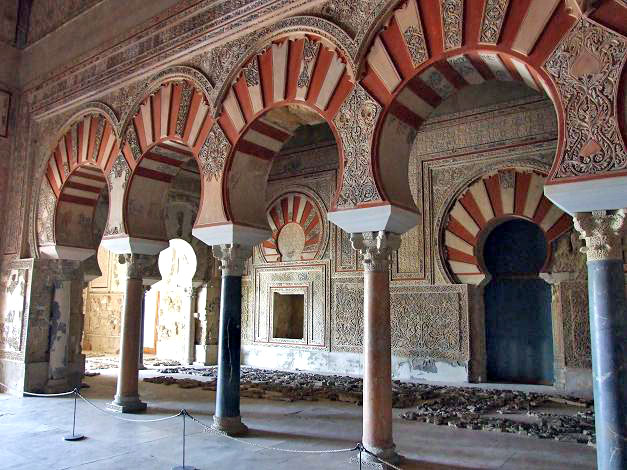
Madinat al-Zahra or Medina Azahara (Arabic: مدينة الزهراء, romanized: Madīnat az-Zahrāʾ, lit. 'the radiant city') was a fortified palace-city on the western outskirts of Córdoba in present-day Spain. Its remains are a major archaeological site today. The city was built in the 10th century by Abd ar-Rahman III (912–961), a member of the Umayyad dynasty and the first caliph of Al-Andalus. It served as the capital of the Caliphate of Córdoba and its center of government.
The main reason for its construction was politico-ideological: Abd ar-Rahman III had declared himself "caliph" in 929 and the dignity of this new title required the establishment of a new city, a symbol of his power, imitating eastern caliphates. It sought to demonstrate his superiority over his great rivals, the Fatimid Caliphs of Ifriqiya in North Africa and the Abbasid Caliphs in Baghdad. The city was built near Córdoba, the existing capital of al-Andalus under Umayyad rule. Construction began in 936–940 and continued in multiple phases throughout his reign and the reign of his son, Al-Hakam II (r. 961–976). The new city included ceremonial reception halls, a congregational mosque, administrative and government offices, aristocratic residences, gardens, a mint, workshops, barracks, service quarters, and baths. Water was supplied through aqueducts. After al-Hakam II's death, however, the city ceased to act as the center of government under the rule of Ibn Abi Amir al-Mansur (Almanzor). In 978–9, al-Mansur began construction of his own palace-city, the similarly-named Madinat al-Zahira, to replace it in this role. Between 1010 and 1013, Madinat al-Zahra was sacked during a civil war and thereafter abandoned, with many of its materials re-used elsewhere.
The ruins of the city were excavated starting in 1911. Only about 10 hectares of the 112 hectares (0.43 sq mi) of the city have been excavated and partially restored, but this area includes the main palaces. A dedicated archeological museum, located on the edge of the site, was opened in 2009. On July 1, 2018, the site was listed as a UNESCO World Heritage Site with the inscription name "Caliphate City of Medina Azahara".
Popular legend, recorded by historical writers such as al-Maqqari, holds that the city's name, az-Zahra' (or Azahara in Spanish), came from Abd ar-Rahman III's favorite wife and that a statue of her stood over the entrance. Although statuary was present in the city, scholar Marianne Barrucand argues that the existence of this particular statue is unlikely. Scholar Felix Arnold argues that a simpler explanation is that the city's name, which also means the "Flowering City" or "Radiant City", emulated the style of other caliphal cities founded by the Abbasids (e.g. Madinat as-Salam, "City of Peace", now Baghdad) and the Fatimids (e.g. Madinat al-Qahira, "Victorious City", now Cairo). Jonathan Bloom also notes that the name may have been chosen as a riposte to Abd ar-Rahman's main rivals, the Fatimids, because the Fatimids claimed descent from Muhammad's daughter Fatimah, who was also known as az-Zahra ("the Radiant").
Abd ar-Rahman III was a member of the Umayyad dynasty, which had formerly ruled the Islamic world as head of the Umayyad Caliphate. The title "caliph" signified the political and spiritual leader of the whole Muslim world. In 750 the Umayyads were overthrown by the Abbasids, who took on the title of caliphs and established a new capital at Baghdad. In 756 Abd ar Rahman III's ancestor, Abd ar-Rahman I, managed to re-establish the dynasty's power in the Iberian Peninsula in the far western part of the Muslim world, known as Al-Andalus. Although independent from the Abbasids, the new Umayyad rulers in Al-Andalus, based in Córdoba, did not reclaim the title of "caliph" at this time. Instead, they ruled as "emirs", a lower title designating local Muslim rulers, as heads of the Emirate of Córdoba. While Arabic and Islamic culture thrived in Al-Andalus during this period, it was still a relatively decentralized realm and the emir in Córdoba often struggled to keep different factions under control.
When Abd ar-Rahman III came to power as emir in 912, he began to systematically re-establish Umayyad authority over rebel regions within his realm and reinforce his own authority across Al-Andalus through military and diplomatic means. In 929, after years of constant campaigning, Abd ar-Rahman III felt confident enough to declare himself "caliph", a title equal to the Abbasid rulers in Baghdad (whose own power had significantly weakened by this time). This move may also have been in response to the rise of the Fatimid Caliphate in North Africa around the same time, which challenged the Sunni caliphs of Baghdad and also presented a threat to the interests of the Umayyad state in Al-Andalus.
Before the creation of Madinat al-Zahra, the residence and centre of government for the Umayyad emirs had been the Alcázar in the heart of Córdoba, across from which stood the Great Mosque of Córdoba. Many scholars argue that the motives for the construction of a new palace-city must have included a desire to create a capital and residence that would reflect the dignity and grandeur which Abd ar-Rahman III wanted to project around his new caliphate. The creation of such palace-cities also had precedents because both the Abbasids caliphs and the Fatimid caliphs had previously built such cities for themselves.
According to historical sources the new palace-city was founded in 936. It was located about 5 km west of Córdoba. Abd ar-Rahman III's son, Al-Hakam II, the crown prince and his future successor, was entrusted to oversee the construction. The 16th-century writer Al-Maqqari cites a man named Maslama ibn 'Abdallah as the architect of the city, but it is unclear how large his role was or how much of the city he actually designed. Major construction might not have actually started until 940, and evidence suggests that it occurred in stages, with the overall plan changing as further work was executed. The mosque on the site was completed in 941–942 or in 944–945. By 945, the caliph was already living in the city. The road between the new city and Córdoba was paved in 946. Finally, in 947 the apparatus of state, including the mint (dar al-sikka), was transferred here from Córdoba. Construction in the city nonetheless continued throughout the remaining years of Abd ar-Rahman III's reign (up to 961) and throughout Al-Hakam II's reign (961–976). High-ranking officials under both caliphs were often involved in the construction as well.
Madinat al-Zahra
Madinat al-Zahra or Medina Azahara (Arabic: مدينة الزهراء, romanized: Madīnat az-Zahrāʾ, lit. 'the radiant city') was a fortified palace-city on the western outskirts of Córdoba in present-day Spain. Its remains are a major archaeological site today. The city was built in the 10th century by Abd ar-Rahman III (912–961), a member of the Umayyad dynasty and the first caliph of Al-Andalus. It served as the capital of the Caliphate of Córdoba and its center of government.
The main reason for its construction was politico-ideological: Abd ar-Rahman III had declared himself "caliph" in 929 and the dignity of this new title required the establishment of a new city, a symbol of his power, imitating eastern caliphates. It sought to demonstrate his superiority over his great rivals, the Fatimid Caliphs of Ifriqiya in North Africa and the Abbasid Caliphs in Baghdad. The city was built near Córdoba, the existing capital of al-Andalus under Umayyad rule. Construction began in 936–940 and continued in multiple phases throughout his reign and the reign of his son, Al-Hakam II (r. 961–976). The new city included ceremonial reception halls, a congregational mosque, administrative and government offices, aristocratic residences, gardens, a mint, workshops, barracks, service quarters, and baths. Water was supplied through aqueducts. After al-Hakam II's death, however, the city ceased to act as the center of government under the rule of Ibn Abi Amir al-Mansur (Almanzor). In 978–9, al-Mansur began construction of his own palace-city, the similarly-named Madinat al-Zahira, to replace it in this role. Between 1010 and 1013, Madinat al-Zahra was sacked during a civil war and thereafter abandoned, with many of its materials re-used elsewhere.
The ruins of the city were excavated starting in 1911. Only about 10 hectares of the 112 hectares (0.43 sq mi) of the city have been excavated and partially restored, but this area includes the main palaces. A dedicated archeological museum, located on the edge of the site, was opened in 2009. On July 1, 2018, the site was listed as a UNESCO World Heritage Site with the inscription name "Caliphate City of Medina Azahara".
Popular legend, recorded by historical writers such as al-Maqqari, holds that the city's name, az-Zahra' (or Azahara in Spanish), came from Abd ar-Rahman III's favorite wife and that a statue of her stood over the entrance. Although statuary was present in the city, scholar Marianne Barrucand argues that the existence of this particular statue is unlikely. Scholar Felix Arnold argues that a simpler explanation is that the city's name, which also means the "Flowering City" or "Radiant City", emulated the style of other caliphal cities founded by the Abbasids (e.g. Madinat as-Salam, "City of Peace", now Baghdad) and the Fatimids (e.g. Madinat al-Qahira, "Victorious City", now Cairo). Jonathan Bloom also notes that the name may have been chosen as a riposte to Abd ar-Rahman's main rivals, the Fatimids, because the Fatimids claimed descent from Muhammad's daughter Fatimah, who was also known as az-Zahra ("the Radiant").
Abd ar-Rahman III was a member of the Umayyad dynasty, which had formerly ruled the Islamic world as head of the Umayyad Caliphate. The title "caliph" signified the political and spiritual leader of the whole Muslim world. In 750 the Umayyads were overthrown by the Abbasids, who took on the title of caliphs and established a new capital at Baghdad. In 756 Abd ar Rahman III's ancestor, Abd ar-Rahman I, managed to re-establish the dynasty's power in the Iberian Peninsula in the far western part of the Muslim world, known as Al-Andalus. Although independent from the Abbasids, the new Umayyad rulers in Al-Andalus, based in Córdoba, did not reclaim the title of "caliph" at this time. Instead, they ruled as "emirs", a lower title designating local Muslim rulers, as heads of the Emirate of Córdoba. While Arabic and Islamic culture thrived in Al-Andalus during this period, it was still a relatively decentralized realm and the emir in Córdoba often struggled to keep different factions under control.
When Abd ar-Rahman III came to power as emir in 912, he began to systematically re-establish Umayyad authority over rebel regions within his realm and reinforce his own authority across Al-Andalus through military and diplomatic means. In 929, after years of constant campaigning, Abd ar-Rahman III felt confident enough to declare himself "caliph", a title equal to the Abbasid rulers in Baghdad (whose own power had significantly weakened by this time). This move may also have been in response to the rise of the Fatimid Caliphate in North Africa around the same time, which challenged the Sunni caliphs of Baghdad and also presented a threat to the interests of the Umayyad state in Al-Andalus.
Before the creation of Madinat al-Zahra, the residence and centre of government for the Umayyad emirs had been the Alcázar in the heart of Córdoba, across from which stood the Great Mosque of Córdoba. Many scholars argue that the motives for the construction of a new palace-city must have included a desire to create a capital and residence that would reflect the dignity and grandeur which Abd ar-Rahman III wanted to project around his new caliphate. The creation of such palace-cities also had precedents because both the Abbasids caliphs and the Fatimid caliphs had previously built such cities for themselves.
According to historical sources the new palace-city was founded in 936. It was located about 5 km west of Córdoba. Abd ar-Rahman III's son, Al-Hakam II, the crown prince and his future successor, was entrusted to oversee the construction. The 16th-century writer Al-Maqqari cites a man named Maslama ibn 'Abdallah as the architect of the city, but it is unclear how large his role was or how much of the city he actually designed. Major construction might not have actually started until 940, and evidence suggests that it occurred in stages, with the overall plan changing as further work was executed. The mosque on the site was completed in 941–942 or in 944–945. By 945, the caliph was already living in the city. The road between the new city and Córdoba was paved in 946. Finally, in 947 the apparatus of state, including the mint (dar al-sikka), was transferred here from Córdoba. Construction in the city nonetheless continued throughout the remaining years of Abd ar-Rahman III's reign (up to 961) and throughout Al-Hakam II's reign (961–976). High-ranking officials under both caliphs were often involved in the construction as well.
Recent media
Recent media