
Recent from talks
Medway Megaliths
Knowledge base stats:
Talk channels stats:
Members stats:
Medway Megaliths
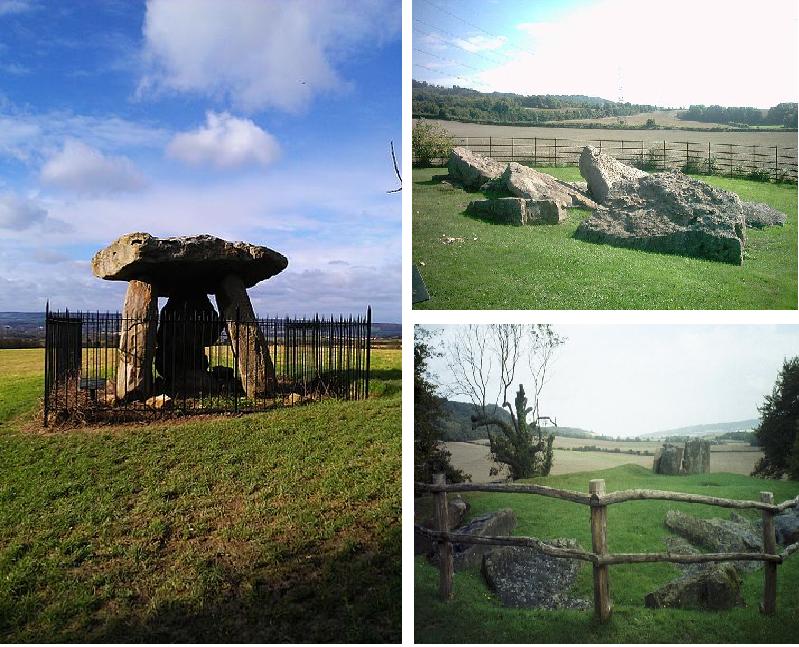
The Medway Megaliths, sometimes termed the Kentish Megaliths, are a group of Early Neolithic chambered long barrows and other megalithic monuments located in the lower valley of the River Medway in Kent, South-East England. Constructed from local sarsen stone and soil between the 4th and 3rd millennia BCE, they represent the only known prehistoric megalithic group in eastern England and the most south-easterly group in Britain.
They remain one of several regionally contained chambered long barrow traditions in Britain, although have certain precise architectural characteristics which mark them out as distinct from other groups. The purpose of these long barrows remains elusive, although some were used as tombs for the remains of a select group of individuals. It is also widely believed that they were places where religious rituals were performed. Many archaeologists believe that they reflect the process of Neolithisation of Britain, as hunter-gatherer populations were replaced by pastoralists.
Three chambered tombs have been identified to the west of the river: the Coldrum Stones, Addington Long Barrow, and Chestnuts Long Barrow. To the east of the river, another three chambered tombs have been identified: Kit's Coty House, Little Kit's Coty House, and Smythe's Megalith, although it has also been suggested that two nearby megaliths, the Coffin Stone and the White Horse Stone, are remnants of former chambered tombs. An Early Neolithic longhouse and causewayed enclosure have also been identified in the vicinity of the monuments.
The Medway Megaliths have become heavily damaged and dilapidated since original construction, largely due to an intentional program of destruction in the late 13th century CE. They began to attract the interest of antiquarians in the late 16th century, who developed a number of erroneous theories about their origin, before later being scientifically investigated by archaeologists in the late 19th century. Local folklore has also grown up around the monuments, which came to be interpreted and used as sacred sites by contemporary Pagans in the latter 20th century.
The Early Neolithic was a revolutionary period of British history. Beginning in the fifth millennium BCE, it saw a widespread change in lifestyle as the communities living in the British Isles adopted agriculture as their primary form of subsistence, abandoning the hunter-gatherer lifestyle that had characterised the preceding Mesolithic period. Archaeologists have been unable to prove whether this adoption of farming was because of a new influx of migrants coming in from continental Europe or because the indigenous Mesolithic Britons came to adopt the agricultural practices of continental societies. Either way, it certainly emerged through contact with continental Europe, probably as a result of centuries of interaction between Mesolithic people living in south-east Britain and Linear Pottery culture (LBK) communities in north-eastern France.
Between 4500 and 3800 BCE, all of the British Isles came to abandon its former Mesolithic hunter-gatherer lifestyle, to be replaced by the new agricultural subsistence of the Neolithic Age. Throughout most of Britain, there is little evidence of cereal or permanent dwellings from this period, leading archaeologists to believe that the Early Neolithic economy on the island was largely pastoral, relying on herding cattle, with people living a nomadic or semi-nomadic way of life. It is apparent that although a common material culture was shared throughout most of the British Isles in this period, there was great regional variation regarding the nature and distribution of settlement, architectural styles, and the use of natural resources. There is archaeological evidence of violence and warfare in Early Neolithic Britain from such sites as West Kennet Long Barrow and Hambledon Hill, with some groups constructing fortifications to defend themselves from attackers. Contemporary archaeologists have no direct proof of gender relations on the island at this time, although most believe that it was probably a male-dominated society, in keeping with all recorded societies that practice large-scale animal husbandry.
Britain was largely forested in this period, although did witness some land clearance. It remains unclear to what extent the Kentish area was deforested in the Early Neolithic, although it appears that widespread forest clearance only took place on the chalklands of south-east Britain much later, in the Late Bronze Age. Environmental data from the area around the White Horse Stone supports the idea that the area was still largely forested in the Early Neolithic, covered by a woodland of oak, ash, hazel/alder and Maloideae.
"It seems that the role of ancestors in Neolithic society was much more important than in the world of the hunter-gatherer. Clans and forebears began to have symbolic importance to the settled farming communities of the Neolithic. Dead ancestors were celebrated through funerals, feasts and grave goods, and their carefully selected body-parts were housed in specially built monuments, often symbolising 'houses' of the dead ... The tombs provide the earliest and most tangible evidence of Neolithic people and their customs, and are some of the most impressive and aesthetically distinctive constructions of prehistoric Britain."
Hub AI
Medway Megaliths AI simulator
(@Medway Megaliths_simulator)
Medway Megaliths
The Medway Megaliths, sometimes termed the Kentish Megaliths, are a group of Early Neolithic chambered long barrows and other megalithic monuments located in the lower valley of the River Medway in Kent, South-East England. Constructed from local sarsen stone and soil between the 4th and 3rd millennia BCE, they represent the only known prehistoric megalithic group in eastern England and the most south-easterly group in Britain.
They remain one of several regionally contained chambered long barrow traditions in Britain, although have certain precise architectural characteristics which mark them out as distinct from other groups. The purpose of these long barrows remains elusive, although some were used as tombs for the remains of a select group of individuals. It is also widely believed that they were places where religious rituals were performed. Many archaeologists believe that they reflect the process of Neolithisation of Britain, as hunter-gatherer populations were replaced by pastoralists.
Three chambered tombs have been identified to the west of the river: the Coldrum Stones, Addington Long Barrow, and Chestnuts Long Barrow. To the east of the river, another three chambered tombs have been identified: Kit's Coty House, Little Kit's Coty House, and Smythe's Megalith, although it has also been suggested that two nearby megaliths, the Coffin Stone and the White Horse Stone, are remnants of former chambered tombs. An Early Neolithic longhouse and causewayed enclosure have also been identified in the vicinity of the monuments.
The Medway Megaliths have become heavily damaged and dilapidated since original construction, largely due to an intentional program of destruction in the late 13th century CE. They began to attract the interest of antiquarians in the late 16th century, who developed a number of erroneous theories about their origin, before later being scientifically investigated by archaeologists in the late 19th century. Local folklore has also grown up around the monuments, which came to be interpreted and used as sacred sites by contemporary Pagans in the latter 20th century.
The Early Neolithic was a revolutionary period of British history. Beginning in the fifth millennium BCE, it saw a widespread change in lifestyle as the communities living in the British Isles adopted agriculture as their primary form of subsistence, abandoning the hunter-gatherer lifestyle that had characterised the preceding Mesolithic period. Archaeologists have been unable to prove whether this adoption of farming was because of a new influx of migrants coming in from continental Europe or because the indigenous Mesolithic Britons came to adopt the agricultural practices of continental societies. Either way, it certainly emerged through contact with continental Europe, probably as a result of centuries of interaction between Mesolithic people living in south-east Britain and Linear Pottery culture (LBK) communities in north-eastern France.
Between 4500 and 3800 BCE, all of the British Isles came to abandon its former Mesolithic hunter-gatherer lifestyle, to be replaced by the new agricultural subsistence of the Neolithic Age. Throughout most of Britain, there is little evidence of cereal or permanent dwellings from this period, leading archaeologists to believe that the Early Neolithic economy on the island was largely pastoral, relying on herding cattle, with people living a nomadic or semi-nomadic way of life. It is apparent that although a common material culture was shared throughout most of the British Isles in this period, there was great regional variation regarding the nature and distribution of settlement, architectural styles, and the use of natural resources. There is archaeological evidence of violence and warfare in Early Neolithic Britain from such sites as West Kennet Long Barrow and Hambledon Hill, with some groups constructing fortifications to defend themselves from attackers. Contemporary archaeologists have no direct proof of gender relations on the island at this time, although most believe that it was probably a male-dominated society, in keeping with all recorded societies that practice large-scale animal husbandry.
Britain was largely forested in this period, although did witness some land clearance. It remains unclear to what extent the Kentish area was deforested in the Early Neolithic, although it appears that widespread forest clearance only took place on the chalklands of south-east Britain much later, in the Late Bronze Age. Environmental data from the area around the White Horse Stone supports the idea that the area was still largely forested in the Early Neolithic, covered by a woodland of oak, ash, hazel/alder and Maloideae.
"It seems that the role of ancestors in Neolithic society was much more important than in the world of the hunter-gatherer. Clans and forebears began to have symbolic importance to the settled farming communities of the Neolithic. Dead ancestors were celebrated through funerals, feasts and grave goods, and their carefully selected body-parts were housed in specially built monuments, often symbolising 'houses' of the dead ... The tombs provide the earliest and most tangible evidence of Neolithic people and their customs, and are some of the most impressive and aesthetically distinctive constructions of prehistoric Britain."
Recent media