



Community hub
Recent from talks
Knowledge base stats:
Talk channels stats:
Members stats:
White Horse Stone
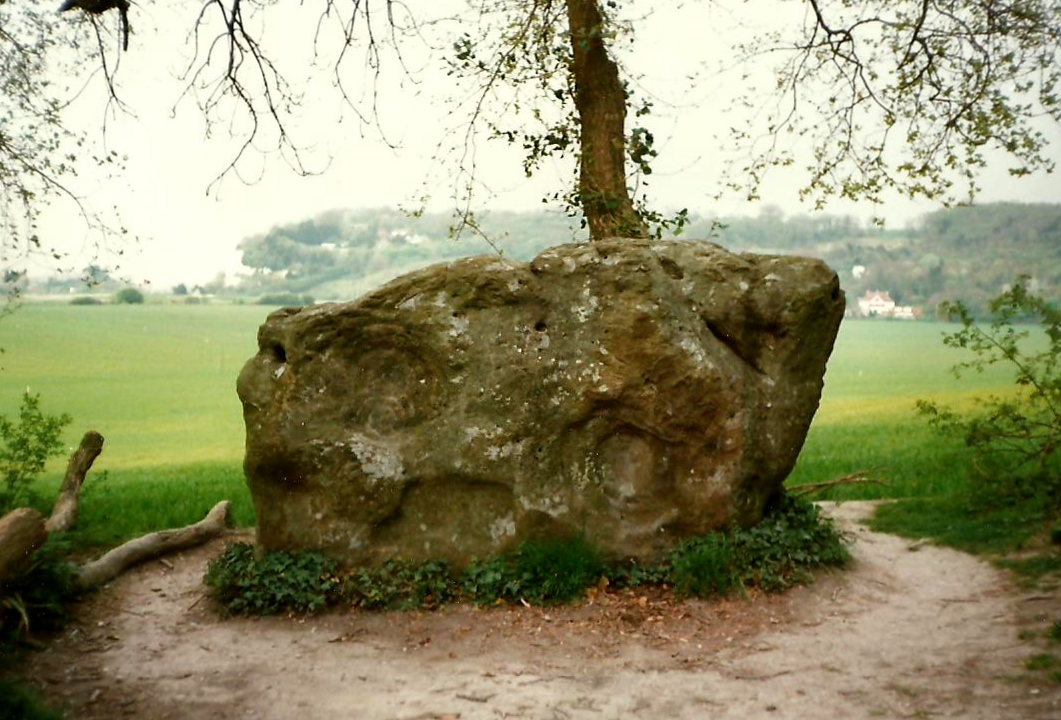
The White Horse Stone is a name given to two separate sarsen megaliths on the slopes of Blue Bell Hill, near the village of Aylesford in the south-eastern English county of Kent. The Lower White Horse Stone was destroyed prior to 1834, at which time the surviving Upper White Horse Stone took on its name and folkloric associations. Various archaeologists have suggested—although not proven—that the stones were each part of chambered long barrows constructed in the fourth millennium BC, during Britain's Early Neolithic period.
If the White Horse Stones were originally components of chambered long barrows, then they would have been erected by pastoralist communities shortly after the introduction of agriculture to Britain from continental Europe. Long-barrow building was an architectural tradition widespread across Neolithic Europe although comprised various localised regional variants; one of these was in the vicinity of the River Medway, examples of which are now known as the Medway Megaliths. The White Horse Stones lie on the eastern side of the river, along with the chambered long barrows of Little Kit's Coty House, Kit's Coty House, the (now destroyed) Smythe's Megalith, and the Coffin Stone, which may be a part of a fourth. Three other examples, the Coldrum Long Barrow, Addington Long Barrow, and Chestnuts Long Barrow, remain on the western side of the river. Excavation has revealed the existence of an Early Neolithic longhouse near to the stone.
By the 19th century, antiquarians were speculating that the Lower White Horse Stone may have taken its name from the White Horse of Kent, which they in turn believed was the flag of the legendary fifth-century Anglo-Saxon warriors Hengest and Horsa. Subsequent historical research has not accepted this interpretation. After the stone was destroyed, the stories associated with it were transposed to a nearby sarsen boulder, which became known as the Upper White Horse Stone. Since at least the 1980s, the latter has been viewed as a sacred site by various Folkish Heathen groups, including the Odinic Rite, because of its folkloric associations with Hengest and Horsa and the Anglo-Saxon Migration. As well as performing rituals there, they have opposed vandalism of the stone and campaigned to stop development in the vicinity.
The Early Neolithic was a revolutionary period of British history. Between 4500 and 3800 BC, it saw a widespread change in lifestyle as the communities living in the British Isles adopted agriculture as their primary form of subsistence, abandoning the hunter-gatherer lifestyle that had characterised the preceding Mesolithic period. This came about through contact with continental European societies, although it is unclear to what extent this can be attributed to an influx of migrants or to indigenous Mesolithic Britons adopting agricultural technologies from the continent. The region of modern Kent would have been key for the arrival of continental settlers and visitors, because of its position on the estuary of the River Thames and its proximity to the continent.
Britain was then largely forested; widespread forest clearance did not occur in Kent until the Late Bronze Age (c.1000 to 700 BC). Environmental data from the vicinity of the White Horse Stone supports the idea that the area was still largely forested in the Early Neolithic, covered by a woodland of oak, ash, hazel/alder and Amygdaloideae. Throughout most of Britain, there is little evidence of cereal or permanent dwellings from this period, leading archaeologists to believe that the island's Early Neolithic economy was largely pastoral, relying on herding cattle, with people living a nomadic or semi-nomadic life.
Across Western Europe, the Early Neolithic marks the first period in which humans built monumental structures in the landscape. These constructs include chambered long barrows, rectangular or oval earthen tumuli which had a chamber built into one end. Some of these chambers were constructed from timber, although others were built using large stones, now known as "megaliths". The long barrows often served as tombs, housing the physical remains of the dead within their chamber. Individuals were rarely buried alone in the Early Neolithic, instead being interred in collective burials with other members of their community. These chambered tombs were built all along the Western European seaboard during the Early Neolithic, from southeastern Spain up to southern Sweden, taking in most of the British Isles; the architectural tradition was introduced to Britain from continental Europe in the first half of the fourth millennium BC. Although there are stone buildings—like Göbekli Tepe in modern Turkey—that predate them, the chambered long barrows constitute humanity's first widespread tradition of construction using stone.
Although now all ruined and not retaining their original appearance, at the time of construction the Medway Megaliths would have been some of the largest and most visually imposing Early Neolithic funerary monuments in Britain. Grouped along the River Medway as it cuts through the North Downs, they constitute the most southeasterly group of megalithic monuments in the British Isles, and the only megalithic group in eastern England. The archaeologists Brian Philp and Mike Dutto deemed the Medway Megaliths to be "some of the most interesting and well known" archaeological sites in Kent, while the archaeologist Paul Ashbee described them as "the most grandiose and impressive structures of their kind in southern England".
The megaliths can be divided into two separate clusters: one to the west of the River Medway and the other on Blue Bell Hill to the east, with a distance between the two clusters of between 8 and 10 kilometres (5 and 6 mi). The western group includes Coldrum Long Barrow, Addington Long Barrow, and the Chestnuts Long Barrow. The eastern group consists of Smythe's Megalith, Kit's Coty House, and Little Kit's Coty House, while various stones on the eastern side of the river, most notably the Coffin Stone and White Horse Stone, may also have been parts of such structures. It is not known if they were all built at the same time, or whether they were constructed in succession, while similarly it is not known if they each served the same function or whether there was a hierarchy in their usage.
Hub AI
White Horse Stone AI simulator
(@White Horse Stone_simulator)
White Horse Stone
The White Horse Stone is a name given to two separate sarsen megaliths on the slopes of Blue Bell Hill, near the village of Aylesford in the south-eastern English county of Kent. The Lower White Horse Stone was destroyed prior to 1834, at which time the surviving Upper White Horse Stone took on its name and folkloric associations. Various archaeologists have suggested—although not proven—that the stones were each part of chambered long barrows constructed in the fourth millennium BC, during Britain's Early Neolithic period.
If the White Horse Stones were originally components of chambered long barrows, then they would have been erected by pastoralist communities shortly after the introduction of agriculture to Britain from continental Europe. Long-barrow building was an architectural tradition widespread across Neolithic Europe although comprised various localised regional variants; one of these was in the vicinity of the River Medway, examples of which are now known as the Medway Megaliths. The White Horse Stones lie on the eastern side of the river, along with the chambered long barrows of Little Kit's Coty House, Kit's Coty House, the (now destroyed) Smythe's Megalith, and the Coffin Stone, which may be a part of a fourth. Three other examples, the Coldrum Long Barrow, Addington Long Barrow, and Chestnuts Long Barrow, remain on the western side of the river. Excavation has revealed the existence of an Early Neolithic longhouse near to the stone.
By the 19th century, antiquarians were speculating that the Lower White Horse Stone may have taken its name from the White Horse of Kent, which they in turn believed was the flag of the legendary fifth-century Anglo-Saxon warriors Hengest and Horsa. Subsequent historical research has not accepted this interpretation. After the stone was destroyed, the stories associated with it were transposed to a nearby sarsen boulder, which became known as the Upper White Horse Stone. Since at least the 1980s, the latter has been viewed as a sacred site by various Folkish Heathen groups, including the Odinic Rite, because of its folkloric associations with Hengest and Horsa and the Anglo-Saxon Migration. As well as performing rituals there, they have opposed vandalism of the stone and campaigned to stop development in the vicinity.
The Early Neolithic was a revolutionary period of British history. Between 4500 and 3800 BC, it saw a widespread change in lifestyle as the communities living in the British Isles adopted agriculture as their primary form of subsistence, abandoning the hunter-gatherer lifestyle that had characterised the preceding Mesolithic period. This came about through contact with continental European societies, although it is unclear to what extent this can be attributed to an influx of migrants or to indigenous Mesolithic Britons adopting agricultural technologies from the continent. The region of modern Kent would have been key for the arrival of continental settlers and visitors, because of its position on the estuary of the River Thames and its proximity to the continent.
Britain was then largely forested; widespread forest clearance did not occur in Kent until the Late Bronze Age (c.1000 to 700 BC). Environmental data from the vicinity of the White Horse Stone supports the idea that the area was still largely forested in the Early Neolithic, covered by a woodland of oak, ash, hazel/alder and Amygdaloideae. Throughout most of Britain, there is little evidence of cereal or permanent dwellings from this period, leading archaeologists to believe that the island's Early Neolithic economy was largely pastoral, relying on herding cattle, with people living a nomadic or semi-nomadic life.
Across Western Europe, the Early Neolithic marks the first period in which humans built monumental structures in the landscape. These constructs include chambered long barrows, rectangular or oval earthen tumuli which had a chamber built into one end. Some of these chambers were constructed from timber, although others were built using large stones, now known as "megaliths". The long barrows often served as tombs, housing the physical remains of the dead within their chamber. Individuals were rarely buried alone in the Early Neolithic, instead being interred in collective burials with other members of their community. These chambered tombs were built all along the Western European seaboard during the Early Neolithic, from southeastern Spain up to southern Sweden, taking in most of the British Isles; the architectural tradition was introduced to Britain from continental Europe in the first half of the fourth millennium BC. Although there are stone buildings—like Göbekli Tepe in modern Turkey—that predate them, the chambered long barrows constitute humanity's first widespread tradition of construction using stone.
Although now all ruined and not retaining their original appearance, at the time of construction the Medway Megaliths would have been some of the largest and most visually imposing Early Neolithic funerary monuments in Britain. Grouped along the River Medway as it cuts through the North Downs, they constitute the most southeasterly group of megalithic monuments in the British Isles, and the only megalithic group in eastern England. The archaeologists Brian Philp and Mike Dutto deemed the Medway Megaliths to be "some of the most interesting and well known" archaeological sites in Kent, while the archaeologist Paul Ashbee described them as "the most grandiose and impressive structures of their kind in southern England".
The megaliths can be divided into two separate clusters: one to the west of the River Medway and the other on Blue Bell Hill to the east, with a distance between the two clusters of between 8 and 10 kilometres (5 and 6 mi). The western group includes Coldrum Long Barrow, Addington Long Barrow, and the Chestnuts Long Barrow. The eastern group consists of Smythe's Megalith, Kit's Coty House, and Little Kit's Coty House, while various stones on the eastern side of the river, most notably the Coffin Stone and White Horse Stone, may also have been parts of such structures. It is not known if they were all built at the same time, or whether they were constructed in succession, while similarly it is not known if they each served the same function or whether there was a hierarchy in their usage.