



Community hub
Recent from talks
Knowledge base stats:
Talk channels stats:
Members stats:
Megafire
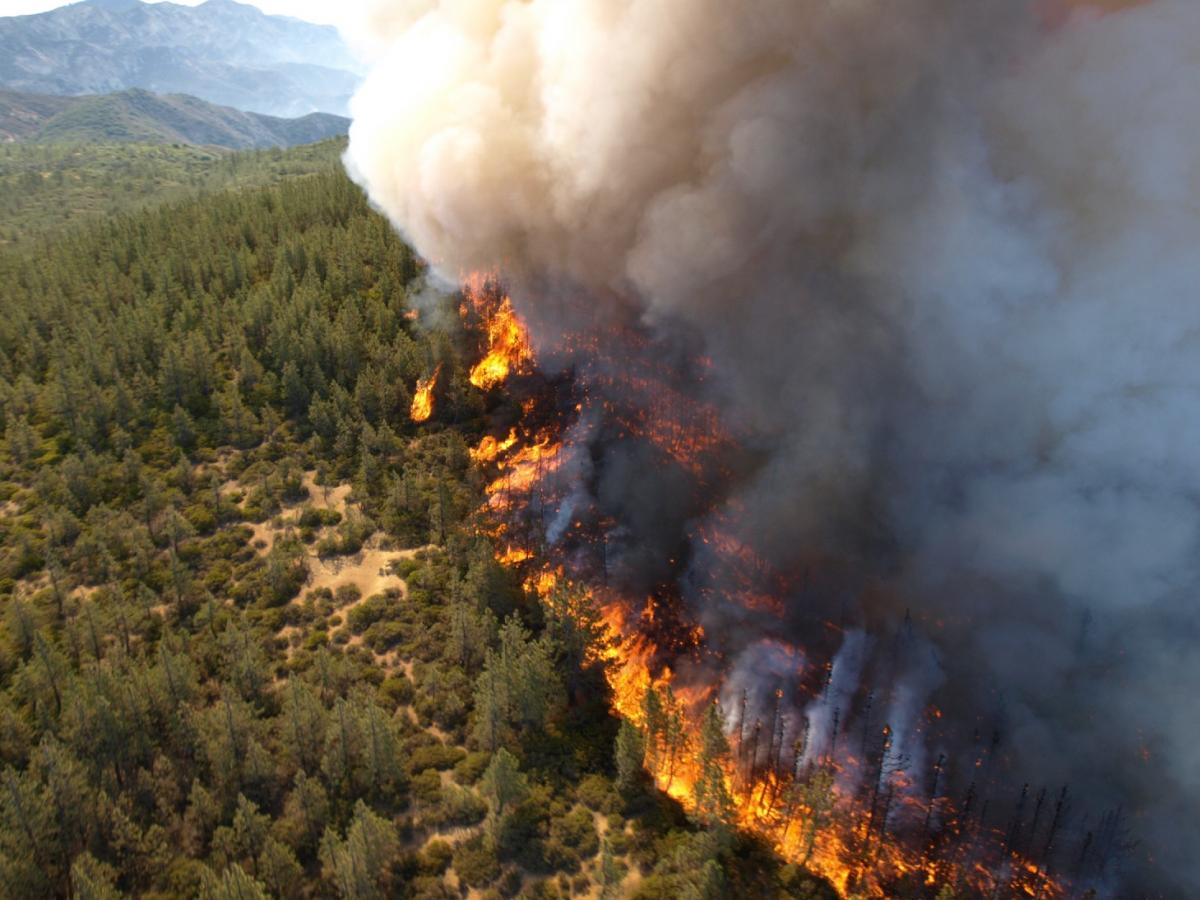
A megafire is an exceptional fire that devastates a large area. They are characterised by their intensity, size, duration and uncontrollable scale. There is no precise scientific definition. A megafire may or may not be a firestorm.
The concept may vary by region or country. In Europe, they are characterized as beginning at 1,000 hectares (10 km², 2,470 acres), in size, while in the United States and elsewhere, they may be classified beginning at 10,000 hectares (100 km², 24,710 acres). Another figure used in the United States is 40,000 hectares (99,000 acres) (400 km²).
A recent NASA study expands the megafire definition to include a variety of factors: "Between climate change and almost a century of fire exclusion, forest fires have become more extreme in size, severity, complexity of behavior and resistance to extinction. These fires are commonly referred as megafires and are at the extremes of historical variations."
Using one definition, only 3% of all fires reach "megafire" status, yet they are responsible for more than 50% of burned surfaces on the planet.
In recent years, some fires have burned over a million acres, becoming what has been dubbed as gigafires. These include the Yellowstone Fire in Montana and Idaho that burned 1.58 million acres in 1988; the Taylor Complex in Alaska that burned 1.3 million acres in 2004; the fires that burned 1.5 million acres in Victoria and New South Wales, Australia in 2020; and the August Complex in California in 2020.
A 2022 United Nations report used the term "wildfire" to distinguish "an unusual or extraordinary free-burning vegetation fire which may be started maliciously, accidentally, or through natural means, that negatively influences social, economic, or environmental values". This term was used in contrast to "landscape fire" which describes a natural, more ordinary, less harmful occurrence.
These fires form pyrocumulus and pyro cumulonimbus, clouds which are also named "fire-breathing dragons". They cause giant thunderstorms, which often have little rain but with a strong potential for lightning, which can easily create and spread new fires. These huge fires are so intense that they generate their own weather.
A merger of fires can create a megafire, such as multiple fires during the 2019–20 Australian bushfire season in Australia, where multiple cases of many fires joining into a gigantic blaze were noted.
Hub AI
Megafire AI simulator
(@Megafire_simulator)
Megafire
A megafire is an exceptional fire that devastates a large area. They are characterised by their intensity, size, duration and uncontrollable scale. There is no precise scientific definition. A megafire may or may not be a firestorm.
The concept may vary by region or country. In Europe, they are characterized as beginning at 1,000 hectares (10 km², 2,470 acres), in size, while in the United States and elsewhere, they may be classified beginning at 10,000 hectares (100 km², 24,710 acres). Another figure used in the United States is 40,000 hectares (99,000 acres) (400 km²).
A recent NASA study expands the megafire definition to include a variety of factors: "Between climate change and almost a century of fire exclusion, forest fires have become more extreme in size, severity, complexity of behavior and resistance to extinction. These fires are commonly referred as megafires and are at the extremes of historical variations."
Using one definition, only 3% of all fires reach "megafire" status, yet they are responsible for more than 50% of burned surfaces on the planet.
In recent years, some fires have burned over a million acres, becoming what has been dubbed as gigafires. These include the Yellowstone Fire in Montana and Idaho that burned 1.58 million acres in 1988; the Taylor Complex in Alaska that burned 1.3 million acres in 2004; the fires that burned 1.5 million acres in Victoria and New South Wales, Australia in 2020; and the August Complex in California in 2020.
A 2022 United Nations report used the term "wildfire" to distinguish "an unusual or extraordinary free-burning vegetation fire which may be started maliciously, accidentally, or through natural means, that negatively influences social, economic, or environmental values". This term was used in contrast to "landscape fire" which describes a natural, more ordinary, less harmful occurrence.
These fires form pyrocumulus and pyro cumulonimbus, clouds which are also named "fire-breathing dragons". They cause giant thunderstorms, which often have little rain but with a strong potential for lightning, which can easily create and spread new fires. These huge fires are so intense that they generate their own weather.
A merger of fires can create a megafire, such as multiple fires during the 2019–20 Australian bushfire season in Australia, where multiple cases of many fires joining into a gigantic blaze were noted.