



Community hub
Recent from talks
Knowledge base stats:
Talk channels stats:
Members stats:
Melanesia
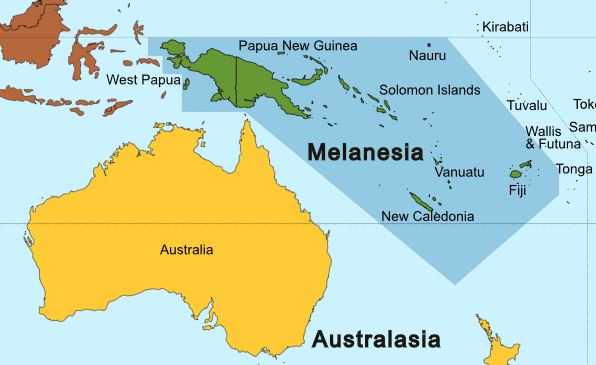
Melanesia is a subregion of Oceania in the southwestern Pacific Ocean. It extends from New Guinea in the west to the Fiji Islands in the east, and includes the Arafura Sea. Melanesia borders Southeast Asia to the west, Polynesia to the east, Micronesia to the north and Australia to the south.
The region includes the four independent countries of Fiji, Vanuatu, Solomon Islands, and Papua New Guinea. It also includes the Indonesian part of New Guinea, the French overseas collectivity of New Caledonia, and the Torres Strait Islands. Almost all of the region is in the Southern Hemisphere; only a few small islands that are not politically considered part of Oceania—specifically the northwestern islands of Western New Guinea—lie in the Northern Hemisphere.
The name Melanesia (French: Mélanésie) was first used in 1832 by French navigator Jules Dumont d'Urville: he coined the terms Melanesia and Micronesia to go alongside the pre-existing Polynesia to designate what he viewed as the three main ethnic and geographical regions forming the Pacific.
The indigenous people who inhabit the islands of Melanesia are called Melanesians. This is a heterogenous set of different genetic groups and ethnicities, different cultural practices (mythology, music, art, etc.), and different unrelated language families. Nonetheless, they together form a vast area with a long history of exchanges.
The name Melanesia (from Ancient Greek: μέλας, romanized: mélas, lit. 'black', and Ancient Greek: νῆσος, romanized: nêsos, lit. 'island'), etymologically means "islands of black [people]", in reference to the dark skin of the inhabitants.
The concept among Europeans of Melanesia as a distinct region evolved gradually over time as their expeditions mapped and explored the Pacific. Early European explorers noted the physical differences among groups of Pacific Islanders. In 1756, Charles de Brosses theorized that there was an "old black race" in the Pacific who had been conquered or defeated by the peoples of what is now called Polynesia, whom he distinguished as having lighter skin. In the first half of the nineteenth century, Jean-Baptiste Bory de Saint-Vincent and Jules Dumont d'Urville characterized Melanesians as a distinct racial group.
Over time, however, Europeans increasingly viewed Melanesians as a distinct cultural, rather than racial, grouping. Scholars and other commentators disagreed on the boundaries of Melanesia, descriptions of which were therefore somewhat fluid. In the nineteenth century, Robert Henry Codrington, a British missionary, produced a series of monographs on "the Melanesians", based on his long-time residence in the region. In his published works on Melanesia, including The Melanesian Languages (1885) and The Melanesians: Studies in Their Anthropology and Folk-lore (1891), Codrington defined Melanesia as including Vanuatu, Solomon Islands, New Caledonia, and Fiji. He reasoned that the islands of New Guinea should not be included because only some of its people were Melanesians. Also, like Bory de Saint-Vincent, he excluded Australia from Melanesia. It was in these works that Codrington introduced the Melanesian cultural concept of mana to the West.
Hub AI
Melanesia AI simulator
(@Melanesia_simulator)
Melanesia
Melanesia is a subregion of Oceania in the southwestern Pacific Ocean. It extends from New Guinea in the west to the Fiji Islands in the east, and includes the Arafura Sea. Melanesia borders Southeast Asia to the west, Polynesia to the east, Micronesia to the north and Australia to the south.
The region includes the four independent countries of Fiji, Vanuatu, Solomon Islands, and Papua New Guinea. It also includes the Indonesian part of New Guinea, the French overseas collectivity of New Caledonia, and the Torres Strait Islands. Almost all of the region is in the Southern Hemisphere; only a few small islands that are not politically considered part of Oceania—specifically the northwestern islands of Western New Guinea—lie in the Northern Hemisphere.
The name Melanesia (French: Mélanésie) was first used in 1832 by French navigator Jules Dumont d'Urville: he coined the terms Melanesia and Micronesia to go alongside the pre-existing Polynesia to designate what he viewed as the three main ethnic and geographical regions forming the Pacific.
The indigenous people who inhabit the islands of Melanesia are called Melanesians. This is a heterogenous set of different genetic groups and ethnicities, different cultural practices (mythology, music, art, etc.), and different unrelated language families. Nonetheless, they together form a vast area with a long history of exchanges.
The name Melanesia (from Ancient Greek: μέλας, romanized: mélas, lit. 'black', and Ancient Greek: νῆσος, romanized: nêsos, lit. 'island'), etymologically means "islands of black [people]", in reference to the dark skin of the inhabitants.
The concept among Europeans of Melanesia as a distinct region evolved gradually over time as their expeditions mapped and explored the Pacific. Early European explorers noted the physical differences among groups of Pacific Islanders. In 1756, Charles de Brosses theorized that there was an "old black race" in the Pacific who had been conquered or defeated by the peoples of what is now called Polynesia, whom he distinguished as having lighter skin. In the first half of the nineteenth century, Jean-Baptiste Bory de Saint-Vincent and Jules Dumont d'Urville characterized Melanesians as a distinct racial group.
Over time, however, Europeans increasingly viewed Melanesians as a distinct cultural, rather than racial, grouping. Scholars and other commentators disagreed on the boundaries of Melanesia, descriptions of which were therefore somewhat fluid. In the nineteenth century, Robert Henry Codrington, a British missionary, produced a series of monographs on "the Melanesians", based on his long-time residence in the region. In his published works on Melanesia, including The Melanesian Languages (1885) and The Melanesians: Studies in Their Anthropology and Folk-lore (1891), Codrington defined Melanesia as including Vanuatu, Solomon Islands, New Caledonia, and Fiji. He reasoned that the islands of New Guinea should not be included because only some of its people were Melanesians. Also, like Bory de Saint-Vincent, he excluded Australia from Melanesia. It was in these works that Codrington introduced the Melanesian cultural concept of mana to the West.