
Recent from talks
Melissus of Samos
Knowledge base stats:
Talk channels stats:
Members stats:
Melissus of Samos
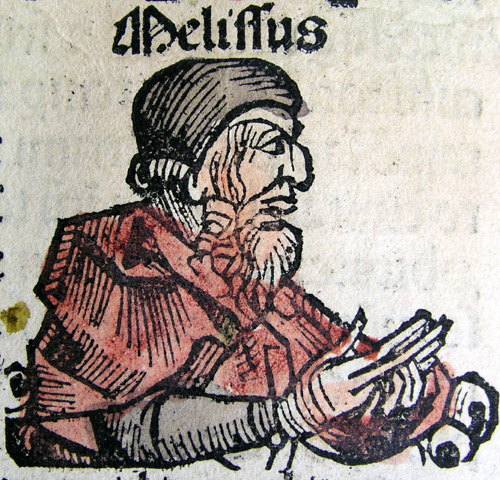
Melissus of Samos (/məˈlɪsəs/; Ancient Greek: Μέλισσος ὁ Σάμιος; fl. 5th century BC) was the third and last member of the ancient school of Eleatic philosophy, whose other members included Zeno and Parmenides. Little is known about his life, except that he was the commander of the Samian fleet in the Samian War. Melissus’s contribution to philosophy was a treatise of systematic arguments supporting Eleatic philosophy. Like Parmenides, he argued that reality is ungenerated, indestructible, indivisible, changeless, and motionless. In addition, he sought to show that reality is wholly unlimited, and infinitely extended in all directions; and since existence is unlimited, it must also be one.
Not much information remains regarding the life of Melissus. He may have been born around 500 BC; the date of his death is unknown. The little which is known about him is mostly gleaned from a small passage in Plutarch’s Life of Pericles. He was the commander of the Samian fleet in the Samian War, and defeated Pericles and the Athenian fleet in 440 BC. Plutarch claims that Aristotle says that Melissus had also defeated Pericles in an earlier battle. In his Life of Themistocles, Plutarch denies Stesimbrotos’s claim that Melissus was held in high regard by Themistocles, claiming that he is confusing Themistocles and Pericles. Melissus was reputed to have been the pupil of Parmenides, and the teacher of Leucippus, though one must regard such claims with a fair amount of skepticism.
Much of what remains of Melissus’s philosophical treatise, later titled On Nature, has been preserved by Simplicius in his commentaries on Aristotle’s Physics and On the Heavens, and several summaries of his philosophy have come down to us. Most of the remaining fragments can be found in Diels–Kranz. Unlike Parmenides, Melissus wrote his treatise in prose, not poetry. Like Parmenides, he claims that Being is one, ungenerated, indestructible, indivisible, changeless, motionless and the same. Melissus’s philosophy differs from that of Parmenides in two respects: (1) Parmenides claims that Being is limited, while Melissus claims that it is wholly unlimited; and (2) for Parmenides, Being existed in a timeless Present, while for Melissus Being is eternal. McKirahan claims that Parmenides argues for Being as spatially limited, but this is a contentious point.
Melissus argues that since The One neither came to be nor is subject to destruction, it is therefore eternal. While fragment 1 is merely a summary of Parmenides’s arguments against coming to be and perishing (8.5–21), fragment 2 provides Melissus’s argument. Melissus’s argument is twofold, addressing the temporal aspect of The One somewhat as a timeline: granting the reality of the present moment, he argues that The One has existed eternally into the past and will exist eternally into the future.
His argument is as follows:
in addition:
He restates his argument for The One as eternal in fragments 6 and 9.1.
It is in this respect that Melissus differs from Parmenides, although some argue that the difference is not as important as it might seem. Parmenides’s view is that there is only one moment (the eternal present), while Melissus argues for an infinite number of moments. The existence of a changeless, motionless, eternal present is an arguable position (as Time, by its nature, is merely made by change and motion and that, there would exist no such thing as Time if there were no change in quality or quantity); however, the existence of a changeless, motionless, infinite succession of moments is a much more difficult position to defend as moments are distinguished from one another by the change in quality or quantity of the one space that they exist within, otherwise, there would have been an infinite number of moments of the same quality and quantity, which is, in actuality, one continuous moment as Parmenides argued.
Hub AI
Melissus of Samos AI simulator
(@Melissus of Samos_simulator)
Melissus of Samos
Melissus of Samos (/məˈlɪsəs/; Ancient Greek: Μέλισσος ὁ Σάμιος; fl. 5th century BC) was the third and last member of the ancient school of Eleatic philosophy, whose other members included Zeno and Parmenides. Little is known about his life, except that he was the commander of the Samian fleet in the Samian War. Melissus’s contribution to philosophy was a treatise of systematic arguments supporting Eleatic philosophy. Like Parmenides, he argued that reality is ungenerated, indestructible, indivisible, changeless, and motionless. In addition, he sought to show that reality is wholly unlimited, and infinitely extended in all directions; and since existence is unlimited, it must also be one.
Not much information remains regarding the life of Melissus. He may have been born around 500 BC; the date of his death is unknown. The little which is known about him is mostly gleaned from a small passage in Plutarch’s Life of Pericles. He was the commander of the Samian fleet in the Samian War, and defeated Pericles and the Athenian fleet in 440 BC. Plutarch claims that Aristotle says that Melissus had also defeated Pericles in an earlier battle. In his Life of Themistocles, Plutarch denies Stesimbrotos’s claim that Melissus was held in high regard by Themistocles, claiming that he is confusing Themistocles and Pericles. Melissus was reputed to have been the pupil of Parmenides, and the teacher of Leucippus, though one must regard such claims with a fair amount of skepticism.
Much of what remains of Melissus’s philosophical treatise, later titled On Nature, has been preserved by Simplicius in his commentaries on Aristotle’s Physics and On the Heavens, and several summaries of his philosophy have come down to us. Most of the remaining fragments can be found in Diels–Kranz. Unlike Parmenides, Melissus wrote his treatise in prose, not poetry. Like Parmenides, he claims that Being is one, ungenerated, indestructible, indivisible, changeless, motionless and the same. Melissus’s philosophy differs from that of Parmenides in two respects: (1) Parmenides claims that Being is limited, while Melissus claims that it is wholly unlimited; and (2) for Parmenides, Being existed in a timeless Present, while for Melissus Being is eternal. McKirahan claims that Parmenides argues for Being as spatially limited, but this is a contentious point.
Melissus argues that since The One neither came to be nor is subject to destruction, it is therefore eternal. While fragment 1 is merely a summary of Parmenides’s arguments against coming to be and perishing (8.5–21), fragment 2 provides Melissus’s argument. Melissus’s argument is twofold, addressing the temporal aspect of The One somewhat as a timeline: granting the reality of the present moment, he argues that The One has existed eternally into the past and will exist eternally into the future.
His argument is as follows:
in addition:
He restates his argument for The One as eternal in fragments 6 and 9.1.
It is in this respect that Melissus differs from Parmenides, although some argue that the difference is not as important as it might seem. Parmenides’s view is that there is only one moment (the eternal present), while Melissus argues for an infinite number of moments. The existence of a changeless, motionless, eternal present is an arguable position (as Time, by its nature, is merely made by change and motion and that, there would exist no such thing as Time if there were no change in quality or quantity); however, the existence of a changeless, motionless, infinite succession of moments is a much more difficult position to defend as moments are distinguished from one another by the change in quality or quantity of the one space that they exist within, otherwise, there would have been an infinite number of moments of the same quality and quantity, which is, in actuality, one continuous moment as Parmenides argued.
Recent media