
Recent from talks
Memory foam
Knowledge base stats:
Talk channels stats:
Members stats:
Memory foam
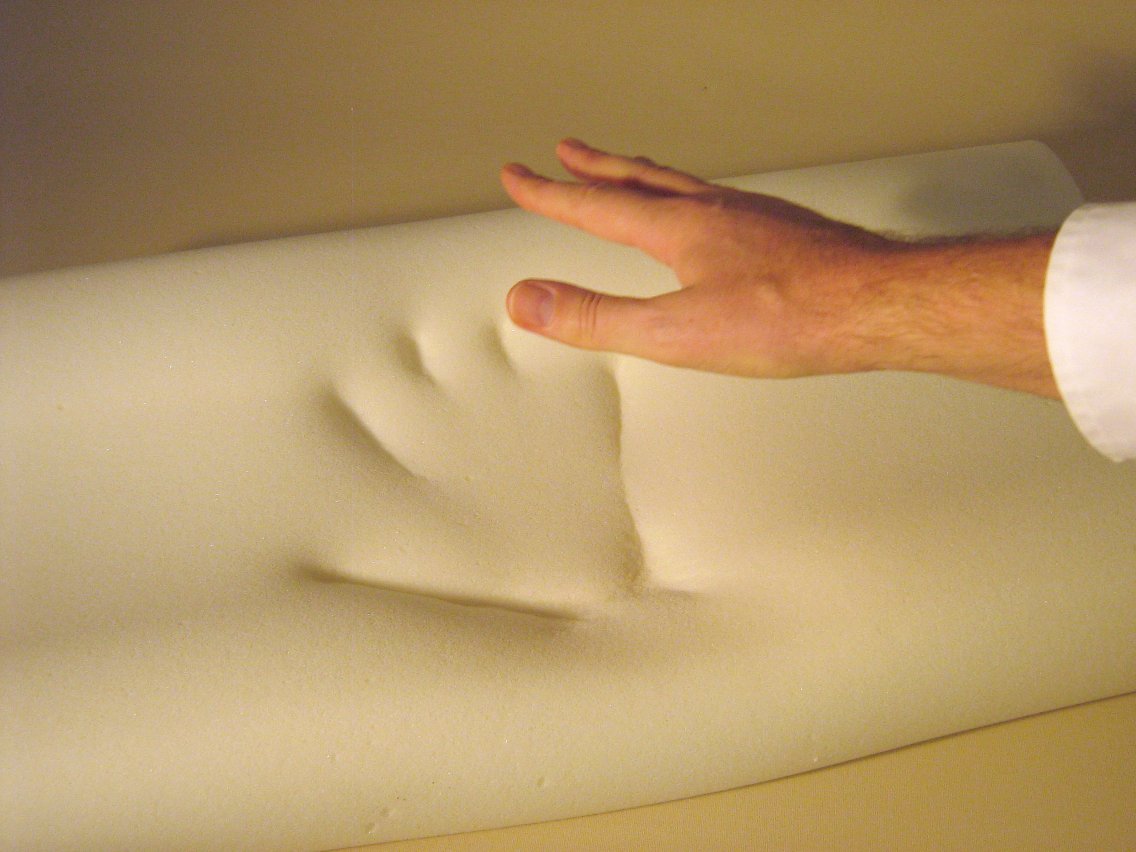
Memory foam consists mainly of polyurethane with additional chemicals that increase its viscosity and density. It is often referred to as "viscoelastic" polyurethane foam, or low-resilience polyurethane foam (LRPu). The foam bubbles or 'cells' are open, effectively creating a matrix through which air can move. Higher-density memory foam softens in reaction to body heat, allowing it to mold to a warm body in a few minutes. Newer foams may recover their original shape more quickly.
Memory foam derives its viscoelastic properties from several effects, due to the material's internal structure. The network effect is the force working to restore the foam's structure when it is deformed. This effect is generated by the deformed porous material pushing outwards to restore its structure against an applied pressure. Three effects work against the network effect, slowing the regeneration of the foam's original structure:
The effects are temperature-dependent, so the temperature range at which memory foam retains its properties is limited. If it is too cold, it hardens. If it is too hot, it acts like conventional foams, quickly springing back to its original shape. The underlying physics of this process can be described by polymeric creep.
The pneumatic and adhesive effects are strongly correlated with the size of the pores within memory foam. Smaller pores lead to higher internal surface area and reduced air flow, increasing the adhesion and pneumatic effects. Thus the foam's properties can be controlled by changing its cell structure and porosity. Its glass transition temperature can also be modulated by using additives in the foam's material.
Memory foam's mechanical properties can affect the comfort of mattresses produced with it. There is also a trade-off between comfort and durability. Certain memory foams may have a more rigid cell structure, leading to a weaker distribution of weight, but better recovery of the original structure, leading to improved cyclability and durability. Denser cell structure can also resist the penetration of water vapor, leading to reduced weathering and better durability and overall appearance.
Memory foam was developed in 1966 under a contract by NASA's Ames Research Center to improve the safety of aircraft cushions. The temperature-sensitive memory foam was initially referred to as "slow spring back foam"; most called it "temper foam". Created by feeding gas into a polymer matrix, it had an open-cell solid structure that matched pressure against it, yet slowly returned to its original shape.
Later commercialisation of the foam included use in medical equipment such as X-ray table pads, and sports equipment such as American / Canadian football helmet liners.
When NASA released memory foam to the public domain in the early 1980s, Fagerdala World Foams was one of the few companies willing to work with it, as the manufacturing process remained difficult and unreliable. Their 1991 product, the Tempur-Pedic Swedish Mattress eventually led to the mattress and cushion company Tempur World.
Hub AI
Memory foam AI simulator
(@Memory foam_simulator)
Memory foam
Memory foam consists mainly of polyurethane with additional chemicals that increase its viscosity and density. It is often referred to as "viscoelastic" polyurethane foam, or low-resilience polyurethane foam (LRPu). The foam bubbles or 'cells' are open, effectively creating a matrix through which air can move. Higher-density memory foam softens in reaction to body heat, allowing it to mold to a warm body in a few minutes. Newer foams may recover their original shape more quickly.
Memory foam derives its viscoelastic properties from several effects, due to the material's internal structure. The network effect is the force working to restore the foam's structure when it is deformed. This effect is generated by the deformed porous material pushing outwards to restore its structure against an applied pressure. Three effects work against the network effect, slowing the regeneration of the foam's original structure:
The effects are temperature-dependent, so the temperature range at which memory foam retains its properties is limited. If it is too cold, it hardens. If it is too hot, it acts like conventional foams, quickly springing back to its original shape. The underlying physics of this process can be described by polymeric creep.
The pneumatic and adhesive effects are strongly correlated with the size of the pores within memory foam. Smaller pores lead to higher internal surface area and reduced air flow, increasing the adhesion and pneumatic effects. Thus the foam's properties can be controlled by changing its cell structure and porosity. Its glass transition temperature can also be modulated by using additives in the foam's material.
Memory foam's mechanical properties can affect the comfort of mattresses produced with it. There is also a trade-off between comfort and durability. Certain memory foams may have a more rigid cell structure, leading to a weaker distribution of weight, but better recovery of the original structure, leading to improved cyclability and durability. Denser cell structure can also resist the penetration of water vapor, leading to reduced weathering and better durability and overall appearance.
Memory foam was developed in 1966 under a contract by NASA's Ames Research Center to improve the safety of aircraft cushions. The temperature-sensitive memory foam was initially referred to as "slow spring back foam"; most called it "temper foam". Created by feeding gas into a polymer matrix, it had an open-cell solid structure that matched pressure against it, yet slowly returned to its original shape.
Later commercialisation of the foam included use in medical equipment such as X-ray table pads, and sports equipment such as American / Canadian football helmet liners.
When NASA released memory foam to the public domain in the early 1980s, Fagerdala World Foams was one of the few companies willing to work with it, as the manufacturing process remained difficult and unreliable. Their 1991 product, the Tempur-Pedic Swedish Mattress eventually led to the mattress and cushion company Tempur World.
Recent media