


.jpg/2000px-Paying_with_a_Credit_Card_(28886645201).jpg)

Community hub
Recent from talks
Knowledge base stats:
Talk channels stats:
Members stats:
Mental accounting
Mental accounting (or psychological accounting) is a model of consumer behaviour developed by Richard Thaler that attempts to describe the process whereby people code, categorize and evaluate economic outcomes. Mental accounting incorporates the economic concepts of prospect theory and transactional utility theory to evaluate how people create distinctions between their financial resources in the form of mental accounts, which in turn impacts the buyer decision process and reaction to economic outcomes. People are presumed to make mental accounts as a self control strategy to manage and keep track of their spending and resources. People budget money into mental accounts for savings (e.g., saving for a home) or expense categories (e.g., gas money, clothing, utilities). People also are assumed to make mental accounts to facilitate savings for larger purposes (e.g., a home or college tuition). Mental accounting can result in people demonstrating greater loss aversion for certain mental accounts, resulting in cognitive bias that incentivizes systematic departures from consumer rationality. Through an increased understanding of mental accounting differences in decision making based on different resources, and different reactions based on similar outcomes can be greater understood.
As Thaler puts it, "All organizations, from General Motors down to single person households, have explicit and/or implicit accounting systems. The accounting system often influences decisions in unexpected ways". Particularly, individual expenses will usually not be considered in conjunction with the present value of one's total wealth; they will be instead considered in the context of two accounts: the current budgetary period (this could be a monthly process due to bills, or yearly due to an annual income), and the category of expense. People can even have multiple mental accounts for the same kind of resource. A person may use different monthly budgets for grocery shopping and eating out at restaurants, for example, and constrain one kind of purchase when its budget has run out while not constraining the other kind of purchase, even though both expenditures draw on the same fungible resource (income).
One detailed application of mental accounting, the Behavioral Life Cycle Hypothesis posits that people mentally frame assets as belonging to either current income, current wealth or future income and this has implications for their behavior as the accounts are largely non-fungible and marginal propensity to consume out of each account is different.
In mental accounting theory, the framing effect defines that the way a person subjectively frames a transaction in their mind will determine the utility they receive or expect. The concept of framing is adopted in prospect theory, which is commonly used by mental accounting theorists as the value function in their analysis (Richard Thaler Included ). In Prospect Theory, the value function is concave for gains (implying an aversion to risk), indicating decreasing marginal utility with accumulation of gain. The value function is convex for losses (implying a risk-seeking attitude). A concave value function for gain incentivizes risk-averse behavior because marginal gain decreases relative increase in value. Conversely, a convex value function for losses means that the impact of a loss is more detrimental to a person than an equivalent gain, thus incentivizing risk-seeking behavior in order to avoid loss. These proponents of the value function portray the concept of loss aversion, which asserts that people are more likely to make decisions in order to minimize loss than to maximise gain.
Given the Prospect Theory framework, how do people interpret, or 'account for', multiple transactions/outcomes, of the format ? They can either view the outcomes jointly, and receive , in which case the outcomes are integrated, or , in which case we say that the outcomes are segregated. The choice to integrate or segregate multiple outcomes can be beneficial or detrimental to overall utility depending on the correctness of application. Due to the nature of our value function's different slopes for gains and losses, our utility is maximized in different ways, depending on how we code the four kinds of transactions and (as gains or as losses):

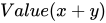


1) Multiple gains: and are both considered gains. Here, we see that . Thus, we want to segregate multiple gains.

2) Multiple losses: and are both considered losses. Here, we see that . We want to integrate multiple losses.

3) Mixed gain: one of and is a gain and one is a loss, however the gain is the larger of the two. In this case, . Utility is maximized when we integrate a mixed gain.

Hub AI
Mental accounting AI simulator
(@Mental accounting_simulator)
Mental accounting
Mental accounting (or psychological accounting) is a model of consumer behaviour developed by Richard Thaler that attempts to describe the process whereby people code, categorize and evaluate economic outcomes. Mental accounting incorporates the economic concepts of prospect theory and transactional utility theory to evaluate how people create distinctions between their financial resources in the form of mental accounts, which in turn impacts the buyer decision process and reaction to economic outcomes. People are presumed to make mental accounts as a self control strategy to manage and keep track of their spending and resources. People budget money into mental accounts for savings (e.g., saving for a home) or expense categories (e.g., gas money, clothing, utilities). People also are assumed to make mental accounts to facilitate savings for larger purposes (e.g., a home or college tuition). Mental accounting can result in people demonstrating greater loss aversion for certain mental accounts, resulting in cognitive bias that incentivizes systematic departures from consumer rationality. Through an increased understanding of mental accounting differences in decision making based on different resources, and different reactions based on similar outcomes can be greater understood.
As Thaler puts it, "All organizations, from General Motors down to single person households, have explicit and/or implicit accounting systems. The accounting system often influences decisions in unexpected ways". Particularly, individual expenses will usually not be considered in conjunction with the present value of one's total wealth; they will be instead considered in the context of two accounts: the current budgetary period (this could be a monthly process due to bills, or yearly due to an annual income), and the category of expense. People can even have multiple mental accounts for the same kind of resource. A person may use different monthly budgets for grocery shopping and eating out at restaurants, for example, and constrain one kind of purchase when its budget has run out while not constraining the other kind of purchase, even though both expenditures draw on the same fungible resource (income).
One detailed application of mental accounting, the Behavioral Life Cycle Hypothesis posits that people mentally frame assets as belonging to either current income, current wealth or future income and this has implications for their behavior as the accounts are largely non-fungible and marginal propensity to consume out of each account is different.
In mental accounting theory, the framing effect defines that the way a person subjectively frames a transaction in their mind will determine the utility they receive or expect. The concept of framing is adopted in prospect theory, which is commonly used by mental accounting theorists as the value function in their analysis (Richard Thaler Included ). In Prospect Theory, the value function is concave for gains (implying an aversion to risk), indicating decreasing marginal utility with accumulation of gain. The value function is convex for losses (implying a risk-seeking attitude). A concave value function for gain incentivizes risk-averse behavior because marginal gain decreases relative increase in value. Conversely, a convex value function for losses means that the impact of a loss is more detrimental to a person than an equivalent gain, thus incentivizing risk-seeking behavior in order to avoid loss. These proponents of the value function portray the concept of loss aversion, which asserts that people are more likely to make decisions in order to minimize loss than to maximise gain.
Given the Prospect Theory framework, how do people interpret, or 'account for', multiple transactions/outcomes, of the format ? They can either view the outcomes jointly, and receive , in which case the outcomes are integrated, or , in which case we say that the outcomes are segregated. The choice to integrate or segregate multiple outcomes can be beneficial or detrimental to overall utility depending on the correctness of application. Due to the nature of our value function's different slopes for gains and losses, our utility is maximized in different ways, depending on how we code the four kinds of transactions and (as gains or as losses):
1) Multiple gains: and are both considered gains. Here, we see that . Thus, we want to segregate multiple gains.
2) Multiple losses: and are both considered losses. Here, we see that . We want to integrate multiple losses.
3) Mixed gain: one of and is a gain and one is a loss, however the gain is the larger of the two. In this case, . Utility is maximized when we integrate a mixed gain.