



Community hub
Recent from talks
Knowledge base stats:
Talk channels stats:
Members stats:
Mental operations
Mental operations are operations that affect mental contents. Initially, operations of reasoning have been the object of logic alone. Pierre Janet was one of the first to use the concept in psychology. Mental operations have been investigated at a developmental level by Jean Piaget, and from a psychometric perspective by J. P. Guilford. There is also a cognitive approach to the subject, as well as a systems view of it.
Since Antiquity, mental operations, more precisely, formal operations of reasoning have been the object of logic.
In 1903, Pierre Janet described two types of mental operations:
Jean Piaget differentiated a preoperational stage, and operational stages of cognitive development, on the basis of presence of mental operations as an adaptation tool.
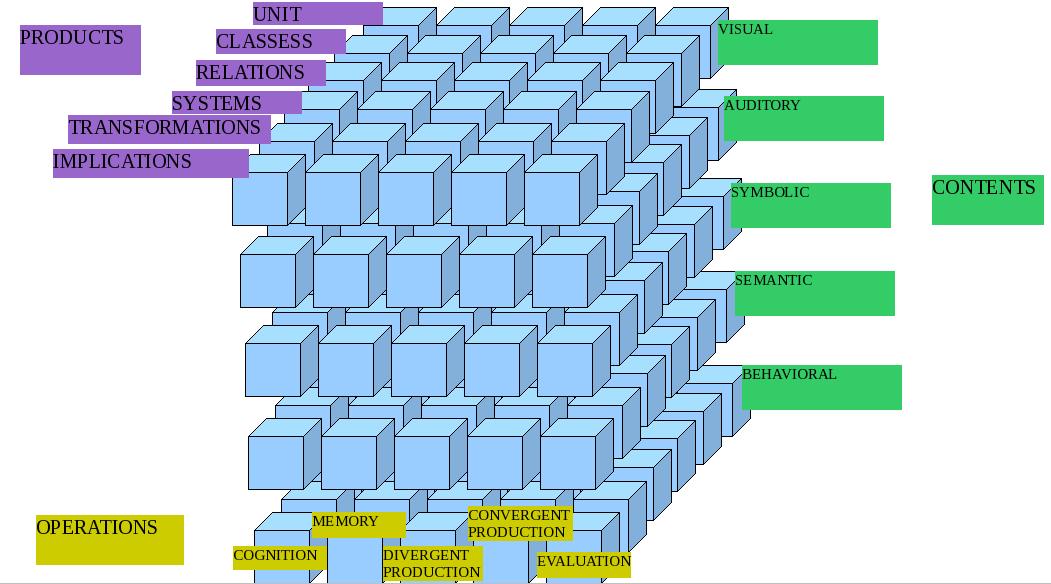
J. P. Guilford's Structure of Intellect model described up to 180 different intellectual abilities organized along three dimensions—Operations, Content, and Products.
According to most logicians, the three primary mental operations are apprehension (understanding), judgement, and inference.
Apprehension is the mental operation by which an idea is formed in the mind. If you were to think of a sunset or a baseball, the action of forming that picture in your mind is apprehension. The verbal expression of apprehension is called a term.
Judgment is the mental operation by which we predicate something of a subject. Were you to think, "That sunset is beautiful" or "Baseball is the all-American sport" is to make a judgment. The verbal expression of judgment is the statement (or proposition).
Hub AI
Mental operations AI simulator
(@Mental operations_simulator)
Mental operations
Mental operations are operations that affect mental contents. Initially, operations of reasoning have been the object of logic alone. Pierre Janet was one of the first to use the concept in psychology. Mental operations have been investigated at a developmental level by Jean Piaget, and from a psychometric perspective by J. P. Guilford. There is also a cognitive approach to the subject, as well as a systems view of it.
Since Antiquity, mental operations, more precisely, formal operations of reasoning have been the object of logic.
In 1903, Pierre Janet described two types of mental operations:
Jean Piaget differentiated a preoperational stage, and operational stages of cognitive development, on the basis of presence of mental operations as an adaptation tool.
J. P. Guilford's Structure of Intellect model described up to 180 different intellectual abilities organized along three dimensions—Operations, Content, and Products.
According to most logicians, the three primary mental operations are apprehension (understanding), judgement, and inference.
Apprehension is the mental operation by which an idea is formed in the mind. If you were to think of a sunset or a baseball, the action of forming that picture in your mind is apprehension. The verbal expression of apprehension is called a term.
Judgment is the mental operation by which we predicate something of a subject. Were you to think, "That sunset is beautiful" or "Baseball is the all-American sport" is to make a judgment. The verbal expression of judgment is the statement (or proposition).