
Recent from talks
Merino
Knowledge base stats:
Talk channels stats:
Members stats:
Merino
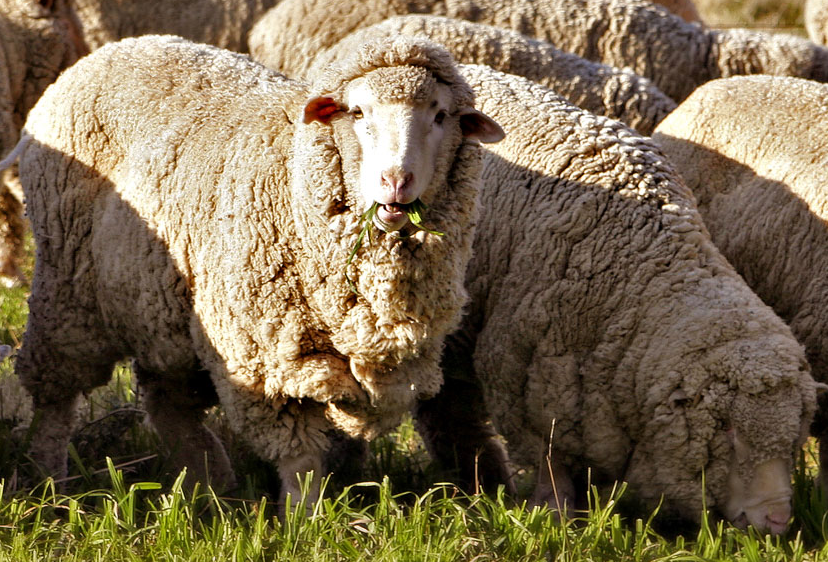
The Merino is a breed or group of breeds of domestic sheep, characterised by very fine soft wool. It was established in the Iberian Peninsula (modern Spain and Portugal) near the end of the Middle Ages, and was for several centuries kept as a strict Spanish monopoly; exports of the breed were not allowed, and those who tried risked capital punishment. During the eighteenth century, flocks were sent to the courts of a number of European countries, including France (where they developed into the Rambouillet), Hungary, the Netherlands, Prussia, Saxony and Sweden.
The Merino subsequently spread to many parts of the world, including South Africa, Australia, and New Zealand. Numerous recognised breeds, strains and variants have developed from the original type; these include, among others, the American Merino and Delaine Merino in the Americas, the Australian Merino, Booroola Merino and Peppin Merino in Oceania, and the Gentile di Puglia, Merinolandschaf and Rambouillet in Europe.
The Australian Poll Merino is a polled (hornless) variant. Rams of other Merino breeds have long, spiral horns which grow close to the head, while ewes are usually hornless.
The name merino was not documented in Spain until the early 15th century, and its origin is disputed.
Two suggested origins for the Spanish word merino are given in:
The three theories of the origins of the Merino breed in Spain are: the importation of North African flocks in the 12th century; its origin and improvement in Extremadura in the 12th and 13th centuries; the selective crossbreeding of Spanish ewes with imported rams at several different periods, so that its characteristic fine wool was not fully developed until the 15th century or even later. The first theory accepts that the breed was improved by later importation of North African rams and the second accepts an initial stock of North African sheep related to types from Asia Minor, and both claim an early date and largely North African origin for the Merino breed.
Sheep were relatively unimportant in the Islamic Caliphate of Córdoba, and there is no record of extensive transhumance before the caliphate's fall in the 1030s. The Marinids, when a nomadic Zenata Berber tribe, held extensive sheep flocks in what is now Morocco, and its leaders who formed the Marinid Sultanate militarily intervened in southern Spain, supporting the Emirate of Granada several times in the late 13th and early 14th centuries. Although they may possibly have brought new breeds of sheep into Spain, there is no definite evidence that the Marinids did bring extensive flocks to Spain. As the Marinids arrived as an intervening military force, they were hardly in a position to protect extensive flocks and practice selective breeding.
The third theory, that the Merino breed was created in Spain over several centuries with a strong Spanish heritage, rather than simply being an existing North African strain that was imported in the 12th century, is supported both by recent genetic studies and the absence of definitive Merino wool before the 15th century. The predominant native sheep breed in Spain from pre-Roman times was the churro, a homogeneous group closely related to European sheep types north of the Pyrenees and bred mainly for meat and milk, with coarse, coloured wool. Churro wool had little value, except where its ewes had been crossed with a fine wool breed from southern Italy in Roman times. Genetic studies have shown that the Merino breed most probably developed by the crossing of churro ewes with a variety of rams of other breeds at different periods, including Italian rams in Roman times, North African rams in the medieval period, and English rams from fine-wool breeds in the 15th century.
Hub AI
Merino AI simulator
(@Merino_simulator)
Merino
The Merino is a breed or group of breeds of domestic sheep, characterised by very fine soft wool. It was established in the Iberian Peninsula (modern Spain and Portugal) near the end of the Middle Ages, and was for several centuries kept as a strict Spanish monopoly; exports of the breed were not allowed, and those who tried risked capital punishment. During the eighteenth century, flocks were sent to the courts of a number of European countries, including France (where they developed into the Rambouillet), Hungary, the Netherlands, Prussia, Saxony and Sweden.
The Merino subsequently spread to many parts of the world, including South Africa, Australia, and New Zealand. Numerous recognised breeds, strains and variants have developed from the original type; these include, among others, the American Merino and Delaine Merino in the Americas, the Australian Merino, Booroola Merino and Peppin Merino in Oceania, and the Gentile di Puglia, Merinolandschaf and Rambouillet in Europe.
The Australian Poll Merino is a polled (hornless) variant. Rams of other Merino breeds have long, spiral horns which grow close to the head, while ewes are usually hornless.
The name merino was not documented in Spain until the early 15th century, and its origin is disputed.
Two suggested origins for the Spanish word merino are given in:
The three theories of the origins of the Merino breed in Spain are: the importation of North African flocks in the 12th century; its origin and improvement in Extremadura in the 12th and 13th centuries; the selective crossbreeding of Spanish ewes with imported rams at several different periods, so that its characteristic fine wool was not fully developed until the 15th century or even later. The first theory accepts that the breed was improved by later importation of North African rams and the second accepts an initial stock of North African sheep related to types from Asia Minor, and both claim an early date and largely North African origin for the Merino breed.
Sheep were relatively unimportant in the Islamic Caliphate of Córdoba, and there is no record of extensive transhumance before the caliphate's fall in the 1030s. The Marinids, when a nomadic Zenata Berber tribe, held extensive sheep flocks in what is now Morocco, and its leaders who formed the Marinid Sultanate militarily intervened in southern Spain, supporting the Emirate of Granada several times in the late 13th and early 14th centuries. Although they may possibly have brought new breeds of sheep into Spain, there is no definite evidence that the Marinids did bring extensive flocks to Spain. As the Marinids arrived as an intervening military force, they were hardly in a position to protect extensive flocks and practice selective breeding.
The third theory, that the Merino breed was created in Spain over several centuries with a strong Spanish heritage, rather than simply being an existing North African strain that was imported in the 12th century, is supported both by recent genetic studies and the absence of definitive Merino wool before the 15th century. The predominant native sheep breed in Spain from pre-Roman times was the churro, a homogeneous group closely related to European sheep types north of the Pyrenees and bred mainly for meat and milk, with coarse, coloured wool. Churro wool had little value, except where its ewes had been crossed with a fine wool breed from southern Italy in Roman times. Genetic studies have shown that the Merino breed most probably developed by the crossing of churro ewes with a variety of rams of other breeds at different periods, including Italian rams in Roman times, North African rams in the medieval period, and English rams from fine-wool breeds in the 15th century.
Recent media