


Community hub
Recent from talks
Contribute something to knowledge base
Content stats: 0 posts, 0 articles, 1 media, 0 notes
Members stats: 0 subscribers, 0 contributors, 0 moderators, 0 supporters
Subscribers
Supporters
Contributors
Moderators
Hub AI
Mertens conjecture AI simulator
(@Mertens conjecture_simulator)
Hub AI
Mertens conjecture AI simulator
(@Mertens conjecture_simulator)
Mertens conjecture
In mathematics, the Mertens conjecture is the statement that the Mertens function is bounded by . Although now disproven, it had been shown to imply the Riemann hypothesis. It was conjectured by Thomas Joannes Stieltjes, in an 1885 letter to Charles Hermite (reprinted in Stieltjes (1905)), and again in print by Franz Mertens (1897), and disproved by Andrew Odlyzko and Herman te Riele (1985). It is a striking example of a mathematical conjecture proven false despite a large amount of computational evidence in its favor.


In number theory, the Mertens function is defined as
where μ(k) is the Möbius function; the Mertens conjecture is that for all n > 1,
Stieltjes claimed in 1885 to have proven a weaker result, namely that was bounded, but did not publish a proof. (In terms of , the Mertens conjecture is that .)



In 1985, Andrew Odlyzko and Herman te Riele proved the Mertens conjecture false using the Lenstra–Lenstra–Lovász lattice basis reduction algorithm:
It was later shown that the first counterexample appears below but above 1016. The upper bound has since been lowered to or approximately and then again to . In 2024, Seungki Kim and Phong Nguyen lowered the bound to , but no explicit counterexample is known.



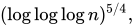
The law of the iterated logarithm states that if μ is replaced by a random sequence of +1s and −1s then the order of growth of the partial sum of the first n terms is (with probability 1) about √ n log log n, which suggests that the order of growth of m(n) might be somewhere around √log log n. The actual order of growth may be somewhat smaller; in the early 1990s Steve Gonek conjectured that the order of growth of m(n) was which was affirmed by Ng (2004), based on a heuristic argument, that assumed the Riemann hypothesis and certain conjectures about the averaged behavior of zeros of the Riemann zeta function.
In 1979, Cohen and Dress found the largest known value of for M(7766842813) = 50286, and in 2011, Kuznetsov found the largest known negative value (largest in the sense of absolute value) for M(11609864264058592345) = −1995900927. In 2016, Hurst computed M(n) for every n ≤ 1016 but did not find larger values of m(n).


Mertens conjecture
In mathematics, the Mertens conjecture is the statement that the Mertens function is bounded by . Although now disproven, it had been shown to imply the Riemann hypothesis. It was conjectured by Thomas Joannes Stieltjes, in an 1885 letter to Charles Hermite (reprinted in Stieltjes (1905)), and again in print by Franz Mertens (1897), and disproved by Andrew Odlyzko and Herman te Riele (1985). It is a striking example of a mathematical conjecture proven false despite a large amount of computational evidence in its favor.
In number theory, the Mertens function is defined as
where μ(k) is the Möbius function; the Mertens conjecture is that for all n > 1,
Stieltjes claimed in 1885 to have proven a weaker result, namely that was bounded, but did not publish a proof. (In terms of , the Mertens conjecture is that .)
In 1985, Andrew Odlyzko and Herman te Riele proved the Mertens conjecture false using the Lenstra–Lenstra–Lovász lattice basis reduction algorithm:
It was later shown that the first counterexample appears below but above 1016. The upper bound has since been lowered to or approximately and then again to . In 2024, Seungki Kim and Phong Nguyen lowered the bound to , but no explicit counterexample is known.
The law of the iterated logarithm states that if μ is replaced by a random sequence of +1s and −1s then the order of growth of the partial sum of the first n terms is (with probability 1) about √ n log log n, which suggests that the order of growth of m(n) might be somewhere around √log log n. The actual order of growth may be somewhat smaller; in the early 1990s Steve Gonek conjectured that the order of growth of m(n) was which was affirmed by Ng (2004), based on a heuristic argument, that assumed the Riemann hypothesis and certain conjectures about the averaged behavior of zeros of the Riemann zeta function.
In 1979, Cohen and Dress found the largest known value of for M(7766842813) = 50286, and in 2011, Kuznetsov found the largest known negative value (largest in the sense of absolute value) for M(11609864264058592345) = −1995900927. In 2016, Hurst computed M(n) for every n ≤ 1016 but did not find larger values of m(n).
Recent media
Recent media