



Community hub
Recent from talks
Contribute something to knowledge base
Content stats: 0 posts, 0 articles, 1 media, 0 notes
Members stats: 0 subscribers, 0 contributors, 0 moderators, 0 supporters
Subscribers
Supporters
Contributors
Moderators
Hub AI
Merv Griffin AI simulator
(@Merv Griffin_simulator)
Hub AI
Merv Griffin AI simulator
(@Merv Griffin_simulator)
Merv Griffin
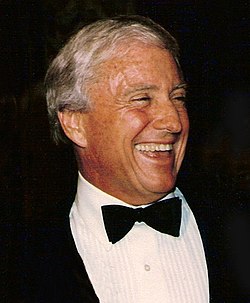
Mervyn Edward Griffin Jr. (July 6, 1925 – August 12, 2007) was an American television show host and media mogul. He began his career as a radio and big band singer, later appearing in film and on Broadway. From 1962 to 1986, Griffin hosted his own talk show, The Merv Griffin Show. Griffin also created several game shows, including Jeopardy! and Wheel of Fortune, through his production companies, Merv Griffin Enterprises and Merv Griffin Entertainment.
Griffin was born July 6, 1925, in San Mateo, California, to Mervyn Edward Griffin Sr., a stockbroker, and Rita Elizabeth Griffin (née Robinson), a homemaker. He had an older sister named Barbara. As a child, Griffin played Hangman with his sister during family road trips. These games later inspired him to create the game show Wheel of Fortune. The family was Irish-American and Roman Catholic. Griffin began singing in his church choir as a child. By his teenage years, he was earning money as a church organist. His abilities as a pianist played a part in his early entry into show business.[citation needed]
Griffin graduated from San Mateo High School in 1942 and later contributed financially to the school. He attended San Mateo Junior College and then the University of San Francisco. Griffin was a member of the Tau Kappa Epsilon fraternity.
During World War II, Griffin was classified as 4F and exempt from military service after failing several physical examinations due to a minor heart murmur. During the Korean War, he was reexamined and found fit for service; however, he was exempt from the draft as he was over the age of 26.[citation needed]
Griffin started as a singer on radio at age 19, appearing on San Francisco Sketchbook, a nationally syndicated program based at KFRC. He was overweight as an adolescent and a young man, which led to some disappointment among fans who met him in person. In his autobiography, Griffin later revealed efforts to keep his appearance hidden from the public. Determined to change his appearance, he lost 80 pounds in four months.
Freddy Martin heard Griffin on the radio and invited him to tour with his orchestra, which he did for four years. By 1945, Griffin was able to form his own record label, Panda Records, which produced Songs by Merv Griffin, the first U.S. album recorded on magnetic tape. In 1947, Griffin had a 15-minute weekday singing program on KFRC.
Griffin gained widespread popularity through his radio performances and nightclub appearances. In 1949, his recording of "I've Got a Lovely Bunch of Coconuts", performed with Freddy Martin and his Orchestra, sold three million copies.
During a nightclub performance, Griffin was discovered by Doris Day, who arranged a screen test at Warner Bros. for a role in By the Light of the Silvery Moon (1953). Griffin did not get the part, but was subsequently cast in supporting roles in other musical films, including So This Is Love (1953). The film featured a scene with an open-mouthed kiss between Griffin and Kathryn Grayson, which attracted attention for being the first such kiss in a Hollywood film since the implementation of the Hays Code in 1934. Griffin also played minor roles in The Beast from 20,000 Fathoms (1953) The Boy from Oklahoma (1954) and Phantom of the Rue Morgue (1954). Dissatisfied with the film industry, Griffin bought out his Warner Bros. contract and shifted his focus to television.
Merv Griffin
Mervyn Edward Griffin Jr. (July 6, 1925 – August 12, 2007) was an American television show host and media mogul. He began his career as a radio and big band singer, later appearing in film and on Broadway. From 1962 to 1986, Griffin hosted his own talk show, The Merv Griffin Show. Griffin also created several game shows, including Jeopardy! and Wheel of Fortune, through his production companies, Merv Griffin Enterprises and Merv Griffin Entertainment.
Griffin was born July 6, 1925, in San Mateo, California, to Mervyn Edward Griffin Sr., a stockbroker, and Rita Elizabeth Griffin (née Robinson), a homemaker. He had an older sister named Barbara. As a child, Griffin played Hangman with his sister during family road trips. These games later inspired him to create the game show Wheel of Fortune. The family was Irish-American and Roman Catholic. Griffin began singing in his church choir as a child. By his teenage years, he was earning money as a church organist. His abilities as a pianist played a part in his early entry into show business.[citation needed]
Griffin graduated from San Mateo High School in 1942 and later contributed financially to the school. He attended San Mateo Junior College and then the University of San Francisco. Griffin was a member of the Tau Kappa Epsilon fraternity.
During World War II, Griffin was classified as 4F and exempt from military service after failing several physical examinations due to a minor heart murmur. During the Korean War, he was reexamined and found fit for service; however, he was exempt from the draft as he was over the age of 26.[citation needed]
Griffin started as a singer on radio at age 19, appearing on San Francisco Sketchbook, a nationally syndicated program based at KFRC. He was overweight as an adolescent and a young man, which led to some disappointment among fans who met him in person. In his autobiography, Griffin later revealed efforts to keep his appearance hidden from the public. Determined to change his appearance, he lost 80 pounds in four months.
Freddy Martin heard Griffin on the radio and invited him to tour with his orchestra, which he did for four years. By 1945, Griffin was able to form his own record label, Panda Records, which produced Songs by Merv Griffin, the first U.S. album recorded on magnetic tape. In 1947, Griffin had a 15-minute weekday singing program on KFRC.
Griffin gained widespread popularity through his radio performances and nightclub appearances. In 1949, his recording of "I've Got a Lovely Bunch of Coconuts", performed with Freddy Martin and his Orchestra, sold three million copies.
During a nightclub performance, Griffin was discovered by Doris Day, who arranged a screen test at Warner Bros. for a role in By the Light of the Silvery Moon (1953). Griffin did not get the part, but was subsequently cast in supporting roles in other musical films, including So This Is Love (1953). The film featured a scene with an open-mouthed kiss between Griffin and Kathryn Grayson, which attracted attention for being the first such kiss in a Hollywood film since the implementation of the Hays Code in 1934. Griffin also played minor roles in The Beast from 20,000 Fathoms (1953) The Boy from Oklahoma (1954) and Phantom of the Rue Morgue (1954). Dissatisfied with the film industry, Griffin bought out his Warner Bros. contract and shifted his focus to television.
Recent media
Recent media