



Community hub
Recent from talks
Knowledge base stats:
Talk channels stats:
Members stats:
Mesa/Boogie Mark Series
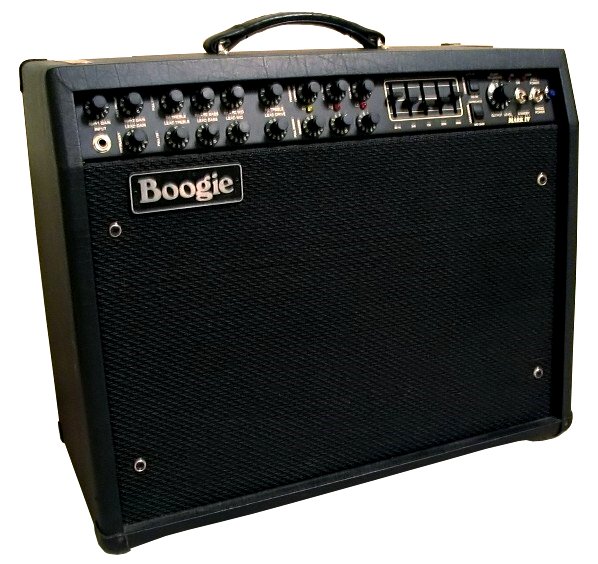
The Mark Series is a line of guitar amplifiers designed and produced by California-based manufacturer Mesa/Boogie since 1972. The first "Boogies," as they were originally known, were based on a Fender Princeton modified by company founder Randall Smith to produce more power and gain. The resulting production model, the Mark I, was popularized by guitarists like Carlos Santana and Keith Richards and helped establish Mesa/Boogie as a brand. A Mark II model followed, introducing amplifier milestones like channel switching and effects loops. The line experienced a sea change in 1983 with the Mark IIC+ variant, which revoiced the amp for more aggression and midrange and tighter lows. Metallica would famously use the IIC+ on Master of Puppets, a major factor in it later becoming one of the industry's most coveted vintage amp models. Despite its success, the IIC+ was only produced for little more than a year. The Mark series, with its constantly-expanding feature set, maintained its status as Mesa/Boogie's flagship offering through Mark III and Mark IV iterations, before being supplanted by the Rectifier series in the early 1990s. Mesa/Boogie has since released Mark V and Mark VII models, as well as a John Petrucci signature version and a IIC+ reissue.
Randall Smith began Mesa/Boogie with a practical joke: he borrowed a Fender Princeton (a small 12-watt amplifier) from his friend, Barry Melton of Country Joe and the Fish, and "hotrodded" it by replacing the amplifier section with a powerful Fender Bassman amp and installing a 12-inch speaker instead of the original 10-inch. The resulting amplifier proved to be loud and successful, and Smith made more than 200 of these Princeton "Boogies" - a name allegedly provided by Carlos Santana, who is to have exclaimed "Man, that little thing really boogies!".
A second important improvement was in developing an extra gain stage for the guitar input. Smith added an extra tube gain stage to the preamp, with three variable gain controls at different points in the circuit (this is now called a "cascaded" design), creating the first high-gain amplifier. He set about designing a guitar amplifier around the new principle, and in 1972 the Mark I was released.
One of the more notable amps in the series was built in 1977, with serial number A804: this is the amp built for Keith Richards, the first one in a long collaboration between Smith and the Rolling Stones, a collaboration which started somewhat inauspiciously when the Stones manager asked Smith for some free amps ("We're the Rolling Stones; we don't pay for amps"), and Smith refused. (Richards had played Santana's Boogie and decided he wanted one too.) Finally, Smith talked to Richards and they agreed that he would send them an amp, and that the Stones would pay for it or return it. Richards ended up using the amp for the El Mocambo show (as one of six), and the Stones, over the years, received and paid for over forty of Smith's amps.
The first Boogies are referred to as Mark I's, though they were not given this name until the Mark II was released. They were 60 or 100 watt combo amps with a 12-inch speaker, primarily Altec-Lansing 417-8H Series II. The Mark I had two channels: The "Input 2" channel, voiced like the Fender Bassman, and the high gain "Input 1" channel, which produced the overdriven "Boogie lead" sound used most notably by Carlos Santana on side 2 of Caravanserai, and by The Rolling Stones' Keith Richards and Ron Wood, who used the amps (and Boogie MKIIB Colosseum amps) live and in the studio from 1977 until 1998. Examples of this amp in its original form and in good condition are sought after by collectors and guitar aficionados. Reverb was optional, and not present on many early Boogies. Later, Mark I models were available with reverb and/or graphic EQ.
The S.O.B. was introduced in the Mark IIC era. These amps were made from May 1982 to December 1985. Serial numbers started with 0100 and ended on 2390. This was Mesa/Boogie's first attempt at having a reissue of the Mark I. It had two cascading gain inputs and its controls were Volume(gain) 1, Volume(gain) 2, Master, Treble, Bass, Middle, Limit or Presence (depending on the version). No foot-switching available, however an A/B splitter pedal could be used to select input 1 or input 2 separately. There was also a reverb option which came available in the latter units. These amps had a point-to-point wired power section and had large transformers with great headroom. Most were built in a 60 watt version and later a few in the 100 watt. SOB chassis were shared with other heads, but had different front and rear plates. EQ, slider cutouts and other 1/4" jack cutouts can be seen from inside the chassis.
The Mark II introduced channel footswitching. It was not referred to as the "Mark IIA" until the Mark IIB was issued. It was also available as a head (a standalone amplifier), which could be hooked up to a number of different speaker combinations, although a 1x12" cabinet was the most common. The preamp gain on the Mark IIs occurs after the tone controls and so, according to Mesa/Boogie, the IIA has a "tighter, more focused sound" than the Mark I.[citation needed] The Mark IIA's control panel was extended from the Mark I's to include a separate master volume control for the lead mode, and various push/pull switches including Pull Bright, Pull Treble Shift, Pull Gain Boost, a separate Pull Bright for the lead mode, and of course, Pull Lead. The 1/4" jack previously marked "1" was changed to just "Input", and "2" was changed to "Foot Switch." The Mark IIA was a great improvement over the Mark I, however it had a few major flaws that it received criticism for among collectors. The new footswitching system relied on a relay, which made an audible popping noise when switching modes. The reverb circuit was also noise-ridden on some models. The IIA and IIB, and some late-model Mark I amps, used a JFET-based device called fetron in place of the input stage 12AX7 (V1), and included a switch for configuring the amp for either Fetron or 12AX7 operation. The reason for using a fetron was to address some of the problems associated with microphonic 12AX7 tubes in a high-gain situation; its use was later discontinued as newer production tubes were able to withstand the extreme conditions within the amplifier.
The Mark IIB is credited as the first guitar amplifier with a tube-buffered effects loop. However, the loop was placed between two critical gain stages, and tended to overdrive some instrument level effects, and also caused volume pedals to act as remote gain controls for the lead mode. Mesa later implemented a mod that caused the effects loop to become more transparent, and smoothed out the lead channel, similar to the IIC+'s lead channel. More importantly, it marked the introduction of Mesa/Boogie's "Simul-Class" system, where two of the power tubes (always 6L6s) run in class AB pentode while the other two tubes (either 6L6s or EL34s) run in class A triode. In a simul-class amp, running all four tubes generates approximately 75 watts RMS of power; running only the class A tubes produces about 15 watts. Also available were non-simul-class Mark IIBs in both a 60 watt version and a 100 watt version that allowed shifting down to 60 watts by turning off a pair of power tubes.
Hub AI
Mesa/Boogie Mark Series AI simulator
(@Mesa/Boogie Mark Series_simulator)
Mesa/Boogie Mark Series
The Mark Series is a line of guitar amplifiers designed and produced by California-based manufacturer Mesa/Boogie since 1972. The first "Boogies," as they were originally known, were based on a Fender Princeton modified by company founder Randall Smith to produce more power and gain. The resulting production model, the Mark I, was popularized by guitarists like Carlos Santana and Keith Richards and helped establish Mesa/Boogie as a brand. A Mark II model followed, introducing amplifier milestones like channel switching and effects loops. The line experienced a sea change in 1983 with the Mark IIC+ variant, which revoiced the amp for more aggression and midrange and tighter lows. Metallica would famously use the IIC+ on Master of Puppets, a major factor in it later becoming one of the industry's most coveted vintage amp models. Despite its success, the IIC+ was only produced for little more than a year. The Mark series, with its constantly-expanding feature set, maintained its status as Mesa/Boogie's flagship offering through Mark III and Mark IV iterations, before being supplanted by the Rectifier series in the early 1990s. Mesa/Boogie has since released Mark V and Mark VII models, as well as a John Petrucci signature version and a IIC+ reissue.
Randall Smith began Mesa/Boogie with a practical joke: he borrowed a Fender Princeton (a small 12-watt amplifier) from his friend, Barry Melton of Country Joe and the Fish, and "hotrodded" it by replacing the amplifier section with a powerful Fender Bassman amp and installing a 12-inch speaker instead of the original 10-inch. The resulting amplifier proved to be loud and successful, and Smith made more than 200 of these Princeton "Boogies" - a name allegedly provided by Carlos Santana, who is to have exclaimed "Man, that little thing really boogies!".
A second important improvement was in developing an extra gain stage for the guitar input. Smith added an extra tube gain stage to the preamp, with three variable gain controls at different points in the circuit (this is now called a "cascaded" design), creating the first high-gain amplifier. He set about designing a guitar amplifier around the new principle, and in 1972 the Mark I was released.
One of the more notable amps in the series was built in 1977, with serial number A804: this is the amp built for Keith Richards, the first one in a long collaboration between Smith and the Rolling Stones, a collaboration which started somewhat inauspiciously when the Stones manager asked Smith for some free amps ("We're the Rolling Stones; we don't pay for amps"), and Smith refused. (Richards had played Santana's Boogie and decided he wanted one too.) Finally, Smith talked to Richards and they agreed that he would send them an amp, and that the Stones would pay for it or return it. Richards ended up using the amp for the El Mocambo show (as one of six), and the Stones, over the years, received and paid for over forty of Smith's amps.
The first Boogies are referred to as Mark I's, though they were not given this name until the Mark II was released. They were 60 or 100 watt combo amps with a 12-inch speaker, primarily Altec-Lansing 417-8H Series II. The Mark I had two channels: The "Input 2" channel, voiced like the Fender Bassman, and the high gain "Input 1" channel, which produced the overdriven "Boogie lead" sound used most notably by Carlos Santana on side 2 of Caravanserai, and by The Rolling Stones' Keith Richards and Ron Wood, who used the amps (and Boogie MKIIB Colosseum amps) live and in the studio from 1977 until 1998. Examples of this amp in its original form and in good condition are sought after by collectors and guitar aficionados. Reverb was optional, and not present on many early Boogies. Later, Mark I models were available with reverb and/or graphic EQ.
The S.O.B. was introduced in the Mark IIC era. These amps were made from May 1982 to December 1985. Serial numbers started with 0100 and ended on 2390. This was Mesa/Boogie's first attempt at having a reissue of the Mark I. It had two cascading gain inputs and its controls were Volume(gain) 1, Volume(gain) 2, Master, Treble, Bass, Middle, Limit or Presence (depending on the version). No foot-switching available, however an A/B splitter pedal could be used to select input 1 or input 2 separately. There was also a reverb option which came available in the latter units. These amps had a point-to-point wired power section and had large transformers with great headroom. Most were built in a 60 watt version and later a few in the 100 watt. SOB chassis were shared with other heads, but had different front and rear plates. EQ, slider cutouts and other 1/4" jack cutouts can be seen from inside the chassis.
The Mark II introduced channel footswitching. It was not referred to as the "Mark IIA" until the Mark IIB was issued. It was also available as a head (a standalone amplifier), which could be hooked up to a number of different speaker combinations, although a 1x12" cabinet was the most common. The preamp gain on the Mark IIs occurs after the tone controls and so, according to Mesa/Boogie, the IIA has a "tighter, more focused sound" than the Mark I.[citation needed] The Mark IIA's control panel was extended from the Mark I's to include a separate master volume control for the lead mode, and various push/pull switches including Pull Bright, Pull Treble Shift, Pull Gain Boost, a separate Pull Bright for the lead mode, and of course, Pull Lead. The 1/4" jack previously marked "1" was changed to just "Input", and "2" was changed to "Foot Switch." The Mark IIA was a great improvement over the Mark I, however it had a few major flaws that it received criticism for among collectors. The new footswitching system relied on a relay, which made an audible popping noise when switching modes. The reverb circuit was also noise-ridden on some models. The IIA and IIB, and some late-model Mark I amps, used a JFET-based device called fetron in place of the input stage 12AX7 (V1), and included a switch for configuring the amp for either Fetron or 12AX7 operation. The reason for using a fetron was to address some of the problems associated with microphonic 12AX7 tubes in a high-gain situation; its use was later discontinued as newer production tubes were able to withstand the extreme conditions within the amplifier.
The Mark IIB is credited as the first guitar amplifier with a tube-buffered effects loop. However, the loop was placed between two critical gain stages, and tended to overdrive some instrument level effects, and also caused volume pedals to act as remote gain controls for the lead mode. Mesa later implemented a mod that caused the effects loop to become more transparent, and smoothed out the lead channel, similar to the IIC+'s lead channel. More importantly, it marked the introduction of Mesa/Boogie's "Simul-Class" system, where two of the power tubes (always 6L6s) run in class AB pentode while the other two tubes (either 6L6s or EL34s) run in class A triode. In a simul-class amp, running all four tubes generates approximately 75 watts RMS of power; running only the class A tubes produces about 15 watts. Also available were non-simul-class Mark IIBs in both a 60 watt version and a 100 watt version that allowed shifting down to 60 watts by turning off a pair of power tubes.