Hubbry Logo
MeskhenetMeskhenetMain
Open search
Meskhenet
Community hub
Meskhenet
logo
8 pages, 0 posts
0 subscribers
Be the first to start a discussion here.
Meskhenet
Meskhenet
from Wikipedia
Meskhenet
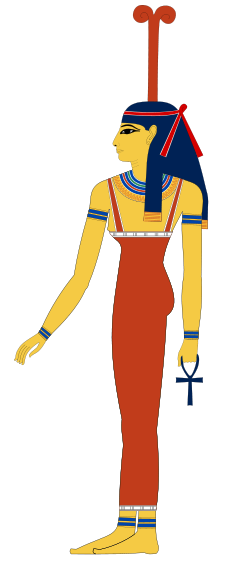
Meskhenet as a woman with a symbolic cow's uterus (Peseshkef) on her head
SymbolCow's uterus

In ancient Egyptian mythology, Meskhenet, (also spelt Mesenet, Meskhent, and Meshkent) was the goddess of childbirth, and the creator of each child's Ka, a part of their soul, which she breathed into them at the moment of birth. She was worshipped from the earliest of times by Egyptians.

In mythology

[edit]

In ancient Egypt, women delivered babies while squatting on a pair of bricks, known as "birth bricks", and Meskhenet was the goddess associated with this form of delivery.[1][2] Consequently, in art, she was sometimes depicted as a brick with a woman's head, wearing a cow's uterus upon it.[3] At other times she was depicted as a woman with a symbolic cow's uterus on her headdress.[3]

Since she was responsible for creating the Ka, she was associated with fate.[citation needed] Thus later she was sometimes said to be paired with Shai, who became a god of destiny after the deity evolved out of an abstract concept.[3]

Meskhenet features prominently in the last of the folktales in the Westcar Papyrus.[2] The story tells of the birth of Userkaf, Sahure, and Neferirkare Kakai, the first three kings of the Fifth Dynasty, who in the story are said to be triplets.[2] Just after each child is born, Meskhenet appears and prophesies that he will become king of Egypt.[2][4]

[edit]

See also

[edit]

References

[edit]
[edit]
Revisions and contributorsEdit on WikipediaRead on Wikipedia
from Grokipedia
Meskhenet was an ancient Egyptian goddess primarily associated with childbirth, serving as a divine midwife who protected women during labor and shaped the destiny of newborns by breathing their ka—a vital part of the soul—into them at birth. She personified the meskhenet birth bricks, upon which squatting mothers delivered their babies, and was often depicted as an anthropomorphic brick topped with a woman's head, symbolizing stability and support in the birthing process. In , Meskhenet frequently appeared alongside deities like , , Heket, and to assist in significant births, such as the triplets of Rudjedet in the Westcar, where she entered the birthing room disguised as a dancer and proclaimed the children's royal futures. Her role extended to funerary contexts, where she announced the fate of the deceased and was linked to rituals like the "Opening of the Mouth" ceremony, ensuring spiritual nourishment in the . Meskhenet's iconography emphasized and : she wore a headdress resembling a bovine , evoking the womb and life's generative power, and was associated with tools like the peseshkef—a flint knife shaped like a or cow used to sever the , warding off evil during delivery. She also held symbols such as the menat necklace and , instruments that doubled as protective amulets resembling uterine forms to safeguard mother and child. Archaeological evidence, including a rare 3,700-year-old painted from South Abydos (ca. 1750–1700 BCE), underscores her enduring cult from the Middle Kingdom onward, blending everyday birthing practices with divine intervention.

Name and Etymology

Hieroglyphic Writing

The hieroglyphic name of the Meskhenet is typically transliterated as msḫn.t and rendered using a combination of phonetic and ideographic signs, including the stylized bovine (Gardiner F31, representing the place of birth), folded cloth (S29, phonetic s), seated (Aa1, indicating ), water ripple (N35, phonetic n), single stroke or bread loaf (X1, phonetic t), and on a standard (G7, for a ). This directly evokes her identity as the deified birth brick (msḫn.t), a upon which women squatted during labor, symbolizing the locus of delivery and the of life. In Old Kingdom texts, such as the Pyramid Texts, the name appears as msḫnt with a more concise form relying heavily on the core ideogram F31 and basic phonetics, without extensive complements, as in Utterance 244 where it denotes the protective role in emergence and birth. By the New Kingdom, spellings show greater elaboration, often incorporating additional phonetic complements like extra n or t signs (e.g., N35 repeated or X1 doubled) for clarity, alongside variant determinatives such as the house (O39) when emphasizing her abode-like aspect, though the uterus ideogram F31 persists as the central element. These evolutions align with broader trends in Egyptian orthography toward increased phonetic specification in later periods while preserving the name's ties to childbirth architecture.

Linguistic Meaning

The name Meskhenet derives from the ancient Egyptian word msḫn.t, which literally translates to "birth brick" or "brick of birth," referring to the upon which women squatted during labor to support delivery. This term encapsulates the physical object central to Egyptian childbirth practices, where such bricks were placed on the floor of the birthing chamber, often inscribed with protective spells to ensure safe delivery and the newborn's vitality. The goddess Meskhenet embodies the of this brick, transforming a mundane architectural element into a divine entity overseeing the transition from womb to world. Her name thus implies an inherent connection to destiny, as the moment of birth on the msḫn.t marked the inception of one's fate, often decreed by the goddess alongside Shai, the personification of lifespan and lot.

Iconography and Depictions

Common Forms

Meskhenet is most commonly represented in as an anthropomorphic figure with a distinctive flat-topped head modeled after a birth brick (meskhenet), the platform used to support women during labor. This form often shows her in a or position, evoking the act of and underscoring her identity as the deified birthing place. The headdress or head shape directly references these bricks, which were essential to delivery practices from the Middle Kingdom onward. Another prevalent depiction portrays Meskhenet as a birth itself, with a woman's head emerging from the top, sometimes adorned with a headdress of two curved loops symbolizing a cow's . This uterine motif, resembling stylized cow horns, highlights her connections to and maternal protection without fully transforming her into a bovine figure. While cow-headed representations are uncommon for Meskhenet specifically, her uterine headdress merges with broader iconography to emphasize life-giving qualities. Specific artifacts illustrate these forms vividly. In the reliefs of Hatshepsut's at Deir el-Bahri (Eighteenth Dynasty), Meskhenet appears in the divine birth sequence as a brick-headed woman, assisting in the queen's delivery and holding the newborn while proclaiming her destiny. Similarly, a Late Middle Kingdom decorated birth from South Abydos (ca. 1750–1700 BCE) features protective imagery tied to her personification, though not a direct statue.

Symbolic Associations

Meskhenet’s primary symbol is the birth brick, or meskhenet, a mud-brick platform used to support women squatting during labor in ancient Egyptian childbirth practices. This symbol directly embodies her function as a divine midwife and protector of the birthing process, transforming a mundane architectural element into a sacred emblem of safe delivery and maternal support. The brick’s significance extended beyond the physical, representing stability and divine intervention to ward off dangers during birth, as evidenced by a rare decorated example from South Abydos (ca. 1750–1700 BCE) featuring apotropaic imagery of protective deities and a mother with newborn, highlighting its role in magical rituals to ensure successful outcomes. Closely tied to her identity, Meskhenet was revered as the creator of the ka, the vital soul or life force, which she instilled into newborns by breathing it into them at birth. This act symbolized the bestowal of essential vitality and destiny upon the child, linking her to the fundamental animation of human existence and reinforcing her protective guardianship over new life. In artistic representations, this life-giving role is implied through her frequent depiction alongside other birth deities, emphasizing the infusion of the soul as a core aspect of her symbolic domain. Additional symbols associated with Meskhenet include her distinctive headdress resembling a cow’s uterus, often rendered as two loops atop a vertical stroke, which underscored her connection to fertility and the reproductive process. This emblem, appearing in her anthropomorphic forms, highlighted the organic, life-bearing aspects of childbirth unique to her cult. She was also associated with the peseshkef, a flint knife shaped like a fish tail or cow uterus used to sever the umbilical cord and ward off evil during delivery. Additionally, Meskhenet held symbols such as the menat necklace and sistrum, musical instruments that doubled as protective amulets resembling uterine forms to safeguard mother and child.

Role in Mythology

Association with Childbirth

Meskhenet was a of in ancient , functioning as a divine who facilitated the delivery process and safeguarded both the mother and the newborn during labor. Her protective role extended to easing the pains of labor and ensuring the safe arrival of the child, often invoked alongside other deities to avert complications. In this capacity, she was depicted as providing strength and support to the birthing mother, embodying the supportive structure essential to the act of delivery. A key mythological narrative illustrating her involvement appears in the Papyrus Westcar, a Middle Kingdom text recounting the birth of the first three kings of the Fifth Dynasty. In the story, Meskhenet, along with , , , and —who were disguised as musicians—assists the priest's wife Rudjedet in delivering triplets after a difficult labor. After the infant is washed, she proclaims their royal destiny, highlighting her direct participation in the physical and ritual aspects of childbirth. This tale underscores her role in not only aiding the delivery but also in the immediate postnatal care that protected the vulnerable newborn. Meskhenet was also regarded as the creator of the child's ka, the vital life force or spiritual double, which she instilled into the newborn immediately after birth to animate and sustain it. This act symbolized the infusion of essential vitality, linking her to the very essence of life emerging from the womb. Her association with the ka tied her to the miraculous moment of transition from womb to world, ensuring the infant's spiritual wholeness alongside physical protection. This mythological function mirrored real birthing practices in ancient Egypt, where women typically squatted over special bricks known as meskhenet—named after the goddess—to support them during labor. These bricks were placed in homes or birthing areas to invoke her presence, blending divine protection with practical aid in the labor process.

Connection to Fate and Destiny

In ancient Egyptian mythology, Meskhenet functioned as the divine proclaimer of a newborn's destiny, determining the essential character and life path through the creation and infusion of the ka, the vital spiritual force that shaped an individual's fate from the moment of birth. This role positioned her within a conceptual triad alongside Renenutet, the goddess of nourishment and secret names who ensured the child's rearing and true identity, and Shai, the personification of overarching fate who governed lifespan and fortune; together, they formed a collective arbiter of human potential and inevitable outcomes, reflecting the Egyptians' belief in predestined yet divinely orchestrated lives. A prominent mythological depiction of Meskhenet's prophetic authority appears in the , a Middle Kingdom narrative recounting the birth of three future Fifth Dynasty kings—, , and —to the priest's wife Rudjedet. In this tale, sent by the sun god Re, Meskhenet arrives with , , , and to assist the delivery; upon the birth of each child, she lifts the infant aloft and declares their royal destiny, proclaiming the first as one who would "exercise kingship in this land" and similarly affirming the others' thrones, thus weaving into the fabric of royal legitimacy. This episode underscores her as an of fate, bridging the immediate act of birth with long-term cosmic order. Meskhenet's influence extended symbolically into the , where her birth-assigned destiny informed the soul's , occasionally portraying her presence near the scales of Ma'at during the weighing of the heart to affirm the deceased's inherent character against their earthly deeds. Evidence from the further hints at this extension, with utterance 667C invoking her aid in the king's posthumous and renewal, suggesting a continuity of her fateful role from earthly to eternal rebirth. In funerary contexts, such as the Halls of Ma'at, she testified alongside and to the soul's predestined essence, ensuring that the ka she had breathed into life endured in the .

Worship and Cult

Primary Sites

Meskhenet lacked dedicated major temples throughout ancient Egyptian history, with her veneration instead integrated into broader fertility and childbirth cults within larger temple complexes and domestic settings. Her worship emphasized protective roles in birth rituals, often alongside deities like , , and , reflecting a decentralized focused on symbolic and functional spaces rather than monumental architecture. In the Ptolemaic period, Meskhenet became prominently associated with birth houses, or mammisi, auxiliary structures within temple precincts dedicated to the miraculous births of gods. At the Temple of in , she participated in divine birth scenes depicted in reliefs and inscriptions. In later traditions, she was syncretized with forms of Nut or as Meskhenet-aat and Meskhenet-weret, underscoring her role in royal and divine nativity myths. Similarly, at the Temple complex in , multiple forms of Meskhenet appear in the mammisi of , including Meskhenet the Great in the Mound of Birth and Meskhenet the Beautiful in the Place of Nativity, as evidenced by wall inscriptions linking her to the protective enclosure of divine parturition. These Late Period integrations highlight her evolving significance in temple cosmology, where mammisi served as ritual spaces for celebrating fertility and kingship. Additional centers of veneration included the temple at , where a describes four Meskhenets assisting the creator god , and the Osiris temple complex at Abydos, featuring four Meskhenets in rebirth rituals. Archaeological evidence for earlier veneration dates to the Old and Middle Kingdoms, primarily through textual references and artifacts rather than temple structures. In the Memphis region, including the Saqqara necropolis, Meskhenet features in Pyramid Texts from the Fifth Dynasty onward, such as Utterance 667, where she aids in the rebirth of the deceased king, indicating her incorporation into funerary and fertility practices at this political and cultic center. At Abydos, a decorated birth brick discovered in a Middle Kingdom mayoral residence at South Abydos bears imagery of childbirth deities like Hathor and protective figures, associating such artifacts with domestic birth rituals and suggesting localized veneration tied to elite households rather than formal sanctuaries. Evidence for freestanding statues of Meskhenet from Old Kingdom Memphis is lacking, but her presence in these contexts underscores an early, embedded role within Osirian and solar fertility traditions at key necropolises.

Rituals and Practices

In ancient Egyptian religious practices, Meskhenet was invoked through the use of protective amulets and spoken spells during labor to safeguard mothers and newborns. Birth bricks, often inscribed with images of protective deities and hieroglyphic formulas, functioned as potent amulets symbolizing Meskhenet's presence; these unfired mud bricks, measuring around 36 cm in length, were positioned to support the and imbued with magical imagery to ensure safe delivery and ward off harm. Spells recited during drew on Meskhenet's role as divine , calling upon her alongside goddesses like and Heket to accelerate labor and protect against complications, as evidenced in obstetric magical texts that mirrored divine assistance narratives. Additionally, Chapter 151 of the provided incantations for four magical bricks placed in tombs, symbolically linking to birth bricks and invoking Meskhenet's protective power for rebirth, a practice that paralleled living rituals by ensuring the soul's safe passage. Offerings dedicated to Meskhenet as were commonly presented in birth houses, specialized temple annexes associated with and delivery. These included votive items such as clay figurines and inscribed bricks honoring her, placed to invoke her aid in the birthing process; such offerings reinforced her role in supporting labor, often alongside standard temple gifts like bread and milk to sustain divine favor. The birth bricks themselves served as objects, sometimes offered or positioned within these spaces to embody Meskhenet's essence and facilitate protection during ceremonies. Meskhenet held a prominent place in royal birth rituals, where she was invoked to bless and protect the pharaoh's heirs. In temple reliefs, such as those at Deir el-Bahri depicting Queen Hatshepsut's divine birth (c. 1479–1458 BCE), Meskhenet appears among the assisting deities, pronouncing the child's royal fate and ensuring legitimacy through her presence. These ceremonies, attended by reciting spells, integrated Meskhenet's protective invocations to affirm the heir's destined kingship, drawing on her authority over to legitimize succession.

Historical Development

Origins and Evolution

Meskhenet emerged as a distinct associated with during (c. 2686–2181 BCE), embodying the practical and symbolic role of the birth used in ancient Egyptian delivery practices, where women squatted on bricks for support and protection during labor. Her conceptualization likely drew from earlier and protective elements in Egyptian religious traditions, though no dedicated cult centers are attested before this period. By the Middle Kingdom (c. 2050–1710 BCE), Meskhenet appeared prominently in literary texts such as the Papyrus Westcar, where she acts as a divine sent by the sun god Re to assist in the birth of Rudjedet's triplets, future kings of the Fifth Dynasty, alongside deities like , , Heket, and . In this narrative, she not only facilitates the delivery but also pronounces the newborns' royal destinies, highlighting her evolving association with fate determination at birth. Her role expanded to include the creation of the ka, the vital life force, which she was believed to breathe into infants. During the New Kingdom (c. 1550–1070 BCE), Meskhenet's significance grew in royal iconography and mythology, as seen in the birth reliefs at Hatshepsut's at Deir el-Bahri, where she oversees the divine birth of the and holds the symbol of life. This period marked a shift in her roles, with functions overlapping those of and in protecting mothers and newborns, and occasionally aligning with the cycle in pronouncing fate, reflecting broader integrations in the pantheon. She also began appearing in funerary contexts, such as the , where she aids in the soul's rebirth and testifies in the judgment hall. In the Late Period (c. 664–332 BCE) and beyond, Meskhenet's prominence waned amid shifting religious emphases, but she persisted in protective roles, sometimes identified as a consort of , a god of rebirth in the who was later assimilated to , extending her influence from birth to the . References in Demotic texts and magical practices underscore her continued cultural adaptation, particularly in household rituals for safety.

Evidence in Texts and Artifacts

One of the earliest literary references to Meskhenet appears in the Westcar Papyrus, a Middle Kingdom document (c. 2000–1800 BCE) containing tales of magic and prophecy. In the final story, the sun god Re dispatches Meskhenet alongside Isis, Nephthys, Heqet, and Khnum to assist the noblewoman Rudjedet in labor with triplets destined to become kings of Egypt. Disguised as musicians, the deities enter Rudjedet's home, and after the births, Meskhenet approaches each newborn, proclaiming their royal fate: "This one will be a king who will rule over the Black Land [Egypt]," repeated for Userkaf, Sahure, and Neferirkare Kakai of the Fifth Dynasty. A key archaeological artifact attesting to Meskhenet's cult is a rare painted birth brick discovered at South Abydos, dated ca. 1750–1700 BCE. This terracotta brick, measuring approximately 36 cm long, features images of and a in labor, with inscriptions invoking protection during , directly linking to Meskhenet's role as the personification of the birth brick. During the New Kingdom (c. 1550–1070 BCE), Meskhenet is attested in inscriptions and depictions on birth-related artifacts, particularly from the workers' village of , where she was invoked for protection during . Birth bricks (meskhenet), molded from mud and often stamped or painted with her image as a with a brick-shaped headdress, supported laboring mothers and symbolized her presence; examples from this site include a stela mentioning sitting on bricks in labor contexts linked to Meskhenet, and terracotta bricks inscribed with protective formulae naming her to ward off dangers to mother and child. Amulets of or stone, depicting Meskhenet in human or hybrid form, were worn by pregnant women and placed in tombs, such as a wooden stool frame from the tomb of Sennedjem (TT 1) bearing the direct inscription "Meskhenet," linking her to both earthly births and funerary renewal. In funerary contexts, the Coffin Texts (c. 2100–1800 BCE), a collection of spells inscribed on Middle Kingdom coffins to facilitate the deceased's rebirth, invoke the birth-brick (meskhenet), personified by the goddess, as a divine seat for transformation. For instance, Spell 159, titled "Going In and Out of the Birth-Brick," invokes the process: "I have come forth from the birth-brick; I sit upon the birth-brick which is under the buttocks of the Great Wild Cow [Hathor/Isis]; I am the guardian of the birth-brick of the sky." Similarly, Spell 161 describes the deceased emerging anew: "O you birth-brick of the gods, lift me up! I am this spirit who is upon the birth-brick," equating the ritual platform with Meskhenet's protective agency in mimicking cosmic birth for the afterlife.

References

Add your contribution
Related Hubs
User Avatar
No comments yet.