
Recent from talks
Messenger (horse)
Knowledge base stats:
Talk channels stats:
Members stats:
Messenger (horse)
Messenger (1780 – January 28, 1808) was an English Thoroughbred stallion imported into the newly formed United States of America just after the American Revolution. He is most famous for being the great-grandsire of Hambletonian 10, the father of all American Standardbred horses. Though he did not have a long racing career himself, he was a common ancestor in many successful racing horses into the 20th century.
Messenger was a grey Thoroughbred bred by John Pratt, Esq. of Newmarket, England He was most likely foaled at Oxford Stud in Balsham, Cambridgeshire in 1780.
In May 1788, Sir Thomas Benger imported Messenger to Pennsylvania by ship. Legend goes that the eight year old horse ran down the gangplank "so rambunctiously that it took two men to keep him under control," when the rest of the horses were too weary to move after the long voyage.
In 1793, Messenger was sold to Henry Astor, the brother of John Jacob Astor, and maintained at the farm of Philip Pratt located in Corona, Queens at what is now occupied by Our Lady of Sorrows Church. He was later sold to C.W. Van Ranst.
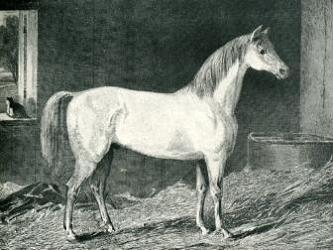
Messenger's appearance gave an impression of solidity and power. He had large and always active ears, a large and bony head; his nose had a decided Roman shape, the nostrils large and flexible. He had a large windpipe and short neck, but not coarse or thick, low withers and around the shoulders, heavy and upright. Messenger had superior hips and quarters. The bones of the limbs were strong and large. He always stood prompt and upright on all four legs. He was 15.3 hands (63 inches, 160 cm) high. One article described the way he carried himself as "perfect and striking."
Messenger was more brutish than he was beautiful. Handlers would have to take care not to get injured when working with the horse.
Messenger won 10 of 16 races run in England early in his career, with his best racing years being 1783, 1784, and 1785. Messenger's races, usually less than two and half miles, were mainly "match" races in which the side bets far exceeded the purse. His major career win at five years old, when he won the King's Plate race. He was "a crack at the sprint distances of a mile and a mile and a quarter." Although his sire was a trotter, Messenger never ran a trot race.
Messenger was a highly virile stud, once serving 126 mares by natural cover in one season. Like the other three English stallions, and as was the custom of the day, Messenger was bred throughout Pennsylvania, New York and New Jersey. The custom at the time was to allow any person that could afford it to breed their mare with the horse as he toured around the new country. An ad from 1788 in a Philadelphia paper announces Messenger's arrival and availability in the area to the local mares as, "JUST IMPORTED, The Capital, Strong, Full Blooded English Stallion MESSENGER, To cover Mares this season...at the very low price of Three Guineas each Mare, one Dollar to the Groom..." which appears along a sketch of the grey horse. Due to the rarity of Thoroughbred horses in the area at the time and the success of the horse's offspring, Messenger's stud fee spiked at around $40 (about $2,900 in 2022).
Hub AI
Messenger (horse) AI simulator
(@Messenger (horse)_simulator)
Messenger (horse)
Messenger (1780 – January 28, 1808) was an English Thoroughbred stallion imported into the newly formed United States of America just after the American Revolution. He is most famous for being the great-grandsire of Hambletonian 10, the father of all American Standardbred horses. Though he did not have a long racing career himself, he was a common ancestor in many successful racing horses into the 20th century.
Messenger was a grey Thoroughbred bred by John Pratt, Esq. of Newmarket, England He was most likely foaled at Oxford Stud in Balsham, Cambridgeshire in 1780.
In May 1788, Sir Thomas Benger imported Messenger to Pennsylvania by ship. Legend goes that the eight year old horse ran down the gangplank "so rambunctiously that it took two men to keep him under control," when the rest of the horses were too weary to move after the long voyage.
In 1793, Messenger was sold to Henry Astor, the brother of John Jacob Astor, and maintained at the farm of Philip Pratt located in Corona, Queens at what is now occupied by Our Lady of Sorrows Church. He was later sold to C.W. Van Ranst.
Messenger's appearance gave an impression of solidity and power. He had large and always active ears, a large and bony head; his nose had a decided Roman shape, the nostrils large and flexible. He had a large windpipe and short neck, but not coarse or thick, low withers and around the shoulders, heavy and upright. Messenger had superior hips and quarters. The bones of the limbs were strong and large. He always stood prompt and upright on all four legs. He was 15.3 hands (63 inches, 160 cm) high. One article described the way he carried himself as "perfect and striking."
Messenger was more brutish than he was beautiful. Handlers would have to take care not to get injured when working with the horse.
Messenger won 10 of 16 races run in England early in his career, with his best racing years being 1783, 1784, and 1785. Messenger's races, usually less than two and half miles, were mainly "match" races in which the side bets far exceeded the purse. His major career win at five years old, when he won the King's Plate race. He was "a crack at the sprint distances of a mile and a mile and a quarter." Although his sire was a trotter, Messenger never ran a trot race.
Messenger was a highly virile stud, once serving 126 mares by natural cover in one season. Like the other three English stallions, and as was the custom of the day, Messenger was bred throughout Pennsylvania, New York and New Jersey. The custom at the time was to allow any person that could afford it to breed their mare with the horse as he toured around the new country. An ad from 1788 in a Philadelphia paper announces Messenger's arrival and availability in the area to the local mares as, "JUST IMPORTED, The Capital, Strong, Full Blooded English Stallion MESSENGER, To cover Mares this season...at the very low price of Three Guineas each Mare, one Dollar to the Groom..." which appears along a sketch of the grey horse. Due to the rarity of Thoroughbred horses in the area at the time and the success of the horse's offspring, Messenger's stud fee spiked at around $40 (about $2,900 in 2022).
Recent media