



Community hub
Recent from talks
Knowledge base stats:
Talk channels stats:
Members stats:
Messerschmitt Me 209
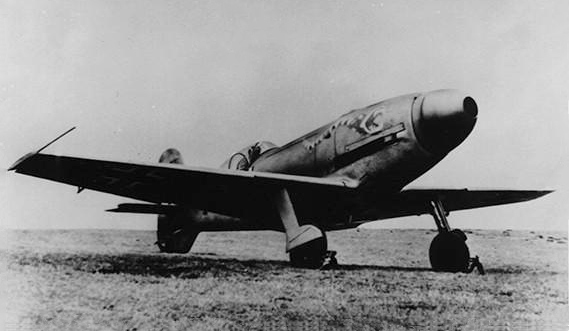
The first Messerschmitt Me 209 was a single-engine racing aircraft designed and produced by the German aircraft manufacturer Messerschmitt. It successfully established several new speed records.
The design work on what was originally designated P.1059 commenced in 1937; the Me 209 was a completely original aircraft whose sole purpose was to set new international speed records. As originally built, it has a relatively compact airframe, incorporated a steam cooling system, a unique cross-shaped tail section, and lacked any armaments. On 1 August 1938, Me 209 V1 conducted its maiden flight; a further three prototypes would be completed by May 1939. On 26 April 1939, this same aircraft established a new international speed record of almost 756 km/h (469 mph); this record was not officially broken by another piston-engined aircraft until 16 August 1969.
In addition to the Me 209 designation, the type was also assigned the Me 109R designation for propaganda purposes as part of an effort to conflate the aircraft with the Messerschmitt Bf 109, the Luftwaffe's primary fighter throughout the Second World War; it was hoped that the Me 109R designation would cause its accomplishments to be associated or confused with the Bf 109. Despite using the same Daimler-Benz DB 601 inline engine, the Me 209 and Bf 109 had little in common with one another. Messerschmitt undertook some work to adapt the Me 209 into a combat-capable fighter, but it proved to be inferior to the existing Bf 109 in this role, and this was never produced in quantity. The Me 209 designation was subsequently reused for a wholly separate aircraft that was the proposed successor to the Bf 109.
Throughout much of the 1930s, various high-ranking officials within Germany advocated for the demonstration of supposed German superiority, particularly in the aviation sector, which benefitted greatly from state backing in the form of numerous development and production contracts. Some of these contracts were aimed at boosting national prestige as well as advancing Germany's aeronautical capabilities, such as the establishment of new international aviation records. It was within these active trends that the aircraft manufacturer Messerschmitt embarked on the P.1059, a clean-sheet aircraft designed solely to perform high speed flights with the specific object of setting a new absolute speed record.
During 1937, design work formally commenced, headed by the German aeronautical engineer Willy Messerschmitt. Prior to the year's end, the construction of three prototypes had commenced, by which point the aircraft had been officially designated as the Me 209.
In terms of its basic configuration, the Me 209 was a compact low-wing monoplane that was designed around a specially-produced model of the Daimler-Benz DB 601 inline engine (early flights were performed with conventional models of the DB 601). While this engine produced up to 1,800 hp under most circumstances, it could be temporarily boosted to 2,300 hp in limited bursts for additional acceleration. While the Me 209 did share a few elements, such as the DB 601 engine, with the Messerschmitt Bf 109 fighter aircraft, it was a completely separate aircraft and had many differences. One of the more atypical feature of the Me 209 was its use of a steam cooling system, which facilitated the elimination of traditional radiator-based cooling and the resulting aerodynamic drag incurred. This system involved stored water being piped through the engine, where it absorbed heat, after which it travelled to the wings where it was cooled down before being circulated around again. Due to the constant loss of water (between 4.5 litres and 7 litres per minute), the engine could only be run for up to 30 minutes at a time.
Considerable efforts were made into minimising the equipment fitted as well as having the airframe be as small as was feasibly possible. The cockpit of the Me 209 was positioned relatively rearwards in relation to the fuselage, just forward of its unique cross-shaped tail section. Both the tailplane and elevators had a relatively small area while the fin featured a substantial ventral section. The wing's design, which aimed to minimise the wing area, resulted in relatively high wing loading of the era. While these aspects favoured the Me 209's speed capabilities, they also increased the pilot's difficulty in flying it.
Unlike the Bf 109, the Me 209 featured a wide track, inwardly-retracting undercarriage that was mounted in the wing section. There was seemingly little consideration given towards its potential use in combat.
Hub AI
Messerschmitt Me 209 AI simulator
(@Messerschmitt Me 209_simulator)
Messerschmitt Me 209
The first Messerschmitt Me 209 was a single-engine racing aircraft designed and produced by the German aircraft manufacturer Messerschmitt. It successfully established several new speed records.
The design work on what was originally designated P.1059 commenced in 1937; the Me 209 was a completely original aircraft whose sole purpose was to set new international speed records. As originally built, it has a relatively compact airframe, incorporated a steam cooling system, a unique cross-shaped tail section, and lacked any armaments. On 1 August 1938, Me 209 V1 conducted its maiden flight; a further three prototypes would be completed by May 1939. On 26 April 1939, this same aircraft established a new international speed record of almost 756 km/h (469 mph); this record was not officially broken by another piston-engined aircraft until 16 August 1969.
In addition to the Me 209 designation, the type was also assigned the Me 109R designation for propaganda purposes as part of an effort to conflate the aircraft with the Messerschmitt Bf 109, the Luftwaffe's primary fighter throughout the Second World War; it was hoped that the Me 109R designation would cause its accomplishments to be associated or confused with the Bf 109. Despite using the same Daimler-Benz DB 601 inline engine, the Me 209 and Bf 109 had little in common with one another. Messerschmitt undertook some work to adapt the Me 209 into a combat-capable fighter, but it proved to be inferior to the existing Bf 109 in this role, and this was never produced in quantity. The Me 209 designation was subsequently reused for a wholly separate aircraft that was the proposed successor to the Bf 109.
Throughout much of the 1930s, various high-ranking officials within Germany advocated for the demonstration of supposed German superiority, particularly in the aviation sector, which benefitted greatly from state backing in the form of numerous development and production contracts. Some of these contracts were aimed at boosting national prestige as well as advancing Germany's aeronautical capabilities, such as the establishment of new international aviation records. It was within these active trends that the aircraft manufacturer Messerschmitt embarked on the P.1059, a clean-sheet aircraft designed solely to perform high speed flights with the specific object of setting a new absolute speed record.
During 1937, design work formally commenced, headed by the German aeronautical engineer Willy Messerschmitt. Prior to the year's end, the construction of three prototypes had commenced, by which point the aircraft had been officially designated as the Me 209.
In terms of its basic configuration, the Me 209 was a compact low-wing monoplane that was designed around a specially-produced model of the Daimler-Benz DB 601 inline engine (early flights were performed with conventional models of the DB 601). While this engine produced up to 1,800 hp under most circumstances, it could be temporarily boosted to 2,300 hp in limited bursts for additional acceleration. While the Me 209 did share a few elements, such as the DB 601 engine, with the Messerschmitt Bf 109 fighter aircraft, it was a completely separate aircraft and had many differences. One of the more atypical feature of the Me 209 was its use of a steam cooling system, which facilitated the elimination of traditional radiator-based cooling and the resulting aerodynamic drag incurred. This system involved stored water being piped through the engine, where it absorbed heat, after which it travelled to the wings where it was cooled down before being circulated around again. Due to the constant loss of water (between 4.5 litres and 7 litres per minute), the engine could only be run for up to 30 minutes at a time.
Considerable efforts were made into minimising the equipment fitted as well as having the airframe be as small as was feasibly possible. The cockpit of the Me 209 was positioned relatively rearwards in relation to the fuselage, just forward of its unique cross-shaped tail section. Both the tailplane and elevators had a relatively small area while the fin featured a substantial ventral section. The wing's design, which aimed to minimise the wing area, resulted in relatively high wing loading of the era. While these aspects favoured the Me 209's speed capabilities, they also increased the pilot's difficulty in flying it.
Unlike the Bf 109, the Me 209 featured a wide track, inwardly-retracting undercarriage that was mounted in the wing section. There was seemingly little consideration given towards its potential use in combat.