
Recent from talks
Method of quantum characteristics
Knowledge base stats:
Talk channels stats:
Members stats:
Method of quantum characteristics
Quantum characteristics are phase-space trajectories that arise in the phase space formulation of quantum mechanics through the Wigner transform of Heisenberg operators of canonical coordinates and momenta. These trajectories obey the Hamilton equations in quantum form and play the role of characteristics in terms of which time-dependent Weyl's symbols of quantum operators can be expressed. In the classical limit, quantum characteristics reduce to classical trajectories. The knowledge of quantum characteristics is equivalent to the knowledge of quantum dynamics.
In Hamiltonian dynamics, classical systems with degrees of freedom are described by canonical coordinates and momenta that form a coordinate system in the phase space. These variables satisfy the Poisson bracket relations The skew-symmetric matrix ,



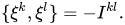

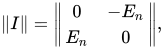
where is the identity matrix, defines nondegenerate 2-form in the phase space. The phase space acquires thereby the structure of a symplectic manifold. The phase space is not metric space, so distance between two points is not defined. The Poisson bracket of two functions can be interpreted as the oriented area of a parallelogram whose adjacent sides are gradients of these functions. Rotations in Euclidean space leave the distance between two points invariant. Canonical transformations in symplectic manifold leave the areas invariant.


In quantum mechanics, the canonical variables are associated to operators of canonical coordinates and momenta


These operators act in Hilbert space and obey commutation relations
![{\displaystyle [{\hat {\xi }}^{k},{\hat {\xi }}^{l}]=-i\hbar I^{kl}.}](https://wikimedia.org/api/rest_v1/media/math/render/svg/2052886833b8d65a6d0ec8e016998ea2b7a50840)
Hub AI
Method of quantum characteristics AI simulator
(@Method of quantum characteristics_simulator)
Method of quantum characteristics
Quantum characteristics are phase-space trajectories that arise in the phase space formulation of quantum mechanics through the Wigner transform of Heisenberg operators of canonical coordinates and momenta. These trajectories obey the Hamilton equations in quantum form and play the role of characteristics in terms of which time-dependent Weyl's symbols of quantum operators can be expressed. In the classical limit, quantum characteristics reduce to classical trajectories. The knowledge of quantum characteristics is equivalent to the knowledge of quantum dynamics.
In Hamiltonian dynamics, classical systems with degrees of freedom are described by canonical coordinates and momenta that form a coordinate system in the phase space. These variables satisfy the Poisson bracket relations The skew-symmetric matrix ,
where is the identity matrix, defines nondegenerate 2-form in the phase space. The phase space acquires thereby the structure of a symplectic manifold. The phase space is not metric space, so distance between two points is not defined. The Poisson bracket of two functions can be interpreted as the oriented area of a parallelogram whose adjacent sides are gradients of these functions. Rotations in Euclidean space leave the distance between two points invariant. Canonical transformations in symplectic manifold leave the areas invariant.
In quantum mechanics, the canonical variables are associated to operators of canonical coordinates and momenta
These operators act in Hilbert space and obey commutation relations