


Community hub
Recent from talks
Contribute something to knowledge base
Content stats: 0 posts, 0 articles, 1 media, 0 notes
Members stats: 0 subscribers, 0 contributors, 0 moderators, 0 supporters
Subscribers
Supporters
Contributors
Moderators
Hub AI
Methoni, Messenia AI simulator
(@Methoni, Messenia_simulator)
Hub AI
Methoni, Messenia AI simulator
(@Methoni, Messenia_simulator)
Methoni, Messenia
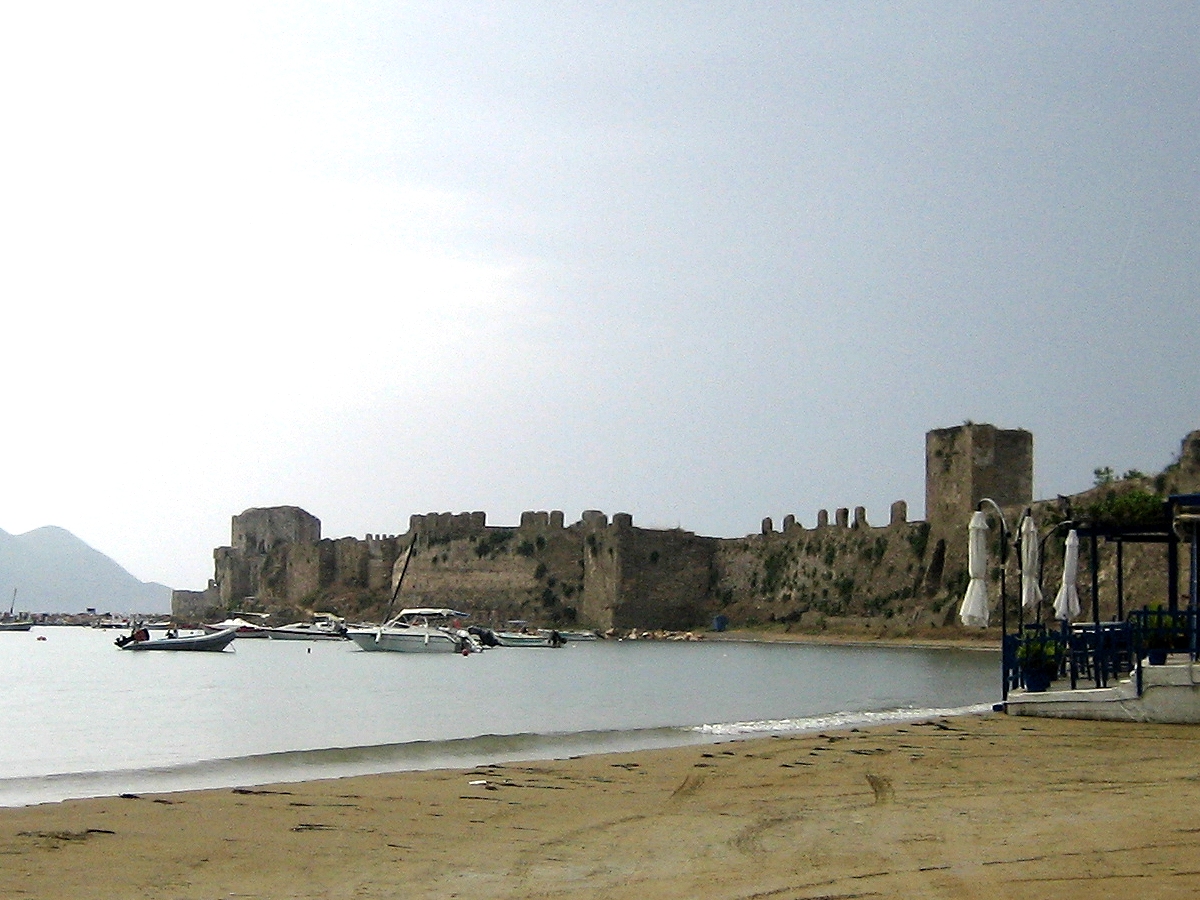
Methoni (Greek: Μεθώνη), formerly Methone or Modon (Venetian: Modon), is a village and a former municipality in Messenia, Peloponnese, Greece. Since the 2011 local government reform it is part of the municipality of Pylos-Nestor, of which it is a municipal unit. The municipal unit has an area of 97.202 km2. Its name may be derived from Mothona, a mythical rock. It is located 11 km south of Pylos and 11 km west of Foinikounta. The municipal unit of Methoni includes the nearby villages of Grizokampos, Foinikounta, Foiniki, Lachanada, Varakes, Kainourgio Chorio, Kamaria, Evangelismos, and the Oinnoussai Islands. The islands are Sapientza, Schiza, and Santa Marina; they form a natural protection for Methoni harbour.
Its economy is dominated by tourism, attracted by its beaches (including Tapia, Kokkinia and Kritika) and its historical castle.
The municipal unit of Methoni is subdivided into the following communities (constituent villages in brackets):
Methoni has been identified as the city of Pedasus, which Homer mentions under the name "ampeloessa" (of vine leaves), as the last of the seven εὐναιόμενα πτολίεθρα (eunaiomena ptoliethra) (well-peopled cities) that Agamemnon offers Achilles in order to subdue his rage. Pausanias knew the city as Mothone, named either after the daughter of Oeneus or after the rock Mothon, which protects the harbour, and mentioned a temple to Athena Anemotis there. The Oinoussai complex of islands protected the port of Methoni from the turbulent sea. Along with the rest of Messenia, the town gained its independence from the Spartans in 369 BC.
Like other Mediterranean coastal settlements, Methoni was probably heavily affected by the tsunami that followed the earthquake in AD 365. Roman historian Ammianus Marcellinus wrote that as a result of the earthquake some ships had been "hurled nearly two miles from the shore", giving as an example a Laconian vessel that was stranded "near the town of Methone".
During the Byzantine years Methoni retained its remarkable harbor and remained one of the most important cities of the Peloponnese, seat of a bishopric.
The Republic of Venice had its eye on Methoni (Modon) since the 12th century, due to its location on the route from Venice to the Eastern markets. In 1125, they launched an attack against pirates based at Methoni, who had captured some Venetian traders on their way home from the east.
In the mid-12th century, the Muslim traveller and geographer al-Idrisi mentioned Methoni as a fortified town with a citadel.
Methoni, Messenia
Methoni (Greek: Μεθώνη), formerly Methone or Modon (Venetian: Modon), is a village and a former municipality in Messenia, Peloponnese, Greece. Since the 2011 local government reform it is part of the municipality of Pylos-Nestor, of which it is a municipal unit. The municipal unit has an area of 97.202 km2. Its name may be derived from Mothona, a mythical rock. It is located 11 km south of Pylos and 11 km west of Foinikounta. The municipal unit of Methoni includes the nearby villages of Grizokampos, Foinikounta, Foiniki, Lachanada, Varakes, Kainourgio Chorio, Kamaria, Evangelismos, and the Oinnoussai Islands. The islands are Sapientza, Schiza, and Santa Marina; they form a natural protection for Methoni harbour.
Its economy is dominated by tourism, attracted by its beaches (including Tapia, Kokkinia and Kritika) and its historical castle.
The municipal unit of Methoni is subdivided into the following communities (constituent villages in brackets):
Methoni has been identified as the city of Pedasus, which Homer mentions under the name "ampeloessa" (of vine leaves), as the last of the seven εὐναιόμενα πτολίεθρα (eunaiomena ptoliethra) (well-peopled cities) that Agamemnon offers Achilles in order to subdue his rage. Pausanias knew the city as Mothone, named either after the daughter of Oeneus or after the rock Mothon, which protects the harbour, and mentioned a temple to Athena Anemotis there. The Oinoussai complex of islands protected the port of Methoni from the turbulent sea. Along with the rest of Messenia, the town gained its independence from the Spartans in 369 BC.
Like other Mediterranean coastal settlements, Methoni was probably heavily affected by the tsunami that followed the earthquake in AD 365. Roman historian Ammianus Marcellinus wrote that as a result of the earthquake some ships had been "hurled nearly two miles from the shore", giving as an example a Laconian vessel that was stranded "near the town of Methone".
During the Byzantine years Methoni retained its remarkable harbor and remained one of the most important cities of the Peloponnese, seat of a bishopric.
The Republic of Venice had its eye on Methoni (Modon) since the 12th century, due to its location on the route from Venice to the Eastern markets. In 1125, they launched an attack against pirates based at Methoni, who had captured some Venetian traders on their way home from the east.
In the mid-12th century, the Muslim traveller and geographer al-Idrisi mentioned Methoni as a fortified town with a citadel.
Recent media
Recent media