



Community hub
Recent from talks
Contribute something to knowledge base
Content stats: 0 posts, 0 articles, 1 media, 0 notes
Members stats: 0 subscribers, 0 contributors, 0 moderators, 0 supporters
Subscribers
Supporters
Contributors
Moderators
Hub AI
MetLife Building AI simulator
(@MetLife Building_simulator)
Hub AI
MetLife Building AI simulator
(@MetLife Building_simulator)
MetLife Building
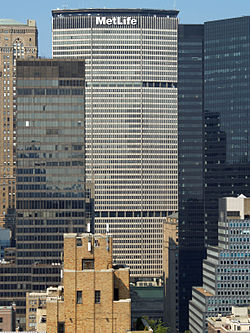
The MetLife Building (also 200 Park Avenue and formerly the Pan Am Building) is a skyscraper at Park Avenue and 45th Street, north of Grand Central Terminal, in the Midtown Manhattan neighborhood of New York City, New York, U.S. Designed in the International style by Richard Roth, Walter Gropius, and Pietro Belluschi and completed in 1962, the MetLife Building is 808 feet (246 m) tall with 59 stories. It was advertised as the world's largest commercial office space by square footage at its opening, with 2.4 million square feet (220,000 m2) of usable office space. As of November 2022[update], the MetLife Building remains one of the 100 tallest buildings in the United States.
The MetLife Building contains an elongated octagonal massing with the longer axis perpendicular to Park Avenue. The building sits atop two levels of railroad tracks leading into Grand Central Terminal. The facade is one of the first precast concrete exterior walls in a building in New York City. In the lobby is a pedestrian passage to Grand Central's Main Concourse, a lobby with artwork, and a parking garage at the building's base. A rooftop heliport operated in the 1960s and briefly in 1977. The MetLife Building's design has been widely criticized since it was proposed, largely due to its location next to Grand Central Terminal.
A skyscraper on the site of Grand Central Terminal was first proposed in 1954 to raise money for the New York Central Railroad and New York, New Haven and Hartford Railroad, the financially struggling railroads that operated the terminal. Subsequently, plans were announced for what later became the MetLife Building, to be built behind the terminal rather than in place of it. Work on the project, initially known as Grand Central City, started in 1959 and the building was formally opened on March 7, 1963. At its opening, the building was named for Pan American World Airways, for which it served as headquarters. The Metropolitan Life Insurance Company (MetLife) bought the Pan Am Building in 1981 and used it as their headquarters before selling the building in 2005. The MetLife Building has been renovated several times, including in the mid-1980s, early 2000s, and late 2010s.
The MetLife Building is at 200 Park Avenue, between the two roadways of the Park Avenue Viaduct to the west and east, in the Midtown Manhattan neighborhood of New York City, New York, U.S. The building faces the Helmsley Building across 45th Street to the north and Grand Central Terminal to the south. Other nearby buildings include One Vanderbilt and 335 Madison Avenue to the southwest; the Yale Club of New York City clubhouse to the west; The Roosevelt Hotel to the northwest; 450 Lexington Avenue to the east; and the Graybar Building to the southeast. The building is assigned its own ZIP Code—10166—and is one of 41 such buildings in Manhattan, as of 2019[update].
In 1871, the New York Central Railroad built the Grand Central Depot, a ground-level depot at the intersection of Park Avenue and 42nd Street; it was succeeded in 1900 by Grand Central Station, also at ground level. The completion of Grand Central Terminal in 1913 resulted in the rapid development of the areas around Grand Central, which became known as Terminal City. The Grand Central Terminal complex included a six-story building for baggage handling just north of the main station building, on what is now the site of the MetLife Building. The baggage handling building was converted to an office building late in its history. The surrounding stretch of Park Avenue was developed with International Style skyscrapers during the 1950s and 1960s.
Designed in the International style by Richard Roth, Walter Gropius, and Pietro Belluschi, the MetLife Building was developed by Erwin S. Wolfson and completed in 1963 as the Pan Am Building. It is 808 feet (246 m) tall with 59 stories, containing both commercial and office space. As of September 2024[update], the MetLife Building is the 42nd-tallest building in New York City and 88th-tallest in the United States.
The Diesel Construction Company was the general contractor for the building; at the time of construction, Wolfson had owned that company. Numerous other engineers and contractors were involved in the building's construction, including Hideo Sasaki as site planning consultant and landscape architect; Jaros, Baum & Bolles as MEP engineers; and James Ruderman as structural engineer. From the beginning, the building was intended for large firms, with 2.4 million square feet (220,000 m2) in office floor area. In total, it has 2,841,511 square feet (263,985.0 m2) of gross floor area, according to The Skyscraper Center.
The massing consists of a base and an octagonal tower. Contemporary sources describe the base as measuring nine stories tall, atop which rises 50 tower stories. However, the Council on Tall Buildings and Urban Habitat gives a conflicting measurement of 10 base stories and 49 tower stories. Exterior planted areas were planned for the sidewalks and above the roof of the base.
MetLife Building
The MetLife Building (also 200 Park Avenue and formerly the Pan Am Building) is a skyscraper at Park Avenue and 45th Street, north of Grand Central Terminal, in the Midtown Manhattan neighborhood of New York City, New York, U.S. Designed in the International style by Richard Roth, Walter Gropius, and Pietro Belluschi and completed in 1962, the MetLife Building is 808 feet (246 m) tall with 59 stories. It was advertised as the world's largest commercial office space by square footage at its opening, with 2.4 million square feet (220,000 m2) of usable office space. As of November 2022[update], the MetLife Building remains one of the 100 tallest buildings in the United States.
The MetLife Building contains an elongated octagonal massing with the longer axis perpendicular to Park Avenue. The building sits atop two levels of railroad tracks leading into Grand Central Terminal. The facade is one of the first precast concrete exterior walls in a building in New York City. In the lobby is a pedestrian passage to Grand Central's Main Concourse, a lobby with artwork, and a parking garage at the building's base. A rooftop heliport operated in the 1960s and briefly in 1977. The MetLife Building's design has been widely criticized since it was proposed, largely due to its location next to Grand Central Terminal.
A skyscraper on the site of Grand Central Terminal was first proposed in 1954 to raise money for the New York Central Railroad and New York, New Haven and Hartford Railroad, the financially struggling railroads that operated the terminal. Subsequently, plans were announced for what later became the MetLife Building, to be built behind the terminal rather than in place of it. Work on the project, initially known as Grand Central City, started in 1959 and the building was formally opened on March 7, 1963. At its opening, the building was named for Pan American World Airways, for which it served as headquarters. The Metropolitan Life Insurance Company (MetLife) bought the Pan Am Building in 1981 and used it as their headquarters before selling the building in 2005. The MetLife Building has been renovated several times, including in the mid-1980s, early 2000s, and late 2010s.
The MetLife Building is at 200 Park Avenue, between the two roadways of the Park Avenue Viaduct to the west and east, in the Midtown Manhattan neighborhood of New York City, New York, U.S. The building faces the Helmsley Building across 45th Street to the north and Grand Central Terminal to the south. Other nearby buildings include One Vanderbilt and 335 Madison Avenue to the southwest; the Yale Club of New York City clubhouse to the west; The Roosevelt Hotel to the northwest; 450 Lexington Avenue to the east; and the Graybar Building to the southeast. The building is assigned its own ZIP Code—10166—and is one of 41 such buildings in Manhattan, as of 2019[update].
In 1871, the New York Central Railroad built the Grand Central Depot, a ground-level depot at the intersection of Park Avenue and 42nd Street; it was succeeded in 1900 by Grand Central Station, also at ground level. The completion of Grand Central Terminal in 1913 resulted in the rapid development of the areas around Grand Central, which became known as Terminal City. The Grand Central Terminal complex included a six-story building for baggage handling just north of the main station building, on what is now the site of the MetLife Building. The baggage handling building was converted to an office building late in its history. The surrounding stretch of Park Avenue was developed with International Style skyscrapers during the 1950s and 1960s.
Designed in the International style by Richard Roth, Walter Gropius, and Pietro Belluschi, the MetLife Building was developed by Erwin S. Wolfson and completed in 1963 as the Pan Am Building. It is 808 feet (246 m) tall with 59 stories, containing both commercial and office space. As of September 2024[update], the MetLife Building is the 42nd-tallest building in New York City and 88th-tallest in the United States.
The Diesel Construction Company was the general contractor for the building; at the time of construction, Wolfson had owned that company. Numerous other engineers and contractors were involved in the building's construction, including Hideo Sasaki as site planning consultant and landscape architect; Jaros, Baum & Bolles as MEP engineers; and James Ruderman as structural engineer. From the beginning, the building was intended for large firms, with 2.4 million square feet (220,000 m2) in office floor area. In total, it has 2,841,511 square feet (263,985.0 m2) of gross floor area, according to The Skyscraper Center.
The massing consists of a base and an octagonal tower. Contemporary sources describe the base as measuring nine stories tall, atop which rises 50 tower stories. However, the Council on Tall Buildings and Urban Habitat gives a conflicting measurement of 10 base stories and 49 tower stories. Exterior planted areas were planned for the sidewalks and above the roof of the base.
Recent media
Recent media