

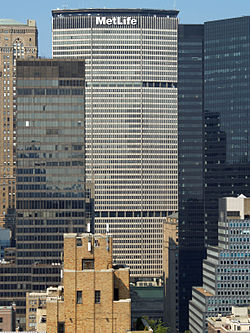

MetLife Building
View on Wikipedia
The MetLife Building (also 200 Park Avenue and formerly the Pan Am Building) is a skyscraper at Park Avenue and 45th Street, north of Grand Central Terminal, in the Midtown Manhattan neighborhood of New York City, New York, U.S. Designed in the International style by Richard Roth, Walter Gropius, and Pietro Belluschi and completed in 1962, the MetLife Building is 808 feet (246 m) tall with 59 stories. It was advertised as the world's largest commercial office space by square footage at its opening, with 2.4 million square feet (220,000 m2) of usable office space. As of November 2022[update], the MetLife Building remains one of the 100 tallest buildings in the United States.
Key Information


The MetLife Building contains an elongated octagonal massing with the longer axis perpendicular to Park Avenue. The building sits atop two levels of railroad tracks leading into Grand Central Terminal. The facade is one of the first precast concrete exterior walls in a building in New York City. In the lobby is a pedestrian passage to Grand Central's Main Concourse, a lobby with artwork, and a parking garage at the building's base. A rooftop heliport operated in the 1960s and briefly in 1977. The MetLife Building's design has been widely criticized since it was proposed, largely due to its location next to Grand Central Terminal.
A skyscraper on the site of Grand Central Terminal was first proposed in 1954 to raise money for the New York Central Railroad and New York, New Haven and Hartford Railroad, the financially struggling railroads that operated the terminal. Subsequently, plans were announced for what later became the MetLife Building, to be built behind the terminal rather than in place of it. Work on the project, initially known as Grand Central City, started in 1959 and the building was formally opened on March 7, 1963. At its opening, the building was named for Pan American World Airways, for which it served as headquarters. The Metropolitan Life Insurance Company (MetLife) bought the Pan Am Building in 1981 and used it as their headquarters before selling the building in 2005. The MetLife Building has been renovated several times, including in the mid-1980s, early 2000s, and late 2010s.
Site
[edit]The MetLife Building is at 200 Park Avenue, between the two roadways of the Park Avenue Viaduct to the west and east, in the Midtown Manhattan neighborhood of New York City, New York, U.S. The building faces the Helmsley Building across 45th Street to the north and Grand Central Terminal to the south. Other nearby buildings include One Vanderbilt and 335 Madison Avenue to the southwest; the Yale Club of New York City clubhouse to the west; The Roosevelt Hotel to the northwest; 450 Lexington Avenue to the east; and the Graybar Building to the southeast.[4] The building is assigned its own ZIP Code—10166—and is one of 41 such buildings in Manhattan, as of 2019[update].[5]
In 1871, the New York Central Railroad built the Grand Central Depot, a ground-level depot at the intersection of Park Avenue and 42nd Street; it was succeeded in 1900 by Grand Central Station, also at ground level.[6] The completion of Grand Central Terminal in 1913 resulted in the rapid development of the areas around Grand Central, which became known as Terminal City.[7] The Grand Central Terminal complex included a six-story building for baggage handling just north of the main station building, on what is now the site of the MetLife Building.[8] The baggage handling building was converted to an office building late in its history.[9] The surrounding stretch of Park Avenue was developed with International Style skyscrapers during the 1950s and 1960s.[10][11]
Architecture
[edit]Designed in the International style by Richard Roth, Walter Gropius, and Pietro Belluschi, the MetLife Building was developed by Erwin S. Wolfson and completed in 1963 as the Pan Am Building.[1] It is 808 feet (246 m) tall with 59 stories,[12][13][14] containing both commercial and office space.[4] As of September 2024[update], the MetLife Building is the 42nd-tallest building in New York City and 88th-tallest in the United States.[13]
The Diesel Construction Company was the general contractor for the building;[15][16] at the time of construction, Wolfson had owned that company.[15] Numerous other engineers and contractors were involved in the building's construction, including Hideo Sasaki as site planning consultant and landscape architect;[17][18] Jaros, Baum & Bolles as MEP engineers;[13][19] and James Ruderman as structural engineer.[19] From the beginning, the building was intended for large firms, with 2.4 million square feet (220,000 m2) in office floor area.[20][21] In total, it has 2,841,511 square feet (263,985.0 m2) of gross floor area, according to The Skyscraper Center.[13]
Form
[edit]The massing consists of a base and an octagonal tower. Contemporary sources describe the base as measuring nine stories tall, atop which rises 50 tower stories.[22][23] However, the Council on Tall Buildings and Urban Habitat gives a conflicting measurement of 10 base stories and 49 tower stories.[24] Exterior planted areas were planned for the sidewalks and above the roof of the base.[18]
The tower stories' floor plates are designed in an elongated octagonal lozenge, with the longer axis running parallel to 45th Street.[25][26] The north and south facades are divided into three broad segments, while the west and east facades are one segment each. The building's form may have been influenced by the 1961 Zoning Resolution, a major change to New York City zoning code that was proposed just before construction started. The massing is similar to Le Corbusier's unbuilt tower in Algiers, proposed between 1938 and 1942,[27][28] as well as the nearly contemporary Pirelli Tower in Milan (completed in 1958).[27][29][30] The architects intended for the octagonal shape and exterior curtain wall to reduce the building's perceived sense of scale.[31]
Facade
[edit]
The facade of the first two stories and mezzanines is clad with granite, aluminum, marble, and stainless steel with glass windows.[22] On Depew Place, an alley running below the eastern leg of the Park Avenue Viaduct, fifteen loading docks were constructed for trucks to conduct deliveries and loading.[32][33] On the Vanderbilt Avenue side, a marquee was installed over the entrance in the 1980s.[34] The third through seventh stories are exclusively sheathed in granite, with window inserts.[22][35] The eighth and ninth floors, which are slightly set back, are clad in aluminum.[22][35][36]
The 10th through 59th stories of the MetLife Building contain one of the first precast concrete exterior walls in a building in New York City.[1][35] The building includes about nine thousand light-tan precast concrete Mo-Sai panels, each of which surrounds a window measuring 4 feet (1.2 m) wide by 8 feet (2.4 m) high.[22][37] The panels themselves measure 6 feet (1.8 m) wide by 13.67 feet (4 m) high and weigh 3,500 pounds (1,600 kg) each.[22] Each panel is coated with a quartz aggregate to give texture to the facade.[22][36][37] Vertical concrete mullions project about 13 inches (330 mm) from the facade, separating the panels on every story.[37] Flat concrete spandrels separate the windows between stories.[22] Though Walter Gropius had considered a precast concrete facade to be more solid than a glass curtain wall, this only made the building appear bulkier.[14] Furthermore, the appearance of concrete degraded over time; this effect could be seen in structures such as the Solomon R. Guggenheim Museum but was more pronounced on the MetLife Building's facade.[29] During the building's construction, the manufacturer of the Mo-Sai panels declared bankruptcy, forcing Diesel Construction to buy out that company to prevent delays in construction.[38]
The facade is recessed at the 21st and 46th stories, where there is mechanical space.[22][27] These recesses create the impression of deep shadows.[29] Both mechanical stories are surrounded by a colonnade of columns, which are spaced 16 feet (4.9 m) apart on centers. The precast concrete curtain wall is recessed behind the columns.[39]
The MetLife Building originally bore 15-foot-tall (4.6 m) "Pan Am" displays on its north and south facades and 25-foot-tall (7.6 m) globe logos on the east and west facades.[40] This was swapped with neon "MetLife" displays to the north and south in 1992.[41][42] These displays were changed again in 2017, being replaced with LED letters to conserve energy.[43][44] The Pan Am Building was the last tall tower erected in New York City before laws were enacted preventing corporate logos and names on the tops of buildings.[45] Modern New York City building code prohibits logos from being more than 25 feet (7.6 m) above the curb or occupying over 200 square feet (19 m2) on a blockfront.[46] The sign replacements had been permitted because the city government considered the new signs to be an "uninterrupted continuation of a use" that was allowed before the zoning laws were changed.[45]
Structural features
[edit]200 Park Avenue was built atop two levels of railroad tracks underground, which feed directly into Grand Central Terminal. The substructure of the building uses foundational columns that extend into the track levels, descending some 55 feet (17 m) below street level into the underlying bedrock.[16][23] The substructure includes more than 300 columns, each 18.5 inches (470 mm) across and clad with 2 inches (51 mm) of concrete. Ninety-nine columns were built specifically for the Pan Am Building; these columns were installed within several inches of existing steel members such as third rails, but had to be isolated from the other steel.[23][47] The new columns weighed between 22 and 44 short tons (20 and 39 long tons; 20 and 40 t).[47][48] Approximately two hundred existing columns, which supported the former baggage building on the site, were reinforced.[23][47] The work involved abridging the tops of many existing columns and installing horizontal beams weighing up to 36 short tons (32 long tons; 33 t).[23] A "triple decker sandwich" made of lead, asbestos, and sheet steel was installed under each level of tracks to provide insulation.[16][23]

The superstructure was constructed similarly to bridge spans. To fabricate the floor slabs, builders used a process called composite action, in which concrete was bonded with structural steel panels to create a stronger structure.[49] Steel panels were fabricated, rather than concrete floors, because steel panels were lighter and could be constructed regardless of unfavorable weather. Over 56 acres (230,000 m2) of steel panels are used in the floor plates, each of which contains wire and cable ducts.[50] A standard floor slab could handle loads of 50 pounds per square foot (240 kg/m2).[51] The building's steel frame weighs over 45,000 short tons (40,000 long tons; 41,000 t) in total.[47] The roof of the building contains NOAA Weather Radio Station KWO35, a National Weather Service radio station.[52] Since 1990,[53] there has also been a peregrine falcon nest on the building's roof.[54]
Helipad
[edit]The initial plans for the Pan Am Building were altered in March 1961 to provide for a helipad on the east side of the roof.[55][56] The helipad garnered controversy immediately after it was announced, and opponents of the plan cited noise and safety concerns.[56] The heliport's opening required approval from the Federal Aviation Administration (FAA), the city government, and the Port Authority of New York and New Jersey.[57][58] Lawyers for the building's owners applied for permission to operate the heliport in August 1963,[59] and the New York City Planning Commission confirmed in early 1964 that the owners had sought a permit for the heliport.[60][61] The New York City Board of Estimate gave final approval to the heliport in January 1965,[62][63] and test flights began that March,[62][64] amid continued opposition to the heliport.[62][65]
Helicopter service started on December 22, 1965.[66] The service was operated by New York Airways, which flew Vertol 107 helicopters from the rooftop helipad to Pan Am's terminal at John F. Kennedy International Airport (JFK).[67][68] There was a ticket office for the heliport at the base of the building. Passengers would check in at the ticket office, then take an express elevator to the 57th floor, an escalator to the heliport lounge, then another elevator to the roof. The flight to JFK lasted an average of six minutes and twenty seconds.[68] The New York City government renewed the heliport's operating license in 1966, despite continued opposition to the heliport.[69] For a short period starting in March 1967, the company also offered service to Teterboro Airport.[70] All helicopter service stopped on February 18, 1968, because of insufficient ridership,[71] as well as disagreements over funding.[69][72][73]
Though discussions to restart helicopter service were held in 1969,[74] approval was not given until early 1977.[75][56] Service to JFK resumed that February using Sikorsky S-61s.[67][76] On May 16, 1977, about one minute after an S-61L landed and its 20 passengers disembarked, the right front landing gear collapsed, causing the aircraft to topple onto its side with the rotors still turning. One of the blades detached, killing four men who were waiting to board and a fifth person at ground level; two other people were seriously injured.[77][78] Helicopter service was suspended that day and never resumed.[67][79] The already-controversial building received further negative attention as a result of the incident, and both New York Airways and Pan Am suffered financially in subsequent years.[79] During its short periods of operation, the heliport was largely perceived as a nuisance and danger, but its presence was also seen as satisfying what David W. Dunlap described as "the consummate technological fantasy of airborne travel through skyscraping pinnacles".[80]
Interior
[edit]Structural and mechanical features
[edit]
A central telephone office was installed on the 20th and 21st stories,[81] serving 30,000 telephones within the building.[51][82] The system, costing $11 million, was the first of its kind in an office building in the United States.[82] The central office, operated by New York Telephone, eliminated the need for tenants to have individual telephone offices and equipment rooms. To avoid interfering with the subterranean railroad tracks, the telephone conduits were routed through the roof of the railroad tunnel.[51] On the two floors where the telephone office was installed, the floor slabs were strengthened to handle loads of 150 to 300 pounds per square foot (730 to 1,460 kg/m2), and floor heights were increased to provide clearance of at least 13.5 feet (4.1 m).[51][81]
A refrigeration plant, described at the time of construction as the world's largest such plant,[83] was installed on the roof with three steam-powered units each weighing 100 short tons (91 t). The plant was placed on the roof because the building has no usable basement, as all the subterranean space is part of Grand Central Terminal.[84] The plant had a cooling capacity of 10,000 refrigeration tons (35 MW) and could use 200,000 pounds of steam every hour. Large fan rooms were placed on the mechanical stories at the 21st and 46th floors, dispersing air to the other floors, and two individual air supply systems were placed on each story.[83] The ventilation systems could deliver 5,000,000 cubic feet (140,000 m3) every minute. The pipes and ducts had to serve all the building's floors, with an electrical system and water pressure system capable of serving all the building's stories.[19] At ground level was a room where wastepaper could be "baled" on-site to make easier to dispose of paper.[85]
Westinghouse Electric Corporation also manufactured 65 elevators and 21 escalators for 200 Park Avenue, which at the time of construction was the largest-ever order for elevators.[86][87] One bank of six elevators was able to travel 1,600 feet per minute (490 m/min), the fastest elevators in the world at the time of their installation.[86][87][88] Five elevators were reserved for freight.[35] The elevators rise from the second-story lobby because the elevator pits could not descend below the first story due to the presence of the tracks.[35][89] The upper stories were served by 59 elevators.[24] According to the Skyscraper Center, as of 2021[update], the building has 85 elevators.[13]
Lobby
[edit]
The MetLife Building's base contains a lobby across its lowest two stories. At ground level is a 76-foot-wide (23 m) pedestrian passageway, enabling traffic flow between the Helmsley Building's pedestrian arcades and Grand Central Terminal. The 45th Street entrance to the passageway is set back 65 feet (20 m) from the sidewalk. A 103-foot-wide (31 m) entrance arcade is placed on Vanderbilt Avenue, with the doorways set about 81 feet (25 m) back from the sidewalk there. The building's main office lobby is placed at the second story, at the level of the viaduct.[32][33][90] The lobby was also designed with plantings and a 40-foot-high (12 m) enclosed plaza.[18] The lobby contains 18 escalators in total.[24] Four escalators lead to the Main Concourse at the southern end of the passageway,[35][91] while fourteen more lead from the passageway to the office lobby.[29][35]
Gropius was responsible for the original design of the lobby, which was largely austere.[92] The building's original anchor tenant, Pan Am, had a ticket office under a 25-foot-wide (7.6 m) niche off the main lobby, measuring 135 feet (41 m) long and 11 feet (3.4 m) high, with circular counters and a wall with a relief map of the world. It was the world's largest airline ticket office at the time of its opening, covering 10,000 square feet (930 m2).[93]
Renovations
[edit]During a 1980s renovation by Warren Platner, some 15,000 square feet (1,400 m2) of retail space were constructed in the lobby.[94][95] Also installed was a staircase at the center of the lobby on 45th Street, which consisted of alternating travertine and gray-granite risers.[34][96] The staircase ranged from 10 feet (3.0 m) wide at the ground floor to 20 feet (6.1 m) at an intermediate landing, where it split into two flights and reached a width of 30 feet (9.1 m) at the mezzanine. There were four triangular planters at the bottom of the staircase, which complemented an orange carpet with flower motifs at the mezzanine.[34][97][98] The lobby also contained unusual semicircular discs that were either mounted atop poles or suspended from the ceiling.[34][96][98] In addition, a security desk was added and the storefronts were expanded.[92]
In an early-2000s renovation by Kohn Pedersen Fox, the lobby received tile and black travertine floors, the storefronts were moved to the side, and the central staircase was removed.[42] The storefronts were removed in the late 2010s, when the lobby was re-clad in light-colored travertine.[99] The renovated lobby has an oak-floored reception lounge overlooking the entrance.[100]
Artwork
[edit]The Pan Am Building's lobby was planned with several works of art,[35][101] which comprised most of the original lobby's decoration.[92] One such artwork is Flight, a triple-story wire sculpture by Richard Lippold.[102][103] The sculpture contains a sphere, representing the earth; a seven-pointed star, representing the seven continents and seas; and gold wires representing aircraft flight patterns.[103][104] It measures 80 feet (24 m) wide, and 40 feet (12 m) deep.[105] The composer John Cage, a friend of Lippold's, had initially proposed a musical program to complement Flight,[102][106] consisting of ten loudspeakers, which would have played works by Muzak whenever people walked in and out of the lobby.[105] Lippold canceled the idea and management instead agreed to play classical music in the lobby.[35][107]
At the Pan Am Building's opening, the entrance from the Main Concourse was topped by Manhattan, a 28-by-55-foot (8.5 by 16.8 m) mosaic mural of red, white, and black panels by Josef Albers.[35][108] That work was removed in a 2001 renovation,[42][109] though Albers had left exact specifications for reproducing the work,[42][110] and a replica was installed in 2019.[111][112]
Suspended over the 45th Street entrance was a mural by György Kepes, consisting of two aluminum screens[113] with concentric squares.[35][101] Kepes's mural measured 40 feet (12 m) wide and was placed on the balcony[105] until it was removed in the 1980s.[34] At Vanderbilt Avenue, Robert Berks sculpted a bronze bust depicting the building's developer, Erwin S. Wolfson.[35][101][105]
Other interior spaces
[edit]The MetLife Building was designed with a six-level parking garage with room for 400 cars. The garage contains entrances and exits from both roadways of the Park Avenue Viaduct.[114][115] According to former minority owner Tishman Speyer, as of 2021[update], the building's garage contains 248 spots across four levels.[116][a]
A variety of commercial and office spaces were included in the Pan Am Building when it opened. Pan Am, the airline for which the building was originally named, contained a ticketing office at 45th Street and Vanderbilt Avenue, similar in design to Eero Saarinen's TWA Flight Center at JFK Airport.[35] Office stories in the octagonal slab typically have between 32,000 to 36,000 square feet (3,000 to 3,300 m2) of usable space, with elevators and stairs at the center, as well as uneven column spacing.[21] This arrangement allows a large amount of window-office space for tenants, as each story contains 780 feet (240 m) of outer perimeter walls.[117] Different companies with full-floor leases designed their spaces in various manners. Some tenants placed private offices along the perimeter, with important executive offices at the far corners of the story.[118] Other tenants placed open spaces at the west and east ends of the floor[119] or in the center.[120]
The Sky Club, a private luncheon club, had been on the 56th floor of the Pan Am Building.[121][122] For several years the Sky Club had contained a private restaurant.[28] Aircraft pioneer Juan Trippe, founder of Pan Am, was a member of this club.[123] Trippe had commissioned a mural of clipper ships for the walls of the Sky Club; it was sent to Tucker's Point resort in Bermuda after the club shuttered.[124][125] On the 57th and 58th stories was the Copter Club, which was used by passengers of the short-lived helicopter service.[80]
History
[edit]Planning
[edit]By the 1950s, passenger volumes at Grand Central Terminal had declined dramatically from the early 20th century, and there were proposals to demolish and replace the station.[126][127] The New York Central Railroad was losing money, partially on paying taxes on the building's air rights. New York Central wanted to sell the property or its air rights to allow the construction of a skyscraper above or on the terminal's site.[128] At the same time, the New York, New Haven and Hartford Railroad retained a partial interest in the terminal's operation.[129][130]
Early plans
[edit]
Initially, New York Central's chairman Robert R. Young had been negotiating with developer Erwin S. Wolfson and their mutual friends Herbert and Stuart Scheftel to determine how the Grand Central site could be redeveloped.[131] After these discussions broke down, two competing plans for the replacement of Grand Central Terminal were proposed in 1954.[127][129][132] One design, by I. M. Pei, was suggested by Young along with developer William Zeckendorf. The proposal called for an 80-story, 5-million-square-foot (460,000 m2) tower that would have succeeded the Empire State Building as the world's tallest building.[132][133][134] The other, by Fellheimer & Wagner, was put forth by New Haven's chairman Patrick B. McGinnis along with Wolfson. The plan envisioned a 55-story building, the largest office building in the world with 4 to 6 million square feet (370,000 to 560,000 m2).[132][135][136] Both proposals were poorly received, with 235 architects cosigning a letter imploring Young and McGinnis to reject the plans.[126][137] Neither plan was ultimately ever carried out.[126][129]
Though the New Haven and New York Central continued to struggle financially, both railroads agreed to work with Wolfson, the New Haven's developer.[129] In February 1955, Wolfson, the Scheftels, and Alfred G. Burger proposed a 65-story tower called Grand Central City, which would replace a six-story baggage structure north of the terminal.[138][139][140] Richard Roth of Emery Roth and Sons, who created the design, had agreed to participate only if the office building would not result in the passenger concourse's demolition.[137][138] The plans were widely circulated in the New York Herald Tribune, The New York Times, and The Wall Street Journal.[140] The proposal garnered significant opposition after architect Giorgio Cavaglieri expressed concerns about the effects of the proposed building on traffic congestion in the area.[141]
Roth and Wolfson's plan was effectively forgotten in March 1955 when Zeckendorf was named the partner for any new development in the vicinity of Grand Central.[142][143] Zeckendorf and Pei modified the blueprints for their 80-story tower but never publicly announced the revised plans.[142] Unpublished drawings indicate that Pei's second design was supposed to be a hyperboloid-shaped tower.[144][145] For various reasons, the hyperboloid tower never progressed past the planning stage. The building had faced extensive criticism from both professionals and the general public; the railroads faced significant financial shortfalls; and the economy as a whole had started to decline, leaving Zeckendorf unable to finance the project. Meanwhile, traffic around Grand Central Terminal worsened in the late 1950s.[146]
Revival of plans
[edit]In January 1958, representatives of an unnamed large company, who were unaware of Grand Central City's cancellation, notified Stuart Scheftel that they were interested in leasing space in the new building.[147][148] Upon learning of the news, Young placed Scheftel in contact with his real estate agent. Although Young died by suicide shortly afterward, the remaining partners continued working on the project.[147] A revised version of Roth's plan was announced in May 1958. The plan called for a 50-story aluminum and glass tower parallel to Park Avenue, with 3 million square feet (280,000 m2) of floor area; three theaters with a total capacity of 5,000; an open-air restaurant on the seventh floor; and a 2,000-spot parking garage.[149][150][151] The New York Central and New Haven railroads were guaranteed at least $1 million a year from the agreement.[147][152] Despite the presence of tracks under the building site, Wolfson said a survey of the site had "no insurmountable problems".[153] James Ruderman, the building's structural engineer, had drawn up preliminary plans for a steel framework spanning the tracks.[154] Wolfson hired James D. Landauer Associates Inc. to handle leasing at the proposed building, negotiating directly with tenants' brokers.[155][156]
Wolfson found Roth's revised plan to be unsatisfactorily modest for such a prominent site.[28][129][155] He said in the New York Herald Tribune that he wanted to "avoid adding just another massive shape to an already developed midtown business community".[157] In July 1958, architects Walter Gropius and Pietro Belluschi were announced as co-designers for Grand Central City.[158][159][160] Wolfson expressed his hope that Gropius and Belluschi, both prominent architects in the Modern style, would be able to help devise an "esthetic and functional design".[129][159] Initially, Gropius and Belluschi were to serve a relatively minor advisory role.[161] A week after being hired, Gropius suggested that the slab be oriented east–west, with a large plaza or courtyard in front of the tower, similar to the design of Lever House. Gropius also recommended that the building include a textured facade, rather than the metal-and-glass curtain walls commonly used by the Roth firm in its previous buildings.[160] Gropius modified the plans in mid-1958; the facade would use simulated stone, the large plaza was dropped from the plans, and the tower was moved northward to 45th Street.[162] That October, Wolfson traveled to Europe to study buildings and gain inspiration for the building's design.[163]
Gropius and the Roth firm continued to modify their design through early 1959.[37] The revised final plans were announced in February 1959. While Wolfson had promised a "modest" redesign,[129] the new plans were a radical change from Roth's 1958 plan, calling for a 55-story octagonal tower parallel to 45th Street, with 2.4 million square feet (220,000 m2) of space.[26][164][165] The Roth firm said the octagonal massing could absorb "different planes of light as on a diamond", while Gropius said the new alignment was easier for air conditioning.[26][27] The octagonal building was smaller than the original plans, but Gropius's team reasoned that a 3-million-square-foot (280,000 m2) edifice would have been too large to rent out. The Roth firm expressed its concerns over the east–west orientation of the tower, since it would raise the cost of the superstructure by 50 percent compared to a slab oriented north–south.[30] A model of the redesigned tower was exhibited publicly in November 1959.[37][166][167]
Construction
[edit]Initial work
[edit]Five leases for a collective 600,000 square feet (56,000 m2) in Grand Central City were announced immediately after the final design was announced in February 1959.[168] A contract for 40,000 short tons (36,000 long tons; 36,000 t) of structural steel was awarded to U.S. Steel's American Bridge division that May; at the time, the contract was reportedly the most expensive ever awarded for an office building.[169][170][171] Ruderman finalized his plans for the framework in September 1959.[88] The next month British firm City Centre Properties invested $25 million and took a half interest in Grand Central City's development, covering part of the project's $100 million cost.[172][148][173] It was the first British–American joint venture for a real estate development in the United States.[173] Gordon I. Kyle, an appraiser who had calculated the valuations of more than two-thirds of Manhattan's skyscrapers,[174] concluded that the building would be worth twice as much as the Empire State Building.[175] Wolfson and City Centre paid Kyle $50,000, which at the time was the highest single appraiser's fee ever recorded.[175][174]
The New York Central Railroad granted an 80-year lease for the air rights above the building, in exchange for a portion of the building's gross revenue.[176][b] This agreement added about $6 million to the construction cost.[177] Final plans were filed with the New York City Department of Buildings on November 24, 1959.[178][179] Construction on the structure officially started two days afterward on November 26,[180] and Cushman & Wakefield were named as leasing agents for Grand Central City the following month.[181] This was followed by contracts for the building's soundproofing and elevators in February 1960.[88] James Ruderman had devised engineering plans for five other structures above the Park Avenue railroad tracks. As the Grand Central City site was impossible to excavate, the substructure had to be erected while the baggage building served as a staging area. Furthermore, as some materials would have to be delivered by railroad, material deliveries would be coordinated closely to avoid delays on the commuter rail lines entering Grand Central.[16][23]
Construction of the substructure commenced in May 1960, during which the architects finalized plans for the entrances, lobbies, and facade lighting.[182] Gropius was involved in all aspects of the building's design, from traffic flow to minor architectural details, which sometimes led to conflicts with the project's other architects and engineers. For example, he wanted the lobby's bronze details to contain a matte finish, and he requested that the elevator penthouse be no higher than 26 feet (7.9 m) above the roof so that it did not "look silly".[183] Work on the tower itself was held up by a steel strike that lasted through much of 1960;[35] the baggage handling building was ultimately demolished starting that June.[184][185][186] Foundations for the building were sunk in August 1960.[187]
Pan Am lease and completion
[edit]Pan Am founder Juan Trippe signed a 25-year, $115.5 million (equivalent to $936 million in 2024[c]) lease for 613,000 square feet (56,900 m2) across 15 floors, plus a new main ticket office at 45th Street and Vanderbilt Avenue, in September 1960.[188][189][190] In an indication of the widespread interest surrounding this lease, the mayor and the governor of New York both congratulated Grand Central City's builders after the lease was signed.[191] Following this, Pan Am hired Ivan Chermayeff to design the building's signage.[182] Grand Central City officially became known as the Pan Am Building in December 1960, after its major lessee. Signs bearing the company's name or logo were placed atop the four major facades.[35][84] Originally, Trippe had wanted signs with the name "Pan Am" on all eight facades, but this was scaled down after Gropius objected that the large number of signs would decrease "the dignity of the building".[191] The Pan Am Building's developers secured a $70 million mortgage loan and a $65 million construction loan during January 1961.[176][192] At the time, the building was more than half rented.[193][194]
The Pan Am Building's construction involved over 200 engineers and 7,500 workers from 75 trades.[38] Three derricks were installed to erect the steel for the tower, while four derricks were used for the base. Five to seven steel columns were installed every day during two shifts, with materials deliveries taking place mostly at night.[47] The Pan Am Building's structural steel topped out during May 1962.[195][196] The facade cladding was installed in two ways. The facade of the base was bolted into place, down to the individual spandrels and mullions. The Mo-Sai panels for the tower were installed via an interior hoist.[22][36] Wolfson, though recovering from surgery during mid-1962, continued to observe the building's progress using a helicopter.[197] When Wolfson died that June, James D. Landauer was selected to oversee the building's completion.[198] The lobby, the last part of the Pan Am Building to be completed, was built with cheap materials such as restroom tiles because the builders had run out of money toward the project's completion.[95]
Opening and Pan Am ownership
[edit]
The as-yet-incomplete Pan Am Building was formally opened on March 7, 1963, with a ceremony attended by British and American officials,[175][199] and tenants started moving into the structure the following month.[200] The building had secured tenants for 91 percent of its office space upon opening, in large part to its central location.[201][202] Within three months, the Pan Am Building was 92 percent rented and 70 percent occupied;[24][203] by the first anniversary of its opening, the building was 97 percent leased with 241 tenants.[204] This contrasted greatly with the smaller Empire State Building, which was only 25 percent rented when it opened and did not reach full occupancy for more than a decade afterward.[201] At the time of its completion, the Pan Am Building was the largest commercial office development in the world by square footage,[14][204][205] being surpassed nearly a decade later by 55 Water Street and the World Trade Center in lower Manhattan.[205] In the 15 years prior to the Pan Am Building's opening, 147 office buildings had been completed in Manhattan, totaling 50.632 million square feet (4,703,900 m2) of office space.[203]
Initially, the airline only had a 10 percent ownership stake in its namesake building.[206] Besides Pan Am, other early tenants included the Westinghouse Electric Corporation,[207] Alcoa,[208] the Hammermill Paper Company,[209] National Steel Corporation,[210] Kodak,[211] the Reader's Digest Association,[212] Mitsui,[213] Chrysler,[117][214] and the British Iron & Steel Corporation.[215] The shops at the Pan Am Building's base were opened in August 1963.[216] The tenant selection process was rigorous, as Cushman and Wakefield examining the services and goods sold by potential tenants: for example, the firm's vice president got haircuts from each of the six applicants for the lobby barbershop.[217] Furthermore, average rents in the Pan Am Building were about $6.75 per square foot ($72.7/m2), slightly higher than the average of $5.25 to $6 per square foot ($56.5 to $64.6/m2) in other Midtown Manhattan buildings.[176]
Although the Pan Am Building's completion averted the terminal's imminent destruction, New York Central had experienced further decline, merging with the Pennsylvania Railroad in 1968 to form the Penn Central Railroad.[218] That year, Pan Am bought a 45 percent stake in the building from the estate of Jack Cotton,[206] formerly chairman and co-owner of City Centre Properties.[219] After Penn Central went bankrupt in 1970, it sought to sell its properties, including the land below the Pan Am Building.[220] Among the building's tenants during this time was the United Brands Company (now Chiquita Brands International), whose CEO, Eli M. Black, jumped from the 44th story to his death on February 3, 1975.[221][222]
Pan Am was considering moving its headquarters from the building by 1978.[223] That year, the airline bought the remaining 45 percent stake in the building from Wolfson, obtaining full ownership of the property.[224][225][226] A Pan Am subsidiary, Grand Central Building Inc., acquired the underlying land for about $25 million (equivalent to $87 million in 2024[c]) the following year as part of a legal settlement with Penn Central.[227] The airline sustained large financial losses during the early 1980s recession,[228][229] leading it to announce in February 1980 that it was considering selling the building.[229][230][231] About half the leases were scheduled to expire in three or four years.[228][232] Many lessees were exempt from paying the building's operating costs, which made the Pan Am Building only marginally profitable for the airline.[228] Amid high fuel costs and a lack of income from airfare, Pan Am decided in April 1980 that it would definitely sell the building.[233]
Sale to MetLife and renovations
[edit]
When the Pan Am Building officially went on the market in May 1980, Business Week magazine predicted that it might be sold for as much as $200 million (equivalent to $637 million in 2024[c]).[234] The sale was so complex that Landauer Associates published a 65-page brochure just to describe the terms of the sale.[98] Nine bidders submitted offers, five of whom were selected for further consideration: the Metropolitan Life Insurance Company (MetLife), the Equitable Life Assurance Society; Donald Trump; Paul Milstein; and Olympia and York.[235][d] In July 1980, Pan Am sold the building to MetLife for $400 million (equivalent to $1,275 million in 2024[c]).[206][228][234] At the time, it was the highest-priced sale of an office building in Manhattan. This was attributed not only to a rezoning of the surrounding area, allowing developers to erect higher buildings there, but also to a strong office market.[234] The sale price amounted to $177 per square foot ($1,910/m2), more than any other office building in Manhattan.[232] MetLife did not plan to move any offices to the building, and Pan Am planned to keep its headquarters there.[206][234] As a condition of the sale, the building would retain Pan Am's name until the airline ceased to be the building's anchor tenant.[232]
The sale was finalized in 1981 when Pan Am transferred stock in the building to MetLife, a move that let the airline avoid paying most of the estate transfer tax.[98][236] Pan Am normally would have paid a $4 million tax, but it ultimately paid only $125.[98] Cross & Brown assumed the responsibility of leasing the building's space.[237] At the time, leases for much of the interior space were set to expire all at once during the early 1980s.[95][238] Starting in 1984, MetLife renovated about half of the space as the original tenants' leases expired. The deteriorating lobby, used by 100,000 pedestrians a day, was extensively reconfigured by Warren Platner. In addition, some mechanical systems were upgraded to comply with building codes, and retail spaces were added.[95][238][239] Asbestos fireproofing on the office stories was removed in advance of an anti-asbestos regulation passed by the city government in 1985.[240][241] The lobby renovation had been completed by 1987[242] at a cost of $15 million.[98]
By 1991, Pan Am's presence had dwindled to four floors.[34][80] MetLife preferred to refer to the building as 200 Park Avenue, its address. At the time, the Pan Am Building was 95 percent occupied, and the public variously referred to the building by the names of its large tenants, such as Mitsui, Dreyfus, and Rogers & Wells.[80] Pan Am moved its headquarters to Miami that year[243] and closed down shortly afterward.[45] In September 1992, MetLife announced that it would remove Pan Am signage from 200 Park Avenue and add letters bearing its own name.[41][42] According to a MetLife spokesperson, the sign change was taking place because the airline had become defunct.[41][244] The signs were changed in January 1993.[42][245] Though 200 Park Avenue subsequently became known as the MetLife Building, its namesake was then headquartered in the Metropolitan Life Insurance Company Tower.[45] As a result, the Park Avenue structure was known specifically as the "MetLife Building 200 Park Avenue".[34]
21st century
[edit]Further renovations to 200 Park Avenue's exterior and lobby were undertaken during 2001 and 2002.[89] Low-pressure compressed air was used to clean the facade, while Kohn Pedersen Fox renovated the lobby.[42] In 2005, MetLife moved its board room from the Metropolitan Life Tower to 200 Park Avenue.[246][247] The same year, the company considered selling 200 Park Avenue to pay for its acquisition of Travelers Life & Annuity.[246] Ultimately, MetLife sold the building that April for $1.72 billion, to a joint venture of Tishman Speyer Properties, the New York City Employees' Retirement System, and the New York City Teachers' Retirement System.[248][249] At the time, the sale was the largest ever transaction involving an office building.[250] The company still retained a boardroom and corporate suite at 200 Park Avenue.[251]
MetLife announced in 2015 that it was consolidating its operations at 200 Park Avenue, with 500,000 square feet (46,000 m2) in its namesake building.[247][252] At the time, Donald Bren, the billionaire owner of the real estate firm Irvine Company, held a 97.3 percent ownership stake in the building. While Tishman Speyer remained the managing partner of the property, its ownership stake had been reduced to less than 3 percent.[253][254] Plans to renovate the lobby were devised in 2016.[111] The next year, the neon light sources for the signs atop the building were swapped with LED light sources to conserve energy.[43][44] A renovation of 200 Park Avenue's lobby started in late 2018. The work included simplifying the lobby's layout by removing storefronts and restoring direct connections to some of Grand Central's platforms.[99][255] Three restaurant owners leased space in the building in mid-2022,[256][257] and MetLife extended its lease the next year.[258][259]
CBRE took over as the building's leasing manager in mid-2024, succeeding Tishman Speyer as leasing manager. Irvine bought out Tishman Speyer's ownership stake at this time.[260][261] The building was 97 percent occupied by that October,[262] at which point another restaurateur had leased space in the lobby.[263][264] The Irvine Company refinanced the building in early 2025 with a $1.5 billion mortgage loan.[265][266]
Reception
[edit]Initial commentary
[edit]
The building's design generated significant controversy from its initial announcement in 1959.[27] Architectural historian Sibyl Moholy-Nagy wrote in Progressive Architecture magazine that the original tower plans "provided human scale and architectural personality", which were "lost" in the revision.[267] Walter McQuade, writing for The Nation, expressed dissatisfaction with even the preliminary drawings.[27][268] International critics, including Italian critic Gillo Dorfles and Romanian architect Martin Pinchis, also criticized the proposal.[269]
Specific concerns included the building's potential impact on transportation infrastructure and urban planning. Architect Victor Gruen questioned the necessity of including a parking garage given the site's proximity to Grand Central Terminal,[270] while Progressive Architecture editor Thomas H. Creighton suggested the space would be better utilized as an open plaza.[270][271] Additional critics expressed concerns that the building would strain existing transit infrastructure.[176]
The proposal also had supporters within the architectural community. Natalie Parry defended the plans in Progressive Architecture, arguing they preserved Grand Central's "star-studded" Main Concourse "together with the precious air space above it".[272] Historian Paul Zucker, urban planner Charles Abrams, and Architectural Record editor Emerson Goble also supported the project, defending its urban planning principles.[270]
Post-completion assessment
[edit]According to contemporary accounts, the building's engineers had not anticipated positive architectural reviews, as the structure was developed primarily for financial rather than aesthetic purposes.[90] Upon the building's completion in 1963, critical reception remained largely negative.[273] Much of the criticism focused on the building's scale and its impact on the surrounding urban environment,[201][202] particularly the building's bulk and horizontal facade design.[14][29] James T. Burns Jr. wrote in Progressive Architecture that the relationship between the base, tower, parking garage, and Grand Central Terminal was "occasionally inexcusably jarring", and described the lobby as an extension of the exterior's "monolithism".[274] Architecture critic Ada Louise Huxtable characterized the building as "a colossal collection of minimums" and described the lobby artwork as a "face-saving gimmick".[275]
A recurring theme in the criticism was the building's perceived disruption of Park Avenue's visual continuity. Multiple observers noted that the monolithic design obstructed northward views along the avenue.[273][276] Art historian Vincent Scully described the building in 1961 as a "fatal blow" to Park Avenue's continuity,[277] while artist Claes Oldenburg referenced the building's positioning in his 1965 artwork Proposed Colossal Monument for Park Avenue, NYC: Good Humor Bar.[278]
Architect Walter Gropius defended the building's size by referencing the 1916 Zoning Resolution, stating that "every citizen has the right to use the law as far as he can";[279][280] his response prompted additional negative commentary.[279] Emerson Goble, who had personal relationships with Gropius and Belluschi, wrote supportive articles in The New York Times and Architectural Record, particularly praising the pedestrian circulation systems.[32][90][281] Gropius also authored a defense of the building, though this was noted to contain few specific architectural details.[282][283]
Later assessments
[edit]The 1980s lobby renovation generated additional criticism from architectural observers. Carter Wiseman compared the new interior decorations to the style of performer Liberace, writing that "even Liberace would have blushed at the vulgarity".[34][284] Architecture critic Paul Goldberger of The New York Times wrote that while the original lobby design was "stark and unwelcoming", the renovation created "a space that is so forced in its joy, so false and so disingenuous, that they make one yearn for some good old-fashioned coldness".[96]
Public opinion surveys from the period reflected continuing negative sentiment. In 1987, New York magazine conducted a poll of over 100 prominent New Yorkers asking which buildings they would prefer to see demolished; the Pan Am Building ranked first on this list.[285] By contrast, architect Robert A. M. Stern stated in 1988 that while the building represented "a wrong-headed dream badly realized", it nevertheless warranted preservation consideration from the New York City Landmarks Preservation Commission.[286]
By the early 21st century, some former critics began expressing more nuanced views, while preservation advocates argued for protecting mid-20th century modernist buildings like the MetLife Building.[89] In 2016, ArchDaily described the building as "commendable for its robust form and excellent public spaces, as well as its excellent integration into the elevated arterial roads around it".[28] The building's prominent profile has led to its use as a filming location for various movies and television productions, contributing to its recognition in popular culture.[287]
See also
[edit]

References
[edit]Notes
[edit]- ^ However, according to The Skyscraper Center, there are 315 parking spaces.[13]
- ^ New York Central's income was guaranteed to be $1.1 million or 8 percent of the gross rental, whichever was larger.[176]
- ^ a b c d Johnston, Louis; Williamson, Samuel H. (2023). "What Was the U.S. GDP Then?". MeasuringWorth. Retrieved November 30, 2023. United States Gross Domestic Product deflator figures follow the MeasuringWorth series.
- ^ Additional firms were invited to bid on the property, though some chose not to bid, while the others were eliminated in the first round of consideration. The other bidders included the Prudential Life Insurance Company; Corporate Property Investors; the Fisher Brothers; the Aetna Life Insurance Company; the Rreef Corporation; and an investment group which included Bernard H. Mendik, Robert Tishman, and Jerry Speyer.[235]
Citations
[edit]- ^ a b c White, Norval; Willensky, Elliot; Leadon, Fran (2010). AIA Guide to New York City (5th ed.). New York: Oxford University Press. p. 316. ISBN 978-0-19538-386-7.
- ^ "MetLife Building". SkyscraperPage.
- ^ "MetLife Building". Emporis. Archived from the original on March 6, 2016.
- ^ a b "375 Park Avenue, 10022". New York City Department of City Planning. Archived from the original on November 27, 2020. Retrieved September 7, 2020.
- ^ Brown, Nicole (March 18, 2019). "Why do some buildings have their own ZIP codes? NYCurious". amNewYork. Archived from the original on July 8, 2022. Retrieved July 8, 2022.
- ^ White, Norval; Willensky, Elliot; Leadon, Fran (2010). AIA Guide to New York City (5th ed.). New York: Oxford University Press. p. 313. ISBN 978-0-19538-386-7.
- ^ Fitch, James Marston; Waite, Diana S. (1974). Grand Central Terminal and Rockefeller Center: A Historic-critical Estimate of Their Significance. Albany, New York: The Division. p. 6.
- ^ Schlichting 2001, pp. 62–63.
- ^ Belle, John; Leighton, Maxinne Rhea (2000). Grand Central: Gateway to a Million Lives. Norton. p. 6. ISBN 978-0-393-04765-3.
- ^ Schlichting 2001, pp. 180–181.
- ^ Gray, Christopher (May 14, 1989). "Is It Time to Redevelop Park Avenue Again?". The New York Times. ISSN 0362-4331. Archived from the original on April 20, 2021. Retrieved March 15, 2021.
- ^ "MetLife Building". Emporis. Archived from the original on May 12, 2007. Retrieved March 9, 2021.
- ^ a b c d e f "MetLife Building – The Skyscraper Center". Council on Tall Buildings and Urban Habitat. August 24, 2020. Archived from the original on May 1, 2022. Retrieved November 19, 2022.
- ^ a b c d Stichweh, Dirk (2016). New York Skyscrapers. Prestel Publishing. p. 90. ISBN 978-3-7913-8226-5. OCLC 923852487.
- ^ a b Clausen 2005, p. 114.
- ^ a b c d "Skyscraper Here to Rise Like Vine: Old Building Will Linger While New One Is Begun at Grand Central". The New York Times. September 20, 1959. p. R1. ISSN 0362-4331. ProQuest 114649780.
- ^ "$500,000 Landscaping For Grand Central City" (PDF). The New York Times. November 2, 1959. p. 51. ISSN 0362-4331. Archived from the original on May 1, 2022. Retrieved March 24, 2021.
- ^ a b c "New Wolfson Building To Have Large Gardens". New York Herald Tribune. November 1, 1959. p. 92. ProQuest 1346191143.
- ^ a b c Lyman, Richard (May 17, 1959). "New Towers Raise Role Of Engineer: Expert Controls Third of Outlay". New York Herald Tribune. p. 1C. ProQuest 1323087094.
- ^ Wolfson, Erwin S. (March 20, 1960). "Grand Central Project Planned for Big Firms". New York Herald Tribune. p. C4. ProQuest 1324052774.
- ^ a b Architectural Forum 1964, p. 102.
- ^ a b c d e f g h i j "Textured Masonry Sheathes New Office Buildings". The New York Times. October 29, 1961. p. R1. ISSN 0362-4331. ProQuest 115325278.
- ^ a b c d e f g "Commuters To Witness Tower Start: Will Get Closcup Of E. 42d St. Job". New York Herald Tribune. May 1, 1960. p. 3C. ProQuest 1324052003.
- ^ a b c d Žaknić, Ivan; Smith, Matthew; Rice, Dolores B.; Council on Tall Buildings and Urban Habitat (1998). 100 of the world's tallest buildings. Corte Madera, CA: Gingko Press. p. 108. ISBN 3-927258-60-1. OCLC 40110184.
- ^ Stern, Mellins & Fishman 1995, pp. 359–360.
- ^ a b c Wing, William G. (February 18, 1959). "New 'Grand Central City' Now Slated To Be 8 Sided". New York Herald Tribune. p. 3. ProQuest 1324243197.
- ^ a b c d e f Stern, Mellins & Fishman 1995, p. 360.
- ^ a b c d Horsley, Carter B. (March 16, 2016). "How the MetLife Building Redefined Midtown Manhattan". ArchDaily. Archived from the original on November 11, 2020. Retrieved March 25, 2021.
- ^ a b c d e Nash, Eric (2005). Manhattan Skyscrapers. New York: Princeton Architectural Press. p. 115. ISBN 978-1-56898-652-4. OCLC 407907000.
- ^ a b Clausen 2005, p. 98.
- ^ Jencks, Charles (June 1996). Modern movements in architecture. Penguin. OCLC 59631835.
- ^ a b c "New Skyscrapers Are Designed To Ease Pedestrian Movement" (PDF). The New York Times. June 26, 1960. pp. R1, R12. ISSN 0362-4331. Archived from the original on May 1, 2022. Retrieved March 24, 2021.
- ^ a b "Big Building Plans to Cut Congestion: Wolfson Tower To Help Traffic". New York Herald Tribune. June 26, 1960. p. 1C. ProQuest 1325739974.
- ^ a b c d e f g h Stern, Fishman & Tilove 2006, p. 144.
- ^ a b c d e f g h i j k l m n o Stern, Mellins & Fishman 1995, p. 366.
- ^ a b c "Concrete Curtain" (PDF). Architectural Forum. Vol. 116. February 1962. p. 10. Archived (PDF) from the original on June 24, 2021. Retrieved March 25, 2021.
- ^ a b c d e Clausen 2005, p. 105.
- ^ a b Clausen 2005, p. 119.
- ^ Clausen 2005, p. 109.
- ^ Schneider, Daniel B. (January 5, 1997). "F.Y.I." The New York Times. ISSN 0362-4331. Archived from the original on November 30, 2019. Retrieved March 25, 2021.
- ^ a b c Maxey, Brigitte (September 20, 1992). "Metlife to Ground Pan Am Logo in N.Y." Chicago Tribune. Archived from the original on May 1, 2022. Retrieved March 25, 2021.
- ^ a b c d e f g Stern, Fishman & Tilove 2006, p. 145.
- ^ a b Gannon, Devin (June 7, 2017). "The MetLife Building's letters are getting a makeover". 6sqft. Archived from the original on April 14, 2021. Retrieved March 25, 2021.
- ^ a b Elstein, Aaron (June 7, 2017). "MetLife Building sign gets a face-lift for the first time in 24 years". Crain's New York Business. Archived from the original on March 5, 2021. Retrieved March 25, 2021.
- ^ a b c d Dunlap, David W. (September 4, 1992). "Final Pan Am Departure". The New York Times. ISSN 0362-4331. Archived from the original on December 11, 2020. Retrieved July 27, 2017.
- ^ Bagli, Charles V. (February 14, 2008). "Big Selling Point for G.M. Tower: Naming Rights". The New York Times. ISSN 0362-4331. Archived from the original on June 10, 2021. Retrieved March 25, 2021.
- ^ a b c d e Fowler, Glenn (March 12, 1961). "Framing Begins for Skyscraper: Columns Lowered Through Grand Central Terminal to Rest on Bedrock". The New York Times. p. R1. ISSN 0362-4331. ProQuest 115226480.
- ^ "Frame of Pan Am Tower Avoids, Train Vibration". New York Herald Tribune. April 23, 1961. p. D7. ProQuest 1325309076.
- ^ Auerbach, George (February 3, 1962). "Bridge Methods Used on Floors; 'Composite Action' Adapted for Pan Am Building". The New York Times. ISSN 0362-4331. Archived from the original on December 26, 2018. Retrieved December 25, 2018.
- ^ "Steel Floors Set in New Skyscraper" (PDF). The New York Times. March 6, 1960. p. R4. ISSN 0362-4331. Archived from the original on May 1, 2022. Retrieved March 25, 2021.
- ^ a b c d Lyman, Richard B. (July 10, 1960). "Tower Plans Large Phone Service Area: Wolfson Center To Aid Tenants". New York Herald Tribune. p. 1C. ProQuest 1324097951.
- ^ "National Weather Service New York, NY Tour NOAA Weather Radio Page". National Weather Service. July 19, 2016. Archived from the original on March 21, 2021. Retrieved March 27, 2021.
- ^ Frank, Saul (1994). City Peregrines: A Ten-year Saga of New York City Falcons. Act Series. Hancock House. ISBN 978-0-88839-330-2.
- ^ Gronewold, Nathanial (August 25, 2009). "Peregrine Falcons Back From the Brink, but Face New Threats in New York". The New York Times. ISSN 0362-4331. Retrieved November 21, 2024.
- ^ Witkin, Richard (March 24, 1961). "Heliport Slated Atop Skyscraper: 59-story Pan Am Building, Behind Grand Central, to Take 2-engine Craft" (PDF). The New York Times. p. 33. ISSN 0362-4331. Archived from the original on May 1, 2022. Retrieved March 25, 2021.
- ^ a b c Clausen 2005, p. 310.
- ^ Fleason, Gene (August 30, 1961). "On 59-Story Rooftop --A Helicopter Station: New Straight-Up-and-Down Craft-- Pan Am Building". New York Herald Tribune. p. 21. ProQuest 1325845863.
- ^ Witkin, Richard (September 21, 1962). "Pan Am Building to Get Heliport; 25-passenger Craft Would Operate 60 Stories Up With Added Power" (PDF). The New York Times. p. 31. ISSN 0362-4331. Archived from the original on May 1, 2022. Retrieved March 25, 2021.
- ^ "Pan Am Building Moves For Heliport Approval". The New York Times. August 1, 1963. ISSN 0362-4331. Archived from the original on August 11, 2022. Retrieved August 11, 2022.
- ^ Clausen 2005, p. 311.
- ^ "Renewal is Voted in City Hall Area". The New York Times. March 12, 1964. ISSN 0362-4331. Archived from the original on August 11, 2022. Retrieved August 11, 2022.
- ^ a b c Clausen 2005, p. 312.
- ^ Witkin, Richard (January 15, 1965). "Pan Am Heliport is Voted by City; Estimate Board Unanimous – Fight by Citizens Group May Be Taken to Court City Sanctions Pan Am Heliport; Civic Group Weighs Court Fight". The New York Times. ISSN 0362-4331. Archived from the original on August 11, 2022. Retrieved August 11, 2022.
- ^ "Copter Test Flights To Be Made Today At Pan Am Heliport". The New York Times. March 3, 1965. ISSN 0362-4331. Archived from the original on August 11, 2022. Retrieved August 11, 2022.
- ^ Schanberg, Sydney H. (March 24, 1965). "Assembly Gets Bill to Block Use Of Pan Am Building's Heliport; Measure Would Ban Flights in Congested Area – Test Runs Started March 3". The New York Times. ISSN 0362-4331. Archived from the original on August 11, 2022. Retrieved August 11, 2022.
- ^ Hudson, Edward (December 22, 1965). "Heliport Opened Atop Skyscraper: Pan Am Building Terminal Starts Shuttles Today" (PDF). The New York Times. p. 26. ISSN 0362-4331. Archived from the original on May 1, 2022. Retrieved March 26, 2021.
- ^ a b c Schneider, Daniel B. (July 25, 1999). "F.Y.I." The New York Times. ISSN 0362-4331. Archived from the original on August 12, 2019. Retrieved March 25, 2021.
- ^ a b Clausen 2005, p. 314.
- ^ a b Clausen 2005, p. 321.
- ^ Hudson, Edward (February 17, 1967). "Teterboro Added to Copter Routes; Service, Beginning March 1, to Link Bergen, Kennedy and Pan Am Building" (PDF). The New York Times. p. 36. ISSN 0362-4331. Archived from the original on May 1, 2022. Retrieved March 26, 2021.
- ^ Hudson, Edward (February 16, 1968). "Helicopter Service From Roof Of Pan Am Building Suspended" (PDF). The New York Times. p. 1. ISSN 0362-4331. Archived from the original on May 1, 2022. Retrieved March 25, 2021.
- ^ "Pan Am Building Helicopter Service May Be Suspended". The Wall Street Journal. February 9, 1968. p. 8. ISSN 0099-9660. ProQuest 133328368.
- ^ Duggan, Dennis (February 9, 1968). "Money Squabble Threatens to Halt Copter Flights to Pan Am Building". Newsday. p. 25A. ProQuest 915695121.
- ^ Lindsey, Robert (August 29, 1969). "Copter Service May Be Resumed From Atop the Pan Am Building" (PDF). The New York Times. p. 59. ISSN 0362-4331. Archived from the original on May 1, 2022. Retrieved March 26, 2021.
- ^ Kaiser, Charles (January 21, 1977). "Helicopter Flights Approved by Board". The New York Times. ISSN 0362-4331. Archived from the original on May 1, 2022. Retrieved March 26, 2021.
- ^ Clausen 2005, p. 322.
- ^ "Aircraft Accident Report – New York Airways, Inc., Sikorsky S-61L, N619PA Pan Am Building Heliport, New York, New York, May 16, 1977" (PDF). National Transportation Safety Board. Archived from the original (PDF) on September 30, 2007. Retrieved March 27, 2021.
- "TRIS Online Record". Research and Innovative Technology Administration. Accession No: 01077007. Archived from the original on October 2, 2010.
- ^ McFadden, Robert D. (May 17, 1977). "5 Killed as Copter on Pan Am Building Throws Rotor Blade". The New York Times. ISSN 0362-4331. Archived from the original on May 1, 2022. Retrieved March 26, 2021.
- ^ a b Clausen 2005, p. 324.
- ^ a b c d Dunlap, David W. (August 18, 1991). "Commercial Property: Pan Am Building; '200 Park Avenue' Preferred". The New York Times. ISSN 0362-4331. Archived from the original on September 28, 2015. Retrieved March 26, 2021.
- ^ a b Clausen 2005, p. 118.
- ^ a b Clausen 2005, pp. 117–118.
- ^ a b "Tall Offices To Have Big Icing Plant: Wolfson Tower Will Use Steam". New York Herald Tribune. April 3, 1960. p. 3C. ProQuest 1324081209.
- ^ a b "More Mosts for Pan Am; Big Cork Gets Big Sign" (PDF). Progressive Architecture. Vol. 41. December 1960. pp. 60–61. Archived (PDF) from the original on June 24, 2021. Retrieved March 25, 2021.
- ^ "Pan Am Building Wastebaskets Collect 40,000 Pounds a Day; Removal System Described" (PDF). The New York Times. September 1, 1963. p. R1. ISSN 0362-4331. Archived from the original on May 1, 2022. Retrieved March 26, 2021.
- ^ a b "Westinghouse $8 Million Contract". The Wall Street Journal. February 29, 1960. p. 8. ISSN 0099-9660. ProQuest 132630206.
- ^ a b "Gets Biggest Elevator Order". New York Herald Tribune. February 24, 1960. p. 37. ProQuest 1325119680.
- ^ a b c Clausen 2005, p. 117.
- ^ a b c Gray, Christopher (October 7, 2001). "Streetscapes/The MetLife Building, Originally the Pan Am Building; Critics Once Called It Ugly; Now They're Not Sure". The New York Times. ISSN 0362-4331. Archived from the original on March 8, 2021. Retrieved March 25, 2021.
- ^ a b c Clausen 2005, p. 188.
- ^ "Escalators Coming to Grand Central" (PDF). The New York Times. February 25, 1962. p. 52. ISSN 0362-4331. Archived from the original on May 1, 2022. Retrieved March 25, 2021.
- ^ a b c Clausen 2005, p. 353.
- ^ Clausen 2005, pp. 139–141.
- ^ Stern, Fishman & Tilove 2006, pp. 143–144.
- ^ a b c d DePalma, Anthony (February 27, 1985). "About Real Estate; Pan Am Lobby Is Upgraded in Effort to Raise Rents". The New York Times. ISSN 0362-4331. Archived from the original on July 9, 2021. Retrieved March 26, 2021.
- ^ a b c Goldberger, Paul (December 11, 1986). "Critic's Notebook; A Change of Makeup for Pan Am Building Lobby". The New York Times. ISSN 0362-4331. Archived from the original on June 9, 2021. Retrieved June 9, 2021.
- ^ "A Grand Staircase is Focal Point in Pan Am Renovation". Metals in Construction. Winter 1985–1986. pp. 16–17.
- ^ a b c d e f Clausen 2005, p. 351.
- ^ a b "Tishman Speyer Announces Transformative Renovation of MetLife Building's Lobby at 200 Park Avenue, in Midtown East". New York YIMBY. December 17, 2018. Archived from the original on October 28, 2020. Retrieved March 25, 2021.
- ^ "Accounting giant BDO takes 145,000 s/f at 200 Park". Real Estate Weekly. October 11, 2021. Archived from the original on November 10, 2021. Retrieved November 10, 2021.
- ^ a b c "Pan Am Lobby Gets Look of Art Gallery; Art Adorns Pan Am Building Lobby" (PDF). The New York Times. July 7, 1963. p. R1. ISSN 0362-4331. Archived from the original on May 1, 2022. Retrieved March 26, 2021.
- ^ a b Fox, Margalit; Robinson, George (September 28, 2003). "F.Y.I." The New York Times. ISSN 0362-4331. Archived from the original on December 26, 2017. Retrieved March 26, 2021.
- ^ a b "Lippold Sculpture Planned for Pan Am Building" (PDF). Architectural Record. Vol. 131, no. 2. February 1962. p. 240. Archived (PDF) from the original on June 24, 2021. Retrieved March 26, 2021.
- ^ Gilroy, Harry (April 25, 1963). "Sculptor Becomes A High-Wire Artist In Pan Am Lobby" (PDF). The New York Times. p. 35. ISSN 0362-4331. Archived from the original on May 1, 2022. Retrieved March 26, 2021.
- ^ a b c d Clausen 2005, p. 151.
- ^ Vanel, Herve (2008). "John Cage's Muzak-Plus: The Fu(rni)ture of Music". Representations. Vol. 102, no. 1. University of California Press. pp. 94–128. doi:10.1525/rep.2008.102.1.94. ISSN 0734-6018.
- ^ Ericson, Raymond (August 12, 1962). "Music World: No Sound at All" (PDF). The New York Times. p. X9. ISSN 0362-4331. Archived from the original on May 1, 2022. Retrieved March 26, 2021.
- ^ "Mural in Pan Am Building Lobby Gets Face Washed" (PDF). The New York Times. December 8, 1963. p. 166. ISSN 0362-4331. Archived from the original on May 1, 2022. Retrieved March 26, 2021.
- ^ Vogel, Carol (July 9, 2001). "A Familiar Mural Finds Itself Without a Wall". The New York Times. ISSN 0362-4331. Archived from the original on March 8, 2021. Retrieved March 26, 2021.
- ^ Vogel, Carol (February 21, 2003). "Inside Art". The New York Times. ISSN 0362-4331. Archived from the original on June 9, 2021. Retrieved June 9, 2021.
- ^ a b Coleman, Nancy (September 23, 2019). "Once Removed and Destroyed, a Modernist Mural Makes Its Return". The New York Times. ISSN 0362-4331. Archived from the original on May 20, 2021. Retrieved March 26, 2021.
- ^ "Josef Albers's Manhattan returns to its rightful place in the MetLife building". The Art Newspaper. September 23, 2019. Archived from the original on March 9, 2021. Retrieved March 26, 2021.
- ^ "Art in Buildings". LIFE. Time Inc. August 9, 1963. p. 14. ISSN 0024-3019. Archived from the original on August 13, 2022. Retrieved August 13, 2022.
- ^ "6-Level Garage Planned in Central City". New York Herald Tribune. August 11, 1960. p. 26. ProQuest 1327121307.
- ^ "Garage Is Leased at Central City; 400-Car Unit to Be Part of 59-Story Skyscraper – Other Rental Deals" (PDF). The New York Times. August 11, 1960. p. 41. ISSN 0362-4331. Archived from the original on May 1, 2022. Retrieved March 24, 2021.
- ^ "200 Park Avenue – Commercial Real Estate NYC". Tishman Speyer. Archived from the original on May 7, 2021. Retrieved March 26, 2021.
- ^ a b Architectural Forum 1964, p. 103.
- ^ Architectural Forum 1964, pp. 104, 108.
- ^ Architectural Forum 1964, pp. 104–105.
- ^ Architectural Forum 1964, p. 107.
- ^ McGrath, Charles (May 26, 2005). "A Lunch Club for the Higher-Ups". The New York Times. ISSN 0362-4331. Archived from the original on September 9, 2017. Retrieved March 23, 2021.
- ^ "The Demise of Sky-High Dining". Observer. August 18, 2009. Archived from the original on March 3, 2021. Retrieved March 26, 2021.
- ^ McDowell, Edwin (April 11, 2000). "Reviving High Life, 67 Floors Up; Chrysler Building Redoes the Cloud Club's Old Space". The New York Times. ISSN 0362-4331. Archived from the original on November 7, 2017. Retrieved March 23, 2021.
- ^ "Tucker's Point". The Wall Street Journal. April 24, 2010. ISSN 0099-9660. Archived from the original on October 23, 2020. Retrieved March 26, 2021.
- ^ "The Point". Travel + Leisure. Archived from the original on September 29, 2020. Retrieved March 26, 2021.
- ^ a b c Langmead, Donald (2009). Icons of American Architecture: From the Alamo to the World Trade Center. Greenwood Icons. Greenwood Press. p. 177. ISBN 978-0-313-34207-3. Archived from the original on December 29, 2019. Retrieved December 24, 2018.
- ^ a b Clausen 2005, pp. 3–4.
- ^ Ohama, Mayu (April 23, 2014). "Preservation Planning for Early Modern Architecture: Comparing the New York Grand Central Terminal and Tokyo Station". ScholarlyCommons. Archived from the original on May 22, 2020. Retrieved December 7, 2019 – via University of Pennsylvania.
- ^ a b c d e f g Stern, Mellins & Fishman 1995, p. 359.
- ^ Clausen 2005, p. 25.
- ^ Clausen 2005, p. 23.
- ^ a b c "Is Grand Central 'Outmoded'? Owners Consider Replacement Schemes" (PDF). Architectural Record. Vol. 116, no. 5. November 1954. pp. 20–25. Archived (PDF) from the original on June 24, 2021. Retrieved March 24, 2021.
- ^ Stetson, Damon (September 8, 1954). "World's Loftiest Tower May Rise On Site of Grand Central Terminal". The New York Times. ISSN 0362-4331. Archived from the original on December 25, 2018. Retrieved December 24, 2018.
- ^ Sugrue, Francis (September 8, 1954). "N.Y. Central Plans Top Skyscraper: 1,600-Footer At Grand Central". New York Herald Tribune. p. 1. ProQuest 1318408878.
- ^ "2d Plan for Grand Central Calls for 50-Story Building". New York Herald Tribune. September 18, 1954. p. 12. ProQuest 1322552896.
- ^ Clausen 2005, pp. 27–28.
- ^ a b "Grand Central's Outdoor Concourse" (PDF). Architectural Forum. February 1955. pp. 116–117. Archived (PDF) from the original on June 24, 2021. Retrieved March 24, 2021.
- ^ a b Bird, Robert S. (February 8, 1955). "New Grand Central Plan Would Save Terminal". New York Herald Tribune. p. 19. ProQuest 1328082697.
- ^ "New Plan Studied on Grand Central; 65-Story Building With Glass Tower Would Spare Present Concourse of Terminal" (PDF). The New York Times. February 8, 1955. p. 20. Archived from the original on May 1, 2022. Retrieved December 24, 2018.
- ^ a b Clausen 2005, pp. 29, 32.
- ^ Clausen 2005, p. 33.
- ^ a b Clausen 2005, pp. 44–45.
- ^ Porter, Russell (March 2, 1955). "Grand Central Area Open for Rebuilding" (PDF). The New York Times. p. 1. ISSN 0362-4331. Archived from the original on May 1, 2022. Retrieved March 25, 2021.
- ^ Clausen 2005, pp. 46–47.
- ^ Belle, John; Leighton, Maxinne Rhea (2000). Grand Central: Gateway to a Million Lives. Norton. p. 4. ISBN 978-0-393-04765-3.
- ^ Clausen 2005, p. 47.
- ^ a b c Clausen 2005, p. 49.
- ^ a b Fowler, Glenn (October 22, 1959). "British Funds Back Grand Central City" (PDF). The New York Times. p. 1. ISSN 0362-4331. Retrieved March 24, 2021.
- ^ "Plan 50-Story Building Next to Grand Central". New York Herald Tribune. May 8, 1958. p. 1. ProQuest 1325125370.
- ^ Fowler, Glenn (May 8, 1958). "Grand Central 'City' Is Planned; 50-Story Skyscraper Slated by 1961 for Rear of Terminal" (PDF). The New York Times. p. 1. Archived from the original on May 1, 2022. Retrieved December 24, 2018.
- ^ "Grand Central site for largest office building" (PDF). Architectural Forum. June 1958. p. 13. Archived (PDF) from the original on May 9, 2021. Retrieved March 24, 2021.
- ^ "Plan Biggest Biz Bldg. at Grand Central". New York Daily News. May 8, 1958. p. 275. Archived from the original on May 1, 2022. Retrieved March 24, 2021 – via newspapers.com.
- ^ "Planning Moves Ahead For Grand Central City". New York Herald Tribune. June 8, 1958. p. 1C. ProQuest 1323060280.
- ^ Clausen 2005, pp. 92–93.
- ^ a b Clausen 2005, p. 50.
- ^ "Central Building Sets Rental Plan: New Approach on Leases Uses Consultant Firm for Planned Skyscraper". The New York Times. July 6, 1958. p. R2. ISSN 0362-4331. ProQuest 114352442.
- ^ Wolfson, Erwin S. (December 20, 1959). "New 42d St. Tower Will Spare Depot: Offices Planned On Separate Site". New York Herald Tribune. p. C3. ProQuest 1326231684.
- ^ "2 Noted Architects to Help Map Center". The New York Times. July 31, 1958. ISSN 0362-4331. Archived from the original on December 25, 2018. Retrieved December 25, 2018.
- ^ a b "3 Architects to Plan Grand Central Building". New York Herald Tribune. July 31, 1958. p. 8. ProQuest 1328101936.
- ^ a b Clausen 2005, p. 96.
- ^ Clausen 2005, p. 94.
- ^ Clausen 2005, p. 100.
- ^ "Wolfson Off For Survey In Europe". The Herald Statesman. October 3, 1958. p. 14. Archived from the original on May 1, 2022. Retrieved March 24, 2021 – via newspapers.com.
- ^ Ennis, Thomas W. (February 18, 1959). "Octagonal Office Skyscraper To Rise Behind Grand Central" (PDF). The New York Times. p. 35. ISSN 0362-4331. Archived from the original on May 1, 2022. Retrieved March 24, 2021.
- ^ "Buildings in the News: Gropius-Belluschi-Roth Design For Grand Central City" (PDF). Architectural Forum. March 1959. p. 10. Archived (PDF) from the original on June 24, 2021. Retrieved March 24, 2021.
- ^ "Model of Huge Office Building, Grand Central City, Is Unveiled". Newsday. November 3, 1959. p. 16. ProQuest 89826064.
- ^ "Model of Grand Central City Shown". The New York Times. November 3, 1959. ISSN 0362-4331. Archived from the original on May 1, 2022. Retrieved March 24, 2021.
- ^ "Pacts for New Building; Leases Reported for Proposed Grand Central City" (PDF). The New York Times. February 20, 1959. p. 41. ISSN 0362-4331. Retrieved March 24, 2021.
- ^ "Huge Steel Award Let For New Building Here" (PDF). The New York Times. May 13, 1959. p. 61. Retrieved December 24, 2018.
- ^ "Ordering Steel for Grand Central City". New York Herald Tribune. May 13, 1959. p. B6. ProQuest 1323963988.
- ^ "U.S. Steel Division Gets Record Contract". The Herald Statesman. May 22, 1959. p. 24. Retrieved March 24, 2021 – via newspapers.com.
- ^ Gleason, Gene (October 22, 1959). "British Aid Grand Central City: Realty Firm Invests $25 Million in Project". New York Herald Tribune. p. 15. ProQuest 1328041816.
- ^ a b Clausen 2005, p. 86.
- ^ a b Talese, Gay (May 7, 1961). "Expert Eye; Gordon I. Kyle is paid big fees to assess the value of big buildings". The New York Times. ISSN 0362-4331. Archived from the original on August 13, 2022. Retrieved August 10, 2022.
- ^ a b c "Pan Am Building Dedicated in N.Y.: World's Largest". The Christian Science Monitor. March 8, 1963. p. 2. ProQuest 510414868.
- ^ a b c d e "Pan Am Building, Called a Huge Gamble, Is Opening 91% Rented, 100% Financed". The Wall Street Journal. March 6, 1963. p. 16. ISSN 0099-9660. ProQuest 132873303.
- ^ Sheehan, Harold (January 2, 1963). "Builders in Crowded Cities Are Finding No Way to Go But Up". The Index-Journal. p. 15. Retrieved March 26, 2021 – via newspapers.com.
- ^ "Building Plan Filed; Cost of Grand Central City Is Put at $42,000,000". The New York Times. November 25, 1959. ISSN 0362-4331. Archived from the original on December 26, 2018. Retrieved December 25, 2018.
- ^ "Architect Files Plans For 59-Story Building". New York Herald Tribune. November 24, 1959. p. 36. ProQuest 1324107387.
- ^ "Skyscraper Is Begun; Work Starts on $100,000,000 Grand Central City". The New York Times. November 27, 1959. Archived from the original on December 25, 2018. Retrieved December 24, 2018.
- ^ "Renting Agent Named; Cushman & Wakefield Gets Job for Grand Central City". The New York Times. December 2, 1959. ISSN 0362-4331. Archived from the original on December 26, 2018. Retrieved December 25, 2018.
- ^ a b Clausen 2005, p. 110.
- ^ Clausen 2005, p. 111.
- ^ Lee, Henry (October 16, 1960). "Grand Old Central Sprouts a Skyscraper". New York Daily News. pp. 52, 53.
- ^ "Wrecking Starts at Grand Central; Office Building Being Razed for Skyscraper – Baggage Installation Advanced". The New York Times. June 28, 1960. ISSN 0362-4331. Archived from the original on December 26, 2018. Retrieved December 25, 2018.
- ^ "Demolition Started at Grand Central City Site" (PDF). Progressive Architecture. Vol. 41. August 1960. p. 64. Archived (PDF) from the original on June 24, 2021. Retrieved March 25, 2021.
- ^ "Foundation Being Sunk 55 Feet for Grand Central City". The New York Times. August 9, 1960. Archived from the original on December 25, 2018. Retrieved December 24, 2018.
- ^ Clausen 2005, p. 137.
- ^ "Pan Am to Occupy 15 Floors of Central Manhattan Skyscraper". The Wall Street Journal. September 28, 1960. p. 3. ISSN 0099-9660. ProQuest 132586529.
- ^ Ennis, Thomas W. (September 28, 1960). "115 Million Lease Sets a Mark Here: Pan Am Takes 15 Floors in New Terminal Building" (PDF). The New York Times. p. 1. ISSN 0362-4331. Retrieved March 25, 2021.
- ^ a b Clausen 2005, p. 138.
- ^ "The largest construction loan ever" (PDF). Architectural Forum. Vol. 115. July 1961. p. 11. Archived (PDF) from the original on February 28, 2020. Retrieved March 25, 2021.
- ^ "Huge Loan For Pan Am Building Set: Midtown Scraper Gets Financing". New York Herald Tribune. January 10, 1961. p. 40. ProQuest 1325446490.
- ^ "Some Financing Details Of Pan Am Building In New York Disclosed". The Wall Street Journal. January 10, 1961. p. 17. ISSN 0099-9660. ProQuest 132711020.
- ^ "Flags Mark Topping-Out of Pan Am Building's Steel" (PDF). The New York Times. May 10, 1962. p. 28. ISSN 0362-4331. Retrieved December 25, 2018.
- ^ "New York City's Pan Am Building Is 'Topped Out'". The Washington Post. May 13, 1962. p. A27. ISSN 0190-8286. ProQuest 141719551.
- ^ "Builder, Confined by Illness, Sees Projects From the Air" (PDF). The New York Times. June 23, 1962. p. 24. ISSN 0362-4331. Retrieved March 25, 2021.
- ^ "Landauer Will Direct Activities of Wolfson" (PDF). The New York Times. July 5, 1962. p. 54. ISSN 0362-4331. Retrieved March 25, 2021.
- ^ "Pan Am Building Dedicated in N.Y.; 100 Million Structure, 59 Stories Tall, City's Biggest Other Speakers at Event". The New York Times. March 8, 1963. Archived from the original on December 25, 2018. Retrieved December 24, 2018.
- ^ "Pan Am Receives First of Tenants; Pan Am Building, Center of a Storm of Controversy, Nears Completion". The New York Times. April 7, 1963. Archived from the original on December 25, 2018. Retrieved December 24, 2018.
- ^ a b c Clausen 2005, p. 216.
- ^ a b O'Donnell, Laurence G. (March 6, 1963). "Pan Am Building, Called a Huge Gamble, Is Opening 91% Rented, 100% Financed". The Wall Street Journal. p. 16. ISSN 0099-9660. ProQuest 133071383.
- ^ a b Clausen 2005, p. 217.
- ^ a b "Pan Am Building 97% Under Lease". The New York Times. March 15, 1964. p. R1. ISSN 0362-4331. ProQuest 115706173.
- ^ a b Horsley, Carter B. "The MetLife (formerly the Pan Am) Building". The Midtown Book. Archived from the original on February 28, 2021. Retrieved March 25, 2021.
- ^ a b c d Pace, Eric (July 29, 1980). "Metropolitan Life Plans to Acquire Pan Am Buildings for $400 Million; Price Apparently a Record --Airline Is Preparing to Retire Some of Debt Pan Am Agrees to Sell Building for $400 Million Equivalent to $177 a Square Foot Cost About $115 Million to Build". The New York Times. ISSN 0362-4331. Retrieved March 26, 2021.
- ^ "Lease Expanded by Westinghouse; Company Will Take 4 Floors in Grand Central City – Other Rental Deals". The New York Times. July 28, 1960. ISSN 0362-4331. Archived from the original on December 26, 2018. Retrieved December 25, 2018.
- ^ "Lease Arranged for Central City; Alcoa to Take Space in Big Skyscraper at. Terminal – Other Rental Deals" (PDF). The New York Times. February 3, 1960. p. 53. ISSN 0362-4331. Retrieved March 24, 2021.
- ^ "Space Is Leased by Hammermill; Paper Company to Locate in Pan Am Building". The New York Times. June 7, 1962. ISSN 0362-4331. Archived from the original on December 25, 2018. Retrieved December 25, 2018.
- ^ "National Steel to Move Offices; Signs at Pan Am Building --Goodrich Expands Unit". The New York Times. May 28, 1962. ISSN 0362-4331. Archived from the original on December 26, 2018. Retrieved December 25, 2018.
- ^ "Eastman Kodak to Moved Division; Gets Space in the Pan Am Building – Other Rentals". The New York Times. July 13, 1961. ISSN 0362-4331. Archived from the original on December 25, 2018. Retrieved December 25, 2018.
- ^ "Reader's Digest to Move Offices; Leases 3 Pan Am Building Floors – Other Deals". The New York Times. September 25, 1961. ISSN 0362-4331. Archived from the original on December 26, 2018. Retrieved December 25, 2018.
- ^ "Pan Am Building Leases a Floor; Japanese Export Company Takes Tower Space". The New York Times. July 11, 1962. ISSN 0362-4331. Archived from the original on December 26, 2018. Retrieved December 25, 2018.
- ^ "Chrysler to Move Offices To the Pan Am Building" (PDF). The New York Times. June 21, 1963. p. 44. ISSN 0362-4331. Retrieved March 26, 2021.
- ^ "British Company Gets Office Here; Steel Concern Takes Space in Pan Am Building". The New York Times. June 14, 1962. ISSN 0362-4331. Archived from the original on December 26, 2018. Retrieved December 25, 2018.
- ^ "Pan Am Building Opens Shops" (PDF). The New York Times. August 16, 1963. p. 53. ISSN 0362-4331. Retrieved March 26, 2021.
- ^ Bartnett, Edimond J. (May 5, 1963). "Agent Scrutinzes Pan Am Applicants" (PDF). The New York Times. p. R311. ISSN 0362-4331. Retrieved March 26, 2021.
- ^ "Court Here Lets Railroads Consolidate Tomorrow". The New York Times. 1968. ISSN 0362-4331. Archived from the original on April 24, 2022. Retrieved February 1, 2018.
- ^ "Jack Cotton Dies; Real Estate Man; British Developer Helped to Finance Pan Am Building" (PDF). The New York Times. March 23, 1964. p. 29. ISSN 0362-4331. Retrieved July 23, 2021.
- ^ Bedingfield, Robert E. (June 3, 1971). "Pennsy Will Sell 23 Valuable Sites in Mid-Manhattan". The New York Times. ISSN 0362-4331. Archived from the original on June 11, 2020. Retrieved June 11, 2020.
- ^ Krajicek, David J. (May 22, 2011). "Going bananas: Pan Am Building suicide in Chiquita scandal". New York Daily News. Archived from the original on October 1, 2015. Retrieved September 30, 2015.
- ^ Kihss, Peter (February 4, 1975). "44-Story Plunge Kills Head of United Brands". The New York Times. ISSN 0362-4331. Retrieved March 26, 2021.
- ^ "Pan Am Weighs Moving Base From New York". The Wall Street Journal. March 13, 1978. p. 34. ISSN 0099-9660. ProQuest 134272483.
- ^ "Pan Am Agrees to Buy 45% of Its Building". The New York Times. April 25, 1978. ISSN 0362-4331. Archived from the original on February 8, 2018. Retrieved March 26, 2021.
- ^ "Pan Am Agrees to Buy All of Pan Am Building". The Wall Street Journal. April 25, 1978. p. 20. ISSN 0099-9660. ProQuest 134340369.
- ^ Clausen 2005, pp. 346–347.
- ^ "Realty News Ownership Changes In Major Buildings: Downtown Move Executives Named". The New York Times. January 28, 1979. p. R6. ISSN 0362-4331. ProQuest 121014232.
- ^ a b c d Incantalupo, Tom (July 29, 1980). "Pan Am Selling Pan Am Building". Newsday. p. 35. ProQuest 965198877.
- ^ a b Clausen 2005, p. 346.
- ^ "Pan Am Is Considering Selling New York City Headquarters Building". The Wall Street Journal. February 13, 1980. p. 16. ISSN 0099-9660. ProQuest 134459071.
- ^ Horsley, Carter (February 13, 1980). "Pan Am Weighs Sale of Its Building; Pan Am Weighs Sale of Its Building". The New York Times. ISSN 0362-4331. Archived from the original on August 9, 2022. Retrieved August 9, 2022.
- ^ a b c Clausen 2005, p. 349.
- ^ Clausen 2005, p. 350.
- ^ a b c d Clausen 2005, p. 347.
- ^ a b Horsley, Carter B. (September 28, 1980). "$400 Million Sale, A 'Morale Booster,' Causes Concern Too" (PDF). The New York Times. p. R1. ISSN 0362-4331. Retrieved March 26, 2021.
- ^ Dionne, E. J. Jr. (August 8, 1981). "New York Closes Loophole in City Realty Transfer Tax". The New York Times. ISSN 0362-4331. Archived from the original on January 26, 2018. Retrieved March 26, 2021.
- ^ Hinds, Michael Decourcy (July 21, 1985). "Tenants Get the Edge in Office Market". The New York Times. ISSN 0362-4331. Archived from the original on November 25, 2017. Retrieved March 26, 2021.
- ^ a b Stern, Fishman & Tilove 2006, p. 143.
- ^ Linscott, Judy (April 1, 1984). "Building born again". New York Daily News. pp. 63, 64. Retrieved March 26, 2021 – via newspapers.com.
- ^ McCain, Mark (January 15, 1989). "Commercial Property: Asbestos; Cleanup Worries Tenants Renting Out Surplus Space". The New York Times. ISSN 0362-4331. Archived from the original on December 21, 2017. Retrieved March 26, 2021.
- ^ McCain, Mark (May 12, 1986). "Chaos Engulfs N.Y. Cleanup on Asbestos". Crain's New York Business. Vol. 2, no. 9. p. 1. ProQuest 219153431.
- ^ McCain, Mark (June 7, 1987). "Commercial Property: Office Lobbies; Images of Elegance Proving a Magnet to Tenants". The New York Times. ISSN 0362-4331. Archived from the original on November 9, 2017. Retrieved March 26, 2021.
- ^ Pulley, Brett (August 14, 1991). "Pan Am Focus Shifts to the Long Term and Away from Day-to-Day Survival". The Wall Street Journal. p. A2. ISSN 0099-9660. ProQuest 398219481.
- ^ "Metropolitan Life Says It Will Put Its Name On Pan Am Building". The Wall Street Journal. September 4, 1992. ISSN 0099-9660. ProQuest 398399929.
- ^ "Postings: Replacing 'Pan Am'; Lighting Up 'MetLife' at 200 Park". The New York Times. January 10, 1993. ISSN 0362-4331. Archived from the original on January 17, 2018. Retrieved March 25, 2021.
- ^ a b Sanger, Elizabeth (February 17, 2005). "MetLife mulls sale of 2 icons, Deals for former Pan Am building and One Madison Avenue would help pay for purchase of Travelers Life & Annuity". Newsday. p. A50. ProQuest 279895445.
- ^ a b Scism, Leslie; Morris, Keiko (March 19, 2015). "MetLife to Unify at Namesake Tower". The Wall Street Journal. ISSN 0099-9660. Archived from the original on June 3, 2021. Retrieved March 25, 2021.
- ^ Ramirez, Anthony (April 2, 2005). "MetLife Sells Second Tower in a Week". The New York Times. ISSN 0362-4331. Archived from the original on February 3, 2015. Retrieved March 25, 2021.
- ^ "MetLife Inc.: Landmark Building to Be Sold To Tishman Speyer-Led Group". The Wall Street Journal. April 4, 2005. p. 1. ISSN 0099-9660. ProQuest 398923814.
- ^ Bagli, Charles V. (December 7, 2006). "A Big Deal, Even in Manhattan: A Tower Goes for $1.8 Billion". The New York Times. ISSN 0362-4331. Retrieved March 26, 2021.
- ^ Bagli, Charles V. (September 15, 2006). "Metlife Plans a Return to Midtown From Queens". The New York Times. ISSN 0362-4331. Archived from the original on November 9, 2020. Retrieved March 25, 2021.
- ^ "MetLife returning to namesake Midtown tower". The Real Deal New York. March 18, 2015. Archived from the original on January 22, 2021. Retrieved March 25, 2021.
- ^ Mulholland, Sarah; de Jong, David (March 11, 2015). "Billionaire Bren Is Secret Owner of NYC's MetLife Tower". Bloomberg. Archived from the original on January 16, 2020. Retrieved March 25, 2021.
- ^ "Real owner of MetLife Building is a Calif. billionaire". Crain's New York Business. March 11, 2015. Archived from the original on May 17, 2021. Retrieved March 25, 2021.
- ^ Krisel, Brendan (December 14, 2018). "MetLife Building Revamp To Restore 'Original Grandeur': Developer". Midtown-Hell's Kitchen, NY Patch. Archived from the original on July 9, 2021. Retrieved July 2, 2021.
- ^ "MetLife Building at 200 Park Avenue to Debut Exciting New Dining Options". Real Estate Weekly. May 23, 2022. Archived from the original on May 24, 2022. Retrieved May 26, 2022.
- ^ "Capital Grille Signs With Tishman Speyer, Irvine at MetLife". The Real Deal New York. May 23, 2022. Archived from the original on May 26, 2022. Retrieved May 26, 2022.
- ^ Rizzi, Nicholas (December 21, 2023). "MetLife Keeping Its 400K-SF Offices in Namesake Tower". Commercial Observer. Retrieved July 12, 2024.
- ^ "MetLife extends lease at Midtown headquarters". Crain's New York Business. December 22, 2023. Retrieved July 12, 2024.
- ^ Hallum, Mark (July 11, 2024). "CBRE Keeping Its 180K SF at MetLife Building for Another 13 Years". Commercial Observer. Retrieved July 12, 2024.
- ^ Kalinoski, Gail (July 12, 2024). "CBRE Extends Manhattan Lease, Takes On Triple Duty at Trophy Tower". Commercial Property Executive. Retrieved July 12, 2024.
- ^ Elstein, Aaron (October 28, 2024). "MetLife Building refills after losing big tenant". Crain's New York Business. Retrieved October 30, 2024.
- ^ Hallum, Mark (October 30, 2024). "La Pecora Bianca Opening 11K-SF Italian Eatery at MetLife Building". Commercial Observer. Retrieved October 31, 2024.
- ^ Small, Eddie (October 30, 2024). "MetLife Building gets another boost as Italian restaurant heads to tower". Crain's New York Business. Retrieved October 31, 2024.
- ^ Coen, Andrew (February 5, 2025). "MetLife Building Slated for $1.5B Refi at 6.25% Interest Rate". Commercial Observer. Retrieved February 7, 2025.
- ^ Elstein, Aaron (February 4, 2025). "MetLife Building nears $1.5B refinancing". Crain's New York Business. Retrieved February 7, 2025.
- ^ Moholy-Nagy, Sibyl (May 1959). "Quantity vs Quality" (PDF). Progressive Architecture. Vol. 40. p. 60. Archived (PDF) from the original on June 24, 2021. Retrieved March 24, 2021.
- ^ McQuade, Walter (January 30, 1960). "Architecture". The Nation. Vol. 190. pp. 104–106.
- ^ Stern, Mellins & Fishman 1995, p. 364.
- ^ a b c Stern, Mellins & Fishman 1995, pp. 364–365.
- ^ Huxtable, Ada Louise (January 24, 1960). "Marvel or Monster? Grand Central City Is Mass Architecture" (PDF). The New York Times. p. X13. ISSN 0362-4331. Retrieved March 25, 2021.
- ^ Parry, Natalie (August 1959). "in defense of Grand Central City Building design" (PDF). Progressive Architecture. Vol. 40. pp. 49, 54. Archived (PDF) from the original on June 24, 2021. Retrieved March 24, 2021.
- ^ a b Stern, Mellins & Fishman 1995, pp. 366, 369.
- ^ Burns, James T. Jr. (April 1963). "The Pan Am Building: A Behemoth Is Born" (PDF). Progressive Architecture. Vol. 44. pp. 60–61. Archived (PDF) from the original on June 24, 2021. Retrieved March 26, 2021.
- ^ Huxtable, Ada Louise (April 14, 1963). "Architecture Stumbles on; Recent Buildings Are Nothing Much to Brag About Other Newcomers "Sixth" Avenue Coming Up" (PDF). The New York Times. p. 119. ISSN 0362-4331. Retrieved March 26, 2021.
- ^ Gray, Christopher (December 19, 2014). "Park Avenue, Interrupted". The New York Times. ISSN 0362-4331. Archived from the original on March 3, 2020. Retrieved March 25, 2021.
- ^ "Arch. League Forums Find 'Architecture in Decline'" (PDF). Architectural Record. Vol. 131, no. 1. January 1962. p. 28. Archived (PDF) from the original on June 24, 2021. Retrieved March 26, 2021.
- ^ Stern, Mellins & Fishman 1995, p. 369.
- ^ a b Clausen 2005, p. 193.
- ^ "Gropius and Garroway" (PDF). Architectural Forum. Vol. 104. April 1960. p. 177. Archived (PDF) from the original on May 9, 2021. Retrieved August 10, 2022.
- ^ Clausen 2005, p. 190.
- ^ Clausen 2005, p. 189.
- ^ Gropius, Walter (June 1961). "True Architectural Goals Yet to be Realized" (PDF). Architectural Record. Vol. 129. pp. 147–152. Archived (PDF) from the original on July 16, 2021. Retrieved August 10, 2022.
- ^ "Pan Am Building: Seven Reactions". Interior Design. Vol. 58. September 1987. p. 262.
- ^ Story, Richard David (June 15, 1987). "The Buildings New Yorkers Love to Hate". New York Magazine. pp. 30–35. Archived from the original on September 1, 2021. Retrieved April 4, 2021.
- ^ Dunlap, David W. (October 25, 1988). "Landmark Is Debated By Experts". The New York Times. ISSN 0362-4331. Archived from the original on January 30, 2018. Retrieved March 26, 2021.
- ^ Alleman, Richard (2013). New York: The Movie Lover's Guide: The Ultimate Insider Tour of Movie New York. Crown. p. 53. ISBN 978-0-8041-3778-2.
Sources
[edit]- "Six Offices From New York's Pan Am Building" (PDF). Architectural Forum. Vol. 120. pp. 102–109.
- Clausen, Meredith (2005). The Pan Am Building and the Shattering of the Modernist Dream. Cambridge, MA: MIT Press. ISBN 9780262033244. OCLC 803843211.
- Schlichting, Kurt C. (2001). Grand Central Terminal: Railroads, Architecture and Engineering in New York. Baltimore: Johns Hopkins University Press. ISBN 978-0-8018-6510-7.
- Stern, Robert A. M.; Mellins, Thomas; Fishman, David (1995). New York 1960: Architecture and Urbanism Between the Second World War and the Bicentennial. New York: Monacelli Press. ISBN 1-885254-02-4. OCLC 32159240. OL 1130718M.
- Stern, Robert A. M.; Fishman, David; Tilove, Jacob (2006). New York 2000: Architecture and Urbanism Between the Bicentennial and the Millennium. New York: Monacelli Press. ISBN 978-1-58093-177-9. OCLC 70267065. OL 22741487M.
External links
[edit]
| Interior |   | ||||
|---|---|---|---|---|---|
| Connections |
| ||||
| Art | |||||
| Terminal City and other nearby buildings |
| ||||
| History | |||||
| Associated entities |
| ||||
| Related topics | |||||
| International | |
|---|---|
| Geographic | |
