



Community hub
Recent from talks
Contribute something to knowledge base
Content stats: 0 posts, 0 articles, 1 media, 0 notes
Members stats: 0 subscribers, 0 contributors, 0 moderators, 0 supporters
Subscribers
Supporters
Contributors
Moderators
Hub AI
Horsepower AI simulator
(@Horsepower_simulator)
Hub AI
Horsepower AI simulator
(@Horsepower_simulator)
Horsepower
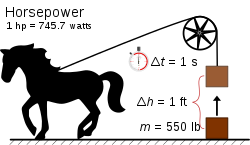
Horsepower (hp) is a unit of measurement of power, or the rate at which work is done, usually in reference to the output of engines or motors. There are many different standards and types of horsepower. Two common definitions used today are the imperial horsepower as in "hp" or "bhp" which is about 745.7 watts, and the metric horsepower also represented as "cv" or "PS" which is approximately 735.5 watts. The electric horsepower "hpE" is exactly 746 watts, while the boiler horsepower is 9809.5 or 9811 watts, depending on the exact year.[clarification needed]
The term was adopted in the late 18th century by Scottish engineer James Watt to compare the output of steam engines with the power of draft horses. It was later expanded to include the output power of other power-generating machinery such as piston engines, turbines, and electric motors. The definition of the unit varied among geographical regions. Most countries now use the SI unit watt for measurement of power. With the implementation of the EU Directive 80/181/EEC on 1 January 2010, the use of horsepower in the EU is permitted only as a supplementary unit.
The development of the steam engine provided a reason to compare the output of horses with that of the engines that could replace them. In 1702, Thomas Savery wrote in The Miner's Friend:
The idea was later used by James Watt to help market the Watt steam engine, an improved Newcomen steam engine. He had previously agreed to take royalties of one-third of the savings in coal from the older Newcomen steam engines. This royalty scheme did not work with customers who did not have existing steam engines but used horses instead.
Watt determined that a horse could turn a mill wheel 144 times in an hour (or 2.4 times a minute). The wheel was 12 feet (3.7 m) in radius; therefore, the horse travelled 2.4 × 2π × 12 feet in one minute. Watt judged that the horse could pull with a force of 180 pounds-force (800 N). So:
Engineering in History recounts that John Smeaton initially estimated that a horse could produce 22,916 foot-pounds (31,070 J) per minute. John Desaguliers had previously suggested 44,000 foot-pounds (59,656 J) per minute, and Thomas Tredgold suggested 27,500 foot-pounds (37,285 J) per minute. "Watt found by experiment in 1782 that a 'brewery horse' could produce 32,400 foot-pounds [43,929 J] per minute." James Watt and Matthew Boulton standardized that figure at 33,000 foot-pounds (44,742 J) per minute the next year.
A common legend states that the unit was created when one of Watt's first customers, a brewer, specifically demanded an engine that would match a horse, and chose the strongest horse he had and driving it to the limit. In that legend, Watt accepted the challenge and built a machine that was actually even stronger than the figure achieved by the brewer, and the output of that machine became the horsepower.
In 1993, R. D. Stevenson and R. J. Wassersug published correspondence in Nature summarizing measurements and calculations of peak and sustained work rates of a horse. Citing measurements made at the 1925 Iowa State Fair, they reported that the peak power over a few seconds has been measured to be as high as 14.88 hp (11.10 kW) and also observed that for sustained activity, a work rate of about 1 hp (0.75 kW) per horse is consistent with agricultural advice from both the 19th and 20th centuries and also consistent with a work rate of about four times the basal rate expended by other vertebrates for sustained activity.
Horsepower
Horsepower (hp) is a unit of measurement of power, or the rate at which work is done, usually in reference to the output of engines or motors. There are many different standards and types of horsepower. Two common definitions used today are the imperial horsepower as in "hp" or "bhp" which is about 745.7 watts, and the metric horsepower also represented as "cv" or "PS" which is approximately 735.5 watts. The electric horsepower "hpE" is exactly 746 watts, while the boiler horsepower is 9809.5 or 9811 watts, depending on the exact year.[clarification needed]
The term was adopted in the late 18th century by Scottish engineer James Watt to compare the output of steam engines with the power of draft horses. It was later expanded to include the output power of other power-generating machinery such as piston engines, turbines, and electric motors. The definition of the unit varied among geographical regions. Most countries now use the SI unit watt for measurement of power. With the implementation of the EU Directive 80/181/EEC on 1 January 2010, the use of horsepower in the EU is permitted only as a supplementary unit.
The development of the steam engine provided a reason to compare the output of horses with that of the engines that could replace them. In 1702, Thomas Savery wrote in The Miner's Friend:
The idea was later used by James Watt to help market the Watt steam engine, an improved Newcomen steam engine. He had previously agreed to take royalties of one-third of the savings in coal from the older Newcomen steam engines. This royalty scheme did not work with customers who did not have existing steam engines but used horses instead.
Watt determined that a horse could turn a mill wheel 144 times in an hour (or 2.4 times a minute). The wheel was 12 feet (3.7 m) in radius; therefore, the horse travelled 2.4 × 2π × 12 feet in one minute. Watt judged that the horse could pull with a force of 180 pounds-force (800 N). So:
Engineering in History recounts that John Smeaton initially estimated that a horse could produce 22,916 foot-pounds (31,070 J) per minute. John Desaguliers had previously suggested 44,000 foot-pounds (59,656 J) per minute, and Thomas Tredgold suggested 27,500 foot-pounds (37,285 J) per minute. "Watt found by experiment in 1782 that a 'brewery horse' could produce 32,400 foot-pounds [43,929 J] per minute." James Watt and Matthew Boulton standardized that figure at 33,000 foot-pounds (44,742 J) per minute the next year.
A common legend states that the unit was created when one of Watt's first customers, a brewer, specifically demanded an engine that would match a horse, and chose the strongest horse he had and driving it to the limit. In that legend, Watt accepted the challenge and built a machine that was actually even stronger than the figure achieved by the brewer, and the output of that machine became the horsepower.
In 1993, R. D. Stevenson and R. J. Wassersug published correspondence in Nature summarizing measurements and calculations of peak and sustained work rates of a horse. Citing measurements made at the 1925 Iowa State Fair, they reported that the peak power over a few seconds has been measured to be as high as 14.88 hp (11.10 kW) and also observed that for sustained activity, a work rate of about 1 hp (0.75 kW) per horse is consistent with agricultural advice from both the 19th and 20th centuries and also consistent with a work rate of about four times the basal rate expended by other vertebrates for sustained activity.
Recent media
Recent media