Recent from talks
Nothing was collected or created yet.
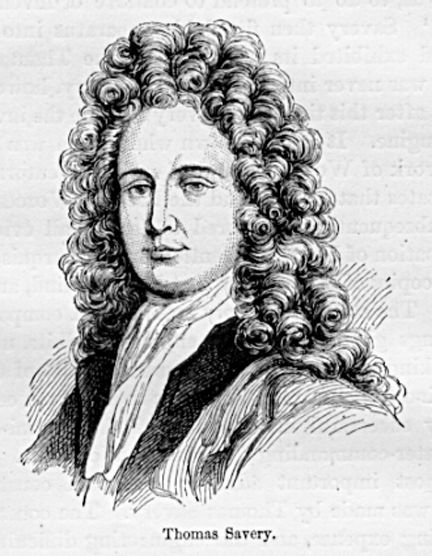
Thomas Savery
View on Wikipedia
Thomas Savery (/ˈseɪvəri/; c. 1650 – 15 May 1715) was an English inventor and engineer. He invented the first commercially used steam-powered device, a steam pump[1] which is often referred to as the "Savery engine". Savery's steam pump was a revolutionary method of pumping water, which improved mine drainage and made widespread public water supply practicable.
Key Information
Career
[edit]Thomas Savery was born around 1650 at the manor house of Shilstone, near Modbury, Devon. He received a good education and became a military engineer, rising to the rank of captain by 1702. He spent his free time performing experiments in mechanics. In 1696 he took out a patent for a machine for polishing glass or marble, and another for "rowing of ships with greater ease and expedition than hitherto been done by any other" which involved paddle-wheels driven by a capstan; however, this was dismissed by the Admiralty following a negative report by Edmund Dummer, the Surveyor of the Navy.[2]
Savery also worked for the Sick and Hurt Commissioners, contracting the supply of medicines to the Navy Stock Company, which was connected with the Society of Apothecaries. His duties on their behalf took him to Dartmouth, Devon, which is probably how he came into contact with Thomas Newcomen.[citation needed]
Steam-powered pump
[edit]
On 2 July 1698 Savery patented a steam-powered pump, which he called:
A new invention for raiseing of water and occasioning motion to all sorts of mill work by the impellent force of fire, which will be of great use and advantage for drayning mines, serveing townes with water, and for the working of all sorts of mills where they have not the benefitt of water nor constant windes.[a]
It was referred to as the "Savery engine" following contemporary use of the word "engine" to mean any device or contrivance. He demonstrated it to the Royal Society on 14 June 1699. The patent had no illustrations or description, but in 1702 Savery described the machine in his book The Miner's Friend; or, An Engine to Raise Water by Fire,[3] in which he claimed that it could pump water out of mines.

Savery's was a pistonless pump with no moving parts except from the taps. It was operated by first raising steam in the boiler; the steam was then admitted to one of the first working vessels, allowing it to blow out through a downpipe into the water that was to be raised. When the system was hot and therefore full of steam the tap between the boiler and the working vessel was shut, and if necessary the outside of the vessel was cooled. This made the steam inside it condense, creating a partial vacuum, and atmospheric pressure pushed water up the downpipe until the vessel was full. At this point the tap below the vessel was closed, and the tap between it and the up-pipe opened, and more steam was admitted from the boiler. As the steam pressure built up, it forced the water from the vessel up the up-pipe to the top of the mine.

However, his pump had four serious problems. First, every time water was admitted to the working vessel much of the heat was wasted in warming up the water that was being pumped. Second, the next stage of the process required high-pressure steam to force the water up, and the pump's soldered joints were barely capable of withstanding high pressure steam and needed frequent repair. Third, although this pump used positive steam pressure to push water up out (with no theoretical limit to the height to which water could be lifted by a single high-pressure pump) practical and safety considerations meant that in practice, to clear water from a deep mine would have needed a series of moderate-pressure pumps all the way from the bottom level to the surface. Fourth, water was pushed up into the pump only by atmospheric pressure (working against a condensed-steam 'vacuum'), so the pump had to be no more than about 30 feet (9.1 m) above the water level – requiring it to be installed, operated, and maintained far down in the dark mines all over.
Fire Engine Act
[edit]Savery's original patent of July 1698 gave 14 years' protection; the next year, 1699, an Act of Parliament was passed which extended his protection for a further 21 years. This act "Encouraging Thomas Savery's invention for raising water and relating to all sorts of mill work" became known as the "Fire Engine Act". Savery's very broad patent covered all pumps that raised water by fire.[4]
The architect James Smith of Whitehill acquired the rights to use Savery's pump in Scotland. In 1699, he entered into an agreement with the inventor, and in 1701 he secured a patent from the Parliament of Scotland, modelled on Savery's grant in England, and designed to run for the same period of time. Smith described the machine as "an engine or invention for raising of water and occasioning motion of mill-work by the force of fire", and he claimed to have modified it to pump from a depth of 14 fathoms, or 84 feet.[5][b]
In England, Savery's patent meant that Thomas Newcomen was forced to go into partnership with him. By 1712, arrangements had been made between the two men to develop Newcomen's more advanced design of steam engine, which was marketed under Savery's patent, adding water tanks and pump rods so that deeper water mines could be accessed with steam power.[6] Newcomen's engine worked purely by atmospheric pressure, thereby avoiding the dangers of high-pressure steam, and used the piston concept invented in 1690 by the Frenchman Denis Papin to produce the first steam engine capable of raising water from deep mines.[7]
When Papin was back to London in 1707, he was asked by Isaac Newton, new President of the Royal Society after Robert Boyle, Papin's friend, to work with Savery, who worked for five years with Papin, but never gave any credit nor revenue to the French scientist.
After his death in 1715 Savery's patent and Act of Parliament became vested in a company, The Proprietors of the Invention for Raising Water by Fire.[c] This company issued licences to others for the building and operation of Newcomen engines, charging as much as £420 per year patent royalties for the construction of steam engines.[8] In one case a colliery paid the Proprietors £200 per year and half their net profits "in return for their services in keeping the engine going".[9]
The Fire Engine Act did not expire until 1733, four years after the death of Newcomen.[10]
Application of the steam pump
[edit]A newspaper in March 1702 announced that Savery's pumps were ready for use and might be seen on Wednesday and Saturday afternoons at his workhouse in Salisbury Court, London, over against the Old Playhouse.
One of his pumps was set up at York Buildings in London. According to later descriptions, the pump produced steam "eight or ten times stronger than common air" (approximately 8 to10 atmospheres), but blew open the joints of the machine, forcing him to solder the joints with spelter.[11]
Another was built to control the water supply at Hampton Court, while another at Campden House in Kensington operated for 18 years.[12]
A few Savery pumps were tried in mines, an unsuccessful attempt being made to use one to clear water from a pool called Broad Waters in Wednesbury (then in Staffordshire) and nearby coal mines. This had been covered by a sudden eruption of water some years before. However, the pump could not be "brought to answer", and the quantity of steam raised was so great it was described to have "rent the whole machine to pieces". The steam pump was laid aside, and the scheme for raising water was dropped as impracticable.[13][14] This may have been in about 1705.[14]
Another pump was proposed in 1706 by George Sparrow at Newbold near Chesterfield, where a landowner was having difficulty in obtaining the consent of his neighbours for a sough (underground channel) to drain his coal. Nothing came of this, perhaps due to the explosion of the Broad Waters pump.[14] It is also possible that a steam pump was tried at Wheal Vor, a copper mine in Cornwall.[15]
Comparison with Newcomen steam engine
[edit]The Savery steam pump was much lower in capital cost than the Newcomen steam engine, with a 2- to 4-horsepower Savery pump costing from 150–200 GBP.[16] It was also available in small sizes, down to one horsepower. Newcomen steam engines were larger and much more expensive. The larger size was due to the fact that piston steam engines became very inefficient in small sizes, at least until around the year 1900, when 2-horsepower piston engines were available.[17] Savery-type pumps continued to be produced well into the late 18th century.
Inspiration for later work
[edit]Several later pumping systems may be based on Savery's pump. For example, the twin-chamber pulsometer steam pump was a successful development of it.[18]
See also
[edit]References
[edit]Footnotes
[edit]Sources
[edit]- Jenkins, Rhys (1936). Links in the History of Engineering and Technology from Tudor Times. Ayer Publishing. p. 66. ISBN 0-8369-2167-4. Retrieved 17 July 2025 – via The Internet Archive.
{{cite book}}: ISBN / Date incompatibility (help)
Other citations
[edit]- ^ Oakes, Elizabeth H. (2002). A to Z of STS scientists. Internet Archive. New York : Facts On File. p. 267. ISBN 978-0-8160-4606-5.
{{cite book}}: CS1 maint: publisher location (link) - ^ Fox, Celina (2007). "The Ingenious Mr Dummer: Rationalizing the Royal Navy in Late Seventeenth-Century England" (PDF). Electronic British Library Journal. p. 25. Archived from the original (PDF) on 3 March 2016. Retrieved 17 July 2025.
- ^ Savery, Thomas (1827). The Miner's Friend: Or, an Engine to Raise Water by Fire. S. Crouch – via The Internet Archive.
- ^ Elizabeth H. Oakes, A to Z of STS scientists, Facts on File Inc – 2002, ISBN 978-0-8160-4606-5 archive.org pp. 214–215, 267
- ^ The Records of the Parliaments of Scotland to 1707, K.M. Brown et al eds (St Andrews, 2007–2013), date accessed: 24 June 2013.[1]
- ^ "Steam Condensate: Important Things to Know | DFT Valves". DFT Valves. 6 March 2018. Retrieved 22 June 2018.
- ^ L. T. C. Rolt and J. S. Allen, The Steam Engine of Thomas Newcomen (Landmark Publishing, Ashbourne 1997).
- ^ Oldroyd, David (2007). Estates, Enterprise and Investment at the Dawn of the Industrial Revolution. Ashgate Publishing Ltd. p. 14. ISBN 978-0-7546-3455-3.
- ^ Roll, Eric (1968). An Early Experiment in Industrial Organisation. Routledge. p. 27. ISBN 0-7146-1357-6.
- ^ Armytage, W.H.G. (1976). A Social History of Engineering. Westview Press. p. 86. ISBN 0-89158-508-7.
- ^ Rolt, L. T. C. (1977). The steam engine of Thomas Newcomen. Hartington (England); Moorland Pub. Co. (New York); Science History Publications. pp. 27–28. ISBN 978-0-88202-171-3. Retrieved 17 July 2025 – via The Internet Archive.
- ^ E. I. Carlyle, 'Savery, Thomas (1650?–1715)', rev. Christopher F. Lindsey, Oxford Dictionary of National Biography, Oxford University Press, 2004, accessed 29 April 2006 URL
- ^ Richard Wilkes of Willenhall, quoted in Stebbing Shaw, History and Antiquities of Staffordshire (1798–1801) II(1), 120
- ^ a b c P. W. King. 'Black Country Mining before the Industrial Revolution' Mining History: The Bulletin of the Peak District Mines History Society 16(6), 42–43.
- ^ Earl, Bryan (1994). Cornish Mining: The Techniques of Metal Mining in the West of England, Past and Present (2nd ed.). St Austell: Cornish Hillside Publications. p. 38. ISBN 0-9519419-3-3.
- ^ Landes, David. S. (1969). The Unbound Prometheus: Technological Change and Industrial Development in Western Europe from 1750 to the Present. Cambridge; New York: Press Syndicate of the University of Cambridge. p. 62, Note 2. ISBN 0-521-09418-6.
- ^ Hunter, Louis C.; Bryant, Lynwood (1991). A History of Industrial Power in the United States, 1730–1930, Vol. 3: The Transmission of Power. Cambridge, Massachusetts, London: MIT Press. p. xxii. ISBN 0-262-08198-9.
- ^ "SPP Pumps". spppumps.com. Archived from the original on 1 December 2006.
Further reading
[edit]- Savery, Thomas (1827). The Miner's Friend: Or, an Engine to Raise Water by Fire. S. Crouch.
- Smiles, Samuel (1865). Lives of Boulton and Watt. Lippincott.
- There are countless modern day reprints: Smiles, Samuel (September 2006). Lives of Boulton and Watt. Michigan. ISBN 1-4255-6053-9. Smiles, Samuel (January 2006). Lives of Boulton and Watt. Read Books. ISBN 1-4067-9863-0. Smiles, Samuel (June 2007). Lives of Boulton and Watt. History Press Limited. ISBN 978-1-84588-371-3.
- Reprinted in Appendix B of: Savary, A.W.; Lydia A. Savary (1893). A Genealogical and Biographical Record of the Savery Families and of the Severy Family. Lippincott.
External links
[edit]- Diagram of Savery's pump at the Wayback Machine (archived 14 August 2007)
Thomas Savery
View on GrokipediaEarly Life and Career
Early Life and Education
Thomas Savery was born around 1650 at Shilstone Manor, a historic estate near Modbury in Devon, England, as one of two sons of Richard Savery.[7] The Savery family was part of the local gentry, known for their prosperity through involvement in farming and trade, with roots tracing back to Christopher Savery, Richard's father, in the nearby town of Totnes.[8] This affluent background provided Savery with a stable upbringing in a rural setting conducive to observing practical mechanics, such as those related to agriculture and local industries. Savery received a solid education typical for a gentleman's son in mid-17th-century England, likely encompassing mathematics and mechanics, subjects that ignited his early fascination with engineering principles.[9] While no records specify particular schools or tutors, his family's social standing afforded access to quality instruction, fostering a foundation in scientific inquiry.[9] From a young age, Savery exhibited self-taught mechanical aptitude, devoting leisure time to hands-on experiments and devising simple devices, which honed his inventive skills long before his professional endeavors. This early exposure to practical problem-solving naturally transitioned into a military engineering career, where he could apply his growing expertise.[9]Military Service and Early Experiments
Thomas Savery entered military engineering in the late 17th century, attaining the rank of trench-master by 1696 through his service in the British armed forces. By 1702, he had risen to the rank of captain in the engineers, a position that involved technical oversight of fortifications and related projects. In 1705, Savery was appointed treasurer of the hospital for sick and hurt seamen, a role under the Commissioners for Sick and Hurt Seamen responsible for naval medical services, which he secured through the patronage of Prince George of Denmark. This position connected him to maritime logistics and supply chains, including contracts for medicines supplied to the Navy Stock Company.[9] During his military duties, Savery pursued mechanical experiments in his spare time, reflecting the inventive spirit of Restoration-era engineers. In 1696, he patented a machine for grinding and polishing plate glass (patent no. 347), though it achieved limited commercial success due to practical challenges in implementation. That same year, he secured another patent for a paddle-wheel propulsion system driven by capstans, designed to row ships more efficiently in calm waters; a demonstration on a small yacht proved feasible but failed to gain widespread naval adoption owing to reliability issues. Among his lesser-known personal inventions were a clock crafted for his family, which remains a testament to his early mechanical aptitude, and an odometer for measuring distances traveled by ships, aiding navigation in an era of expanding maritime trade.[9][10] These devices, though minor, showcased Savery's broad inventive range beyond military applications. Savery's experiments occurred amid the industrial pressures of late 17th-century England, where deepening coal mines increasingly faced severe water inundation, limiting extraction depths to up to around 150-200 feet (45-60 meters) without effective drainage.[11] Growing demand for coal as a fuel substitute for scarce timber exacerbated these challenges in mining regions like Northumberland and Durham, prompting innovators to explore mechanical pumping solutions. Savery, though from Devon, drew inspiration from these widespread problems in his tinkering, with his early mechanical pursuits laying groundwork for later hydraulic innovations.Inventions and Innovations
Pre-Steam Inventions
Thomas Savery's early inventive efforts focused on mechanical devices aimed at improving industrial and maritime efficiency, demonstrating his growing expertise in engineering principles during the 1690s. In 1696, he secured a patent for a machine designed to polish plate glass, which involved grinding and refining surfaces to achieve a smooth finish suitable for windows and decorative applications. This invention reflected Savery's interest in precision mechanics, though it saw limited adoption due to the era's modest demand for such specialized glasswork and the device's operational inefficiencies compared to manual methods.[12] Another significant pre-steam invention was Savery's 1696 contrivance for propelling ships, patented under number 347 on January 10. The design featured two paddle-wheels, one mounted on each side of the vessel, driven by a capstan operated by human manpower to provide motion in calm waters where sails were ineffective. Savery demonstrated a prototype on a small yacht along the River Thames, achieving successful propulsion and earning royal endorsement from King William III.[9] Despite this, the British Royal Navy rejected the innovation, citing concerns over its practicality for large warships and influenced by official reluctance to adopt ideas from non-naval engineers, such as surveyor Edmund Dummer's dismissal of external contributions.[9] Savery also developed an odometer for maritime use around the late 1690s, a gear-based mechanism intended to measure distances traveled by ships at sea, potentially aiding navigation and route planning by registering revolutions from a trailing log line.[10] This device built on earlier odometer concepts but adapted them for marine environments, though specific patent details remain sparse and it did not gain widespread naval implementation. These inventions ultimately failed commercially due to a combination of high development costs—Savery reportedly invested significant personal funds without returns—and insufficient market demand in an era dominated by traditional labor and sail power.[12] The polishing machine struggled against cheaper hand-polishing techniques, while the paddle-wheel and odometer faced institutional barriers within the military and shipping sectors, where innovation was slow to penetrate established practices. Such experiences honed Savery's mechanical skills, which later informed his pivotal work on steam-based systems.Development of the Steam Pump
In the 1690s, Thomas Savery, a military engineer by profession, became motivated to address the severe flooding problems plaguing coal mines in England, where traditional pumps struggled to remove water from deep shafts.[13] This challenge inspired the conception of what he later termed the "Miner's Friend," an innovative device harnessing steam as a power source to lift water without relying on mechanical pistons or animal labor.[14] The core design of Savery's steam pump featured a boiler for steam generation and two receiver vessels that alternated in operation. High-pressure steam from the boiler was directed into one receiver vessel, displacing air and filling it completely, after which a valve was closed to isolate it. Cold water was then sprayed onto the vessel's exterior, rapidly condensing the steam and forming a partial vacuum; atmospheric pressure subsequently forced water up a suction pipe into the vessel, capable of raising it to heights of up to 30 feet. To expel the water, steam pressure was reapplied to the vessel, pushing the contents out through a delivery pipe, with the process alternating between the two receiver vessels for continuous operation. Notably, the mechanism avoided the use of a piston or cylinder, relying instead on the expansive and contractile properties of steam.[14][15][5] During development, Savery constructed early prototypes, including a working model tested in controlled settings, which revealed significant challenges such as fuel inefficiency due to the constant need for fresh steam and substantial heat loss during the condensation phase. These issues required iterative refinements, including the addition of auxiliary boilers to maintain steam supply and insulation attempts to minimize thermal waste, though they persisted as inherent limitations of the design.[14] Savery filed for a patent on July 2, 1698, securing the first legal protection for a steam-powered device under the title "A new invention for raiseing of water and occasioning motion to all sorts of mill-work by the impellent force of fire."[16] This marked the culmination of several years of experimentation, positioning the invention as a pioneering application of thermal power for practical engineering.[9]Patent and Promotion
The 1698 Patent and Fire Engine Act
Thomas Savery secured Letters Patent No. 356 on July 2, 1698, granting him a 14-year monopoly for his invention described as "a new invention for raising of water and occasioning motion to all sorts of mill work by the impellent force of fire."[9] The patent's broad wording encompassed any device using the expansive power of steam generated by fire to lift water from mines, wells, or pits and to drive mechanical work, thereby protecting the core principle of his pump design.[16] To prolong this exclusivity, Parliament enacted the Fire Engine Act on April 25, 1699 (10 William III, c. 31), extending Savery's monopoly for an additional 21 years beyond the original patent's term, lasting until 1733.[17] The act's full title was "An Act for the Encouragement of a new Invention by Thomas Savery, for raising Water, and occasioning Motion to all Sorts of Mill-work, by the impellent Force of Fire," with key clauses affirming Savery's sole rights to all fire-powered water-raising engines, including "vessels and all the pipes and utensils thereunto," and authorizing severe penalties, such as fines up to £200, for any infringement or imitation.[17] Around 1705, Savery partnered with ironmonger John Meres and ironmaster Thomas Newcomen to license engine construction and operation across Britain. Following his death in 1715, a joint-stock company was formed to administer the patent rights.[5] The company implemented a royalty system scaled by engine size, levying up to £420 annually for units exceeding 20 horsepower, with payments continuing to Savery's estate after his death in 1715.[18] The patent's sweeping coverage prompted legal enforcement efforts, including compelling Newcomen to join the partnership since his atmospheric engine was ruled to infringe on Savery's claims, as well as disputes like the 1727 case of Smith v. Newcomen, where challengers contested the patent's applicability to non-pressure-based designs but ultimately upheld the monopoly's breadth.[17]Publication and Demonstrations
On June 14, 1699, Thomas Savery presented a working model of his steam pump, known as the "fire engine," to the fellows of the Royal Society at Gresham College in London. The setup consisted of two boilers—one small for initial steam generation and a larger one for sustained operation—connected via steam pipes to cylindrical receivers, with a double furnace beneath for heating and a regulator valve to control flow. During the demonstration, steam was admitted into the receivers to force out air, followed by sudden condensation using cold water sprays, creating a partial vacuum that drew water up from a reservoir through an inlet pipe; subsequent steam pressure then expelled the water to a height of approximately 20-30 feet, repeating the cycle efficiently over several hours. The Royal Society fellows observed the model's reliable performance in raising and discharging water without mechanical breakdown, leading to their formal approval of the invention.[14][5] In 1702, Savery publicized his invention through the publication of The Miner's Friend; or, An Engine to Raise Water by Fire, a promotional treatise that served as both technical description and sales prospectus. The book was structured with a dedication to King William III, a letter recounting the Royal Society demonstration, an address to mine adventurers, detailed chapters on the engine's operation and installation, and a dialogue addressing potential objections. It featured engraved illustrations, including a frontispiece portrait of Savery, schematic diagrams of the pump's components (such as the boiler, receivers, and piping), and cross-sections showing water flow paths. Savery argued that the engine would revolutionize mining by draining flooded shafts at low cost—claiming it could lift water for about 8 pence per hundredweight compared to 1 shilling with horse-powered pumps—while also improving ventilation to reduce hazardous "damps." For domestic applications, he promoted its use in supplying water to palaces and gardens via elevated cisterns, powering decorative fountains, and enabling rapid fire-fighting by drawing from ponds or rivers.[14][9] Savery's marketing efforts emphasized the engine's versatility and economy, asserting it could raise water to heights of 60-80 feet with minimal fuel—a small firebox of 20 by 14 inches sufficing for a three-inch bore pipe—and that even young operators aged 13-14 could manage it after brief training. He distributed copies of The Miner's Friend to mine managers across England, highlighting its potential to encourage deeper shaft sinking and increased mineral extraction. The publication garnered initial interest from mining interests, with endorsements from the Royal Society's approval and the king's patent grant lending credibility to Savery's claims of practical superiority over existing methods.[14][9]Applications and Limitations
Practical Deployments
One of the earliest practical deployments of Thomas Savery's steam pump occurred at the York Buildings waterworks in London, where it was installed to raise water from the River Thames for public supply, marking a significant step in urban water infrastructure. The pump's ability to operate without complex moving parts made it suitable for such stationary applications, though it was limited to total lifts of around 60-70 feet, with suction limited to about 20-25 feet due to vacuum imperfections.[14] At Hampton Court Palace, Savery's engine was employed to power the fountains and supply water to the grounds, providing a reliable source for ornamental and practical needs following demonstrations to King William III in the late 1690s.[9] Similarly, an installation at Campden House in Kensington demonstrated long-term viability, with the pump operating continuously for 18 years to manage water supply for the estate. In mining contexts, Savery's pump saw attempted use for drainage, notably around 1705 at a coal mine near Wednesbury, where it was set up to clear the flooded Broad Waters pool; while not fully successful for deep workings, it achieved partial effectiveness in shallow drainage operations. Other mining sites explored the technology for similar low-depth water removal, highlighting its potential in areas where traditional horse-powered pumps were costly.[14] These pumps were powered by compact coal-fired boilers, with operational capacities equivalent to the output of several horses and sufficient for the targeted applications.[14] Economically, installation costs for a 2- to 4-horsepower unit ranged from 150 to 200 pounds, while Savery collected royalties under his patent.Technical Drawbacks and Failures
The Savery steam pump suffered from severe fuel inefficiency, primarily due to the design's requirement for repeated boiler firings to generate pressurized steam for each pumping cycle, coupled with significant heat losses in the working vessel during the condensation phase that created the vacuum. This resulted in an overall thermal efficiency below 0.1%, necessitating high coal consumption that made operation economically unviable for prolonged use.[19] A major limitation was the pump's restricted lifting capacity, effective only for suction up to 20-25 feet owing to imperfect vacuums caused by air leakage from boiler feed water and dissolved gases in the source water; while subsequent steam pressure could push water higher to a total of 60-80 feet, this demanded boiler pressures up to 35 psig, heightening the risk of catastrophic explosions from overpressurization.[4][19] Maintenance challenges further compounded these issues, as the system required constant operator vigilance to manually time valve operations and monitor pressures, preventing accidents in the absence of automated controls; the exposure of iron components to alternating hot steam and condensing water also promoted corrosion, accelerating wear on the vessels and pipes.[4] Specific failures underscored the pump's unreliability, including an explosion at the Wednesbury site around 1705 from overpressure and its inability to sustain operations in deeper shafts beyond shallow levels, leading miners to abandon the technology due to safety concerns and practical inadequacies.[19][4]Legacy and Influence
Partnership with Newcomen
In 1712, Thomas Newcomen, an ironmonger and inventor, formed a partnership with Thomas Savery due to the broad scope of Savery's 1698 patent, which encompassed all steam-powered devices for raising water and covered Newcomen's developing atmospheric engine design.[20] This collaboration was compelled by the patent's legal protections, leading Newcomen and his associate John Calley to join forces with Savery to market the new engine under the joint patent, thereby avoiding infringement and extending the patent's commercial viability beyond its original 14-year term.[20][21] The resulting engine adapted Savery's vacuum-generating principles through steam condensation into Newcomen's piston-and-cylinder mechanism, creating a more efficient atmospheric steam pump capable of practical industrial use.[20][21][22] Savery's foundational steam pump, though limited in height and efficiency, provided the essential vacuum-generating principles that Newcomen adapted for broader application in mine drainage.[22] Under the partnership, the duo shared royalties from engine sales and managed the venture's operations, with Savery contributing his promotional expertise from earlier demonstrations.[20] This arrangement persisted until Savery's death in 1715, after which Newcomen and his partners assumed full control.[20] The first installation of the Newcomen engine occurred in 1712 at the Dudley Castle colliery in Staffordshire, England, where it successfully pumped water from coal mines and was explicitly credited to the collaborative efforts of Savery and Newcomen.[20][21][23]Long-Term Impact on Steam Technology
Savery's invention of the steam pump in 1698 marked the first commercially viable steam-powered device, demonstrating the practical application of steam pressure and vacuum for industrial purposes despite its operational limitations.[9] This pioneering achievement established steam as a feasible power source for water management in mining, laying essential groundwork for the technological advancements that propelled the Industrial Revolution by enabling deeper mine operations and mechanized production precursors.[24] The engine's design influenced subsequent non-condensing steam technologies, particularly inspiring 19th-century pulsometer pumps, which adopted Savery's principle of alternating steam admission and condensation in twin chambers to achieve pulsation-driven water lifting without pistons.[25] These later devices, patented in 1872, extended Savery's core concept into more efficient, valveless systems used in water supply and drainage, underscoring his enduring role in the evolution of steam-based pumping mechanisms.[26] Following Savery's death on May 15, 1715, in London, his estate transferred the patent rights via his widow to a joint-stock company formed by his partners in 1716, which managed operations and collected royalties until the patent's expiration in 1733.[18][27] These revenues supported ongoing refinements in steam technology, including the partnership with Thomas Newcomen that produced the atmospheric engine as a key outcome.[28] The extended monopoly, originally secured through the 1699 Fire Engine Act for 35 years, not only protected early innovations but also funded developmental efforts that bridged to broader industrial applications.[28]References
- https://en.wikisource.org/wiki/Dictionary_of_National_Biography%2C_1885-1900/Savery%2C_Thomas
