
Recent from talks
Metronome
Knowledge base stats:
Talk channels stats:
Members stats:
Metronome
A metronome (from Ancient Greek μέτρον (métron) 'measure' and νόμος (nómos) 'law') is a device that produces an audible click or other sound at a uniform interval that can be set by the user, typically in beats per minute (BPM). Metronomes may also include synchronized visual motion, such as a swinging pendulum or a blinking light. Musicians—and others including dancers, athletes, and health professionals—often practise with a metronome to improve their timing, especially the ability to maintain a steady tempo with a regular beat or pulse. Composers and conductors often use numerical metronome markings to communicate their preferred tempos to musicians preparing for a performance.
A type of metronome was among the inventions of the Andalusian polymath Abbas ibn Firnas (810–887). In 1815, the German inventor Johann Maelzel patented a mechanical, wind-up metronome as a tool for musicians, under the title "Instrument/Machine for the Improvement of all Musical Performance, called Metronome". In the 20th century, electronic metronomes and software metronomes were invented.
When interpreting emotion and other qualities in music, performers seldom play exactly on every beat. In a musically expressive performance, the pulse generally does not align with the clicks of a metronome. This has led some musicians to criticize use of a metronome, because "musical time is replaced by clock time".
The word metronome first appeared in English in Maelzel's 1815 patent application, and is Greek in origin, derived from metron—"measure" and nomos—"regulation, law". The London patent refers to the machine as "a metronome or musical time-keeper".
Historical credit for the mechanical metronome is spread across Spanish, Italian, French, Dutch and German contributors.
According to the historian Lynn Townsend White Jr., the Andalusian inventor Abbas Ibn Firnas created "some sort of metronome" in the 9th century. Galileo Galilei studied and discovered key concepts involving the pendulum in the late 16th and early 17th centuries, famously inspired by a steadily swaying chandelier in Pisa Cathedral. In 1696, musician Étienne Loulié built a pendulum-based "chronomètre", consisting of a lead weight hanging from an adjustable string alongside a 6-foot (2 m) vertical ruler. However, his design produced no sound, and did not have an escapement mechanism to keep the pendulum in motion. To get the correct tempo with this type of visual device, a musician would need to watch the pendulum as if watching a conductor's baton.
The more familiar mechanical musical chronometre was invented by Dietrich Nikolaus Winkel in Amsterdam in 1814, based on a spring-powered, inverted pendulum rod with fixed and adjustable weights to achieve compactness. Through questionable practice, Johann Maelzel, incorporating Winkel's ideas, added a numerical scale, called it a metronome, and started mass-manufacturing the pyramid-shaped device in 1816 under his own name: "Maelzel's Metronome." The original text of Maelzel's patent in England (1815) can be downloaded.
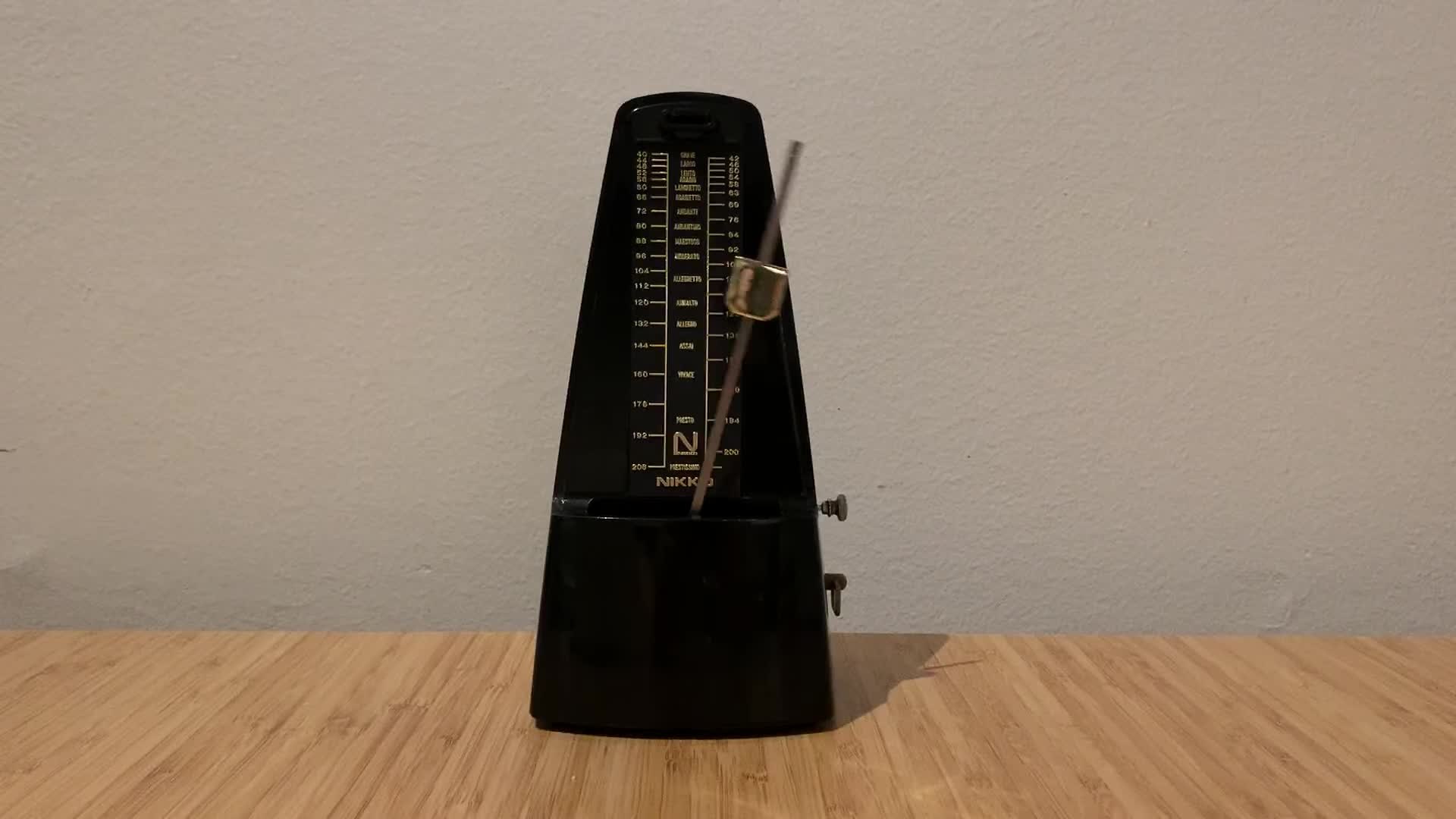
Maelzel's mechanical metronome uses an adjustable weight on an inverted pendulum rod to control tempo. The weight slides up the pendulum rod to decrease tempo, or down to increase tempo. (This mechanism is also called a double-weighted pendulum, because there is a second, fixed weight on the other side of the pendulum pivot, inside the metronome case.) The pendulum swings back and forth in tempo, while a mechanism inside the metronome produces a clicking sound with each oscillation. A mechanical metronome does not need an electric battery, but runs from a spring-wound clockwork escapement. For uniform beats, the metronome should be placed on a hard, level, unmoving surface, and away from any strong magnets. Small variations in pendulum speed can also result from differences in temperature, air pressure, or gravity.
Hub AI
Metronome AI simulator
(@Metronome_simulator)
Metronome
A metronome (from Ancient Greek μέτρον (métron) 'measure' and νόμος (nómos) 'law') is a device that produces an audible click or other sound at a uniform interval that can be set by the user, typically in beats per minute (BPM). Metronomes may also include synchronized visual motion, such as a swinging pendulum or a blinking light. Musicians—and others including dancers, athletes, and health professionals—often practise with a metronome to improve their timing, especially the ability to maintain a steady tempo with a regular beat or pulse. Composers and conductors often use numerical metronome markings to communicate their preferred tempos to musicians preparing for a performance.
A type of metronome was among the inventions of the Andalusian polymath Abbas ibn Firnas (810–887). In 1815, the German inventor Johann Maelzel patented a mechanical, wind-up metronome as a tool for musicians, under the title "Instrument/Machine for the Improvement of all Musical Performance, called Metronome". In the 20th century, electronic metronomes and software metronomes were invented.
When interpreting emotion and other qualities in music, performers seldom play exactly on every beat. In a musically expressive performance, the pulse generally does not align with the clicks of a metronome. This has led some musicians to criticize use of a metronome, because "musical time is replaced by clock time".
The word metronome first appeared in English in Maelzel's 1815 patent application, and is Greek in origin, derived from metron—"measure" and nomos—"regulation, law". The London patent refers to the machine as "a metronome or musical time-keeper".
Historical credit for the mechanical metronome is spread across Spanish, Italian, French, Dutch and German contributors.
According to the historian Lynn Townsend White Jr., the Andalusian inventor Abbas Ibn Firnas created "some sort of metronome" in the 9th century. Galileo Galilei studied and discovered key concepts involving the pendulum in the late 16th and early 17th centuries, famously inspired by a steadily swaying chandelier in Pisa Cathedral. In 1696, musician Étienne Loulié built a pendulum-based "chronomètre", consisting of a lead weight hanging from an adjustable string alongside a 6-foot (2 m) vertical ruler. However, his design produced no sound, and did not have an escapement mechanism to keep the pendulum in motion. To get the correct tempo with this type of visual device, a musician would need to watch the pendulum as if watching a conductor's baton.
The more familiar mechanical musical chronometre was invented by Dietrich Nikolaus Winkel in Amsterdam in 1814, based on a spring-powered, inverted pendulum rod with fixed and adjustable weights to achieve compactness. Through questionable practice, Johann Maelzel, incorporating Winkel's ideas, added a numerical scale, called it a metronome, and started mass-manufacturing the pyramid-shaped device in 1816 under his own name: "Maelzel's Metronome." The original text of Maelzel's patent in England (1815) can be downloaded.
Maelzel's mechanical metronome uses an adjustable weight on an inverted pendulum rod to control tempo. The weight slides up the pendulum rod to decrease tempo, or down to increase tempo. (This mechanism is also called a double-weighted pendulum, because there is a second, fixed weight on the other side of the pendulum pivot, inside the metronome case.) The pendulum swings back and forth in tempo, while a mechanism inside the metronome produces a clicking sound with each oscillation. A mechanical metronome does not need an electric battery, but runs from a spring-wound clockwork escapement. For uniform beats, the metronome should be placed on a hard, level, unmoving surface, and away from any strong magnets. Small variations in pendulum speed can also result from differences in temperature, air pressure, or gravity.
Recent media