
Recent from talks
Micrasterias
Knowledge base stats:
Talk channels stats:
Members stats:
Micrasterias
Micrasterias is a unicellular green alga of the order Desmidiales. Its species vary in size reaching up to hundreds of microns.
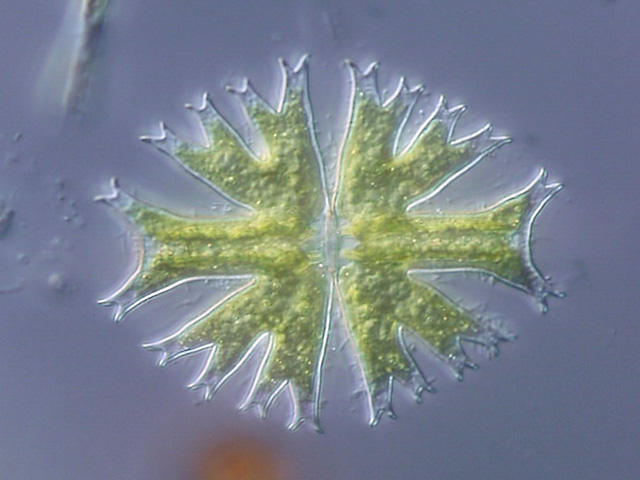
Micrasterias displays a bilateral symmetry, with two mirror image semi-cells joined by a narrow isthmus containing the nucleus of the organism. This dual semi-cell structure is unique to the group of green algae to which Micrasterias belongs. Each semi-cell contains a single large chloroplast, the site of photosynthesis for Micrasterias. Chloroplasts within Micrasterias contain chlorophyll a and chlorophyll b and the enzymes required for photosynthesis. The sugar created is used to provide energy for the organism or, if not used, taken up by many small round pyrenoids which are embedded in the chloroplast. They convert the sugar to a starch for storage.
Micrasterias can produce both asexually and sexually. Asexual reproduction occurs via mitosis. When this occurs the genetic material of Micrasterias is duplicated and two small semi-cells grow between the original semi-cells, gradually increasing in size. Sexual reproduction occurs through a process called conjugation whereby two organisms come together and fuse their haploid cells to form a diploid zygote. This zygote typically forms a thick protective wall which can allow the organism to remain dormant for many months to survive cold winters and long droughts. When adequate conditions resume, the zygospore will germinate, undergo meiosis, and produce new haploid algal cells.
Micrasterias species are symmetrical and generally consist of two flattened, identical portions called semicells that are almost entirely filled with chloroplasts, with a nucleus that lies at the center where the two semicells are joined together. The gaps between the two semicells are joined by an isthmus. Each semicell is further divided into a polar lobe and two lateral lobes. These lobes can be further subdivided up to the fourth order. Some species, such as Micrasterias laticeps, have a very different morphology, with unbranched lobes. Except for a single filament-forming species, Micrasterias foliacea, it is found as single cells. As is common in the green algae, the chloroplasts of Micrasterias contain pyrenoids.
Two species of Micrasterias have different morphologies to species traditionally placed in this genus, but molecular phylogenetic analyses demonstrate that they are embedded within Micrasterias. Micrasterias ralfsii (formerly classified as Cosmarium ralfsii) has no lobes, and the cells are smoothly ellipsoidal in outline. Micrasterias dickiei (formerly classified as Staurodesmus dickiei) is triradiate in polar view instead of flattened, and has three spines on each semicell.
Micrasterias is generally easy to identify due to its shape and typically large size.
The genus Pseudomicrasterias has been split off from the genus Micrasterias, and as of 2023, contains 2 species, formerly known as Micrasterias arcuata. They have a similar morphology to the simpler species of Micrasterias, but molecular phylogenetic analyses show that they are not related.
The genus Prescottiella contains a single species, Prescottiella sudanensis, formerly known as Micrasterias sudanensis. It is distinguished from Micrasterias in that its semicells are not identical, making the cell asymmetrical along one axis; the spines of one semicell curve towards the isthmus, while the spines of the other semicell curve away.
Hub AI
Micrasterias AI simulator
(@Micrasterias_simulator)
Micrasterias
Micrasterias is a unicellular green alga of the order Desmidiales. Its species vary in size reaching up to hundreds of microns.
Micrasterias displays a bilateral symmetry, with two mirror image semi-cells joined by a narrow isthmus containing the nucleus of the organism. This dual semi-cell structure is unique to the group of green algae to which Micrasterias belongs. Each semi-cell contains a single large chloroplast, the site of photosynthesis for Micrasterias. Chloroplasts within Micrasterias contain chlorophyll a and chlorophyll b and the enzymes required for photosynthesis. The sugar created is used to provide energy for the organism or, if not used, taken up by many small round pyrenoids which are embedded in the chloroplast. They convert the sugar to a starch for storage.
Micrasterias can produce both asexually and sexually. Asexual reproduction occurs via mitosis. When this occurs the genetic material of Micrasterias is duplicated and two small semi-cells grow between the original semi-cells, gradually increasing in size. Sexual reproduction occurs through a process called conjugation whereby two organisms come together and fuse their haploid cells to form a diploid zygote. This zygote typically forms a thick protective wall which can allow the organism to remain dormant for many months to survive cold winters and long droughts. When adequate conditions resume, the zygospore will germinate, undergo meiosis, and produce new haploid algal cells.
Micrasterias species are symmetrical and generally consist of two flattened, identical portions called semicells that are almost entirely filled with chloroplasts, with a nucleus that lies at the center where the two semicells are joined together. The gaps between the two semicells are joined by an isthmus. Each semicell is further divided into a polar lobe and two lateral lobes. These lobes can be further subdivided up to the fourth order. Some species, such as Micrasterias laticeps, have a very different morphology, with unbranched lobes. Except for a single filament-forming species, Micrasterias foliacea, it is found as single cells. As is common in the green algae, the chloroplasts of Micrasterias contain pyrenoids.
Two species of Micrasterias have different morphologies to species traditionally placed in this genus, but molecular phylogenetic analyses demonstrate that they are embedded within Micrasterias. Micrasterias ralfsii (formerly classified as Cosmarium ralfsii) has no lobes, and the cells are smoothly ellipsoidal in outline. Micrasterias dickiei (formerly classified as Staurodesmus dickiei) is triradiate in polar view instead of flattened, and has three spines on each semicell.
Micrasterias is generally easy to identify due to its shape and typically large size.
The genus Pseudomicrasterias has been split off from the genus Micrasterias, and as of 2023, contains 2 species, formerly known as Micrasterias arcuata. They have a similar morphology to the simpler species of Micrasterias, but molecular phylogenetic analyses show that they are not related.
The genus Prescottiella contains a single species, Prescottiella sudanensis, formerly known as Micrasterias sudanensis. It is distinguished from Micrasterias in that its semicells are not identical, making the cell asymmetrical along one axis; the spines of one semicell curve towards the isthmus, while the spines of the other semicell curve away.
Recent media