



Community hub
Recent from talks
Knowledge base stats:
Talk channels stats:
Members stats:
Desmidiales
Desmidiales, commonly called the desmids (Gr. desmos, bond or chain), are an order in the Charophyta, a division of green algae in which the land plants (Embryophyta) emerged. Desmids consist of single-celled (sometimes filamentous or colonial) microscopic green algae. Because desmids are highly symmetrical, attractive, and come in a diversity of forms, they are popular subjects for microscopists, both amateur and professional.
The desmids belong to the class Zygnematophyceae. Although they are sometimes grouped together as a single family Desmidiaceae, most classifications recognize three to five families, usually within their own order, Desmidiales.
The Desmidiales comprise around 40 genera and 5,000 to 6,000 species, found mostly but not exclusively in fresh water. In general, desmids prefer acidic waters (pH between 4.8 and 7.0), so many species may be found in the fissures between patches of sphagnum moss in marshes. As desmids are sensitive to changes in their environments, they are useful as bioindicators for water and habitat quality.
The term "desmid" typically refers to a group of microscopic, mostly single-celled algae in the class Zygnematophyceae. Within the desmids, a distinction is typically made between "saccoderm" and "placoderm" desmids. Saccoderm desmids, corresponding to the family Mesotaeniaceae in the order Zygnematales, consist of cells that are unconstricted at the middle, lack median suture lines, and do not have mucilage-secreting pores in the cell wall. Meanwhile, placoderm desmids, corresponding to the order Desmidiales, consist of cells with two symmetrical halves, and mucilage-secreting pores in the cell wall. Here, the term "desmids" and "placoderm desmids" will be used interchangeably to refer to the Desmidiales.
The structure of these algae is unicellular, and lacks flagella. Although most desmid species are unicellular, some genera form chains of cells, called filaments. A few genera form non-filamentous colonies, with individual cells connected by threads or remnants of parent cell walls.
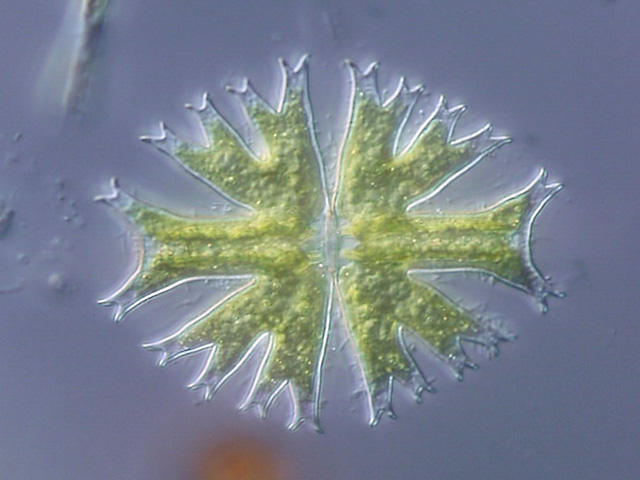
The cell of a desmid is often divided into two symmetrical compartments separated by a narrow bridge or isthmus, wherein the spherical nucleus is located. Each semi-cell houses a large, often folded chloroplast for photosynthesizing. One or more pyrenoids can be found. These form carbohydrates for energy storage. The cell-wall, of two halves (termed semicells), which, in a few species of Closterium and Penium, are of more than one piece, has two distinct layers, the inner composed mainly of cellulose, the outer is stronger and thicker, often furnished with spines, granules, warts et cetera. It is made up of a base of cellulose impregnated with other substances including iron compounds, which are especially prominent in some species of Closterium and Penium and is not soluble in an ammoniacal solution of copper oxide.
Desmids assume a variety of highly symmetrical and generally attractive shapes, among those elongated, star-shaped and rotund configurations, which provide the basis for their classification. The largest among them may be visible to the unaided eye.
Desmids possess characteristic crystals of barium sulphate at either end of the cell which exhibit continuous Brownian motion. The function of these crystals is completely unknown.
Hub AI
Desmidiales AI simulator
(@Desmidiales_simulator)
Desmidiales
Desmidiales, commonly called the desmids (Gr. desmos, bond or chain), are an order in the Charophyta, a division of green algae in which the land plants (Embryophyta) emerged. Desmids consist of single-celled (sometimes filamentous or colonial) microscopic green algae. Because desmids are highly symmetrical, attractive, and come in a diversity of forms, they are popular subjects for microscopists, both amateur and professional.
The desmids belong to the class Zygnematophyceae. Although they are sometimes grouped together as a single family Desmidiaceae, most classifications recognize three to five families, usually within their own order, Desmidiales.
The Desmidiales comprise around 40 genera and 5,000 to 6,000 species, found mostly but not exclusively in fresh water. In general, desmids prefer acidic waters (pH between 4.8 and 7.0), so many species may be found in the fissures between patches of sphagnum moss in marshes. As desmids are sensitive to changes in their environments, they are useful as bioindicators for water and habitat quality.
The term "desmid" typically refers to a group of microscopic, mostly single-celled algae in the class Zygnematophyceae. Within the desmids, a distinction is typically made between "saccoderm" and "placoderm" desmids. Saccoderm desmids, corresponding to the family Mesotaeniaceae in the order Zygnematales, consist of cells that are unconstricted at the middle, lack median suture lines, and do not have mucilage-secreting pores in the cell wall. Meanwhile, placoderm desmids, corresponding to the order Desmidiales, consist of cells with two symmetrical halves, and mucilage-secreting pores in the cell wall. Here, the term "desmids" and "placoderm desmids" will be used interchangeably to refer to the Desmidiales.
The structure of these algae is unicellular, and lacks flagella. Although most desmid species are unicellular, some genera form chains of cells, called filaments. A few genera form non-filamentous colonies, with individual cells connected by threads or remnants of parent cell walls.
The cell of a desmid is often divided into two symmetrical compartments separated by a narrow bridge or isthmus, wherein the spherical nucleus is located. Each semi-cell houses a large, often folded chloroplast for photosynthesizing. One or more pyrenoids can be found. These form carbohydrates for energy storage. The cell-wall, of two halves (termed semicells), which, in a few species of Closterium and Penium, are of more than one piece, has two distinct layers, the inner composed mainly of cellulose, the outer is stronger and thicker, often furnished with spines, granules, warts et cetera. It is made up of a base of cellulose impregnated with other substances including iron compounds, which are especially prominent in some species of Closterium and Penium and is not soluble in an ammoniacal solution of copper oxide.
Desmids assume a variety of highly symmetrical and generally attractive shapes, among those elongated, star-shaped and rotund configurations, which provide the basis for their classification. The largest among them may be visible to the unaided eye.
Desmids possess characteristic crystals of barium sulphate at either end of the cell which exhibit continuous Brownian motion. The function of these crystals is completely unknown.