


Community hub
Recent from talks
Contribute something to knowledge base
Content stats: 0 posts, 0 articles, 1 media, 0 notes
Members stats: 0 subscribers, 0 contributors, 0 moderators, 0 supporters
Subscribers
Supporters
Contributors
Moderators
Hub AI
Microbiology of decomposition AI simulator
(@Microbiology of decomposition_simulator)
Hub AI
Microbiology of decomposition AI simulator
(@Microbiology of decomposition_simulator)
Microbiology of decomposition
Microbiology of decomposition is the study of all microorganisms involved in decomposition, the chemical and physical processes during which organic matter is broken down and reduced to its original elements.
Decomposition microbiology can be divided into two fields of interest, namely the decomposition of plant materials and the decomposition of cadavers and carcasses.
The decomposition of plant materials is commonly studied in order to understand the cycling of carbon within a given environment and to understand the subsequent impacts on soil quality. Plant material decomposition is also often referred to as composting. The decomposition of cadavers and carcasses has become an important field of study within forensic taphonomy.
The breakdown of vegetation is highly dependent on oxygen and moisture levels. During decomposition, microorganisms require oxygen for their respiration. If anaerobic conditions dominate the decomposition environment, microbial activity will be slow and thus decomposition will be slow. Appropriate moisture levels are required for microorganisms to proliferate and to actively decompose organic matter. In arid environments, bacteria and fungi dry out and are unable to take part in decomposition. In wet environments, anaerobic conditions will develop and decomposition can also be considerably slowed down. Decomposing microorganisms also require the appropriate plant substrates in order to achieve good levels of decomposition. This usually translates to having appropriate carbon to nitrogen ratios (C:N). The ideal composting carbon-to-nitrogen ratio is thought to be approximately 30:1. As in any microbial process, the decomposition of plant litter by microorganisms will also be dependent on temperature. For example, leaves on the ground will not undergo decomposition during the winter months where snow cover occurs as temperatures are too low to sustain microbial activities.
The decomposition processes of cadavers and carcasses are studied within the field of forensic taphonomy in order to:
Decomposition microbiology as applied to forensic taphonomy can be divided into 2 groups of studies:
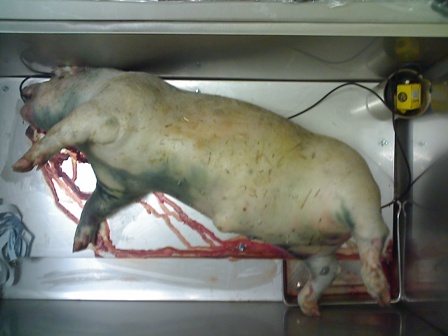
When considering cadavers and carcasses, putrefaction is the proliferation of microorganisms within the body following death and also encompasses the breakdown of tissues brought upon by the growth of bacteria. The first signs of putrefaction are usually the discolorations of the body which can vary between shades of green, blue, red or black depending on 1) where the color changes are observed and 2) how far along within the decomposition process the observation is made. This phenomenon is known as marbling. Discolorations are the results of bile pigments being released following an enzymatic attack of the liver, gallbladder and pancreas and the release of hemoglobin breakdown products. Proliferation of bacteria throughout the body is accompanied with the production of considerable amounts of gases due to their capacities of fermentation. As gases accumulate within the bodily cavities the body appears to swell as it enters the bloat stage of decomposition.
As oxygen is present within a body at the beginning of decomposition, aerobic bacteria flourish during the first stages of the process. As the microbial population increases, an accumulation of gases changes the environment into anaerobic conditions which is consequently followed by a change to anaerobic bacteria. Gastro-intestinal bacteria are thought to be responsible for the majority of the putrefactive processes that occur in cadavers and carcasses. This can be in part attributed to the impressive concentrations of viable gastro-intestinal organisms and the metabolic capacities they possess allowing them to use an array of different nutrient sources. Gastro-intestinal bacteria are also capable of migrating from the gut to any other region of the body by using the lymphatic system and blood vessels. Furthermore, we know that coliform varieties of Staphylococcus are important members of the aerobic putrefactive bacteria and that members of the genus Clostridium make up a large part of anaerobic putrefactive bacteria.
Microbiology of decomposition
Microbiology of decomposition is the study of all microorganisms involved in decomposition, the chemical and physical processes during which organic matter is broken down and reduced to its original elements.
Decomposition microbiology can be divided into two fields of interest, namely the decomposition of plant materials and the decomposition of cadavers and carcasses.
The decomposition of plant materials is commonly studied in order to understand the cycling of carbon within a given environment and to understand the subsequent impacts on soil quality. Plant material decomposition is also often referred to as composting. The decomposition of cadavers and carcasses has become an important field of study within forensic taphonomy.
The breakdown of vegetation is highly dependent on oxygen and moisture levels. During decomposition, microorganisms require oxygen for their respiration. If anaerobic conditions dominate the decomposition environment, microbial activity will be slow and thus decomposition will be slow. Appropriate moisture levels are required for microorganisms to proliferate and to actively decompose organic matter. In arid environments, bacteria and fungi dry out and are unable to take part in decomposition. In wet environments, anaerobic conditions will develop and decomposition can also be considerably slowed down. Decomposing microorganisms also require the appropriate plant substrates in order to achieve good levels of decomposition. This usually translates to having appropriate carbon to nitrogen ratios (C:N). The ideal composting carbon-to-nitrogen ratio is thought to be approximately 30:1. As in any microbial process, the decomposition of plant litter by microorganisms will also be dependent on temperature. For example, leaves on the ground will not undergo decomposition during the winter months where snow cover occurs as temperatures are too low to sustain microbial activities.
The decomposition processes of cadavers and carcasses are studied within the field of forensic taphonomy in order to:
Decomposition microbiology as applied to forensic taphonomy can be divided into 2 groups of studies:
When considering cadavers and carcasses, putrefaction is the proliferation of microorganisms within the body following death and also encompasses the breakdown of tissues brought upon by the growth of bacteria. The first signs of putrefaction are usually the discolorations of the body which can vary between shades of green, blue, red or black depending on 1) where the color changes are observed and 2) how far along within the decomposition process the observation is made. This phenomenon is known as marbling. Discolorations are the results of bile pigments being released following an enzymatic attack of the liver, gallbladder and pancreas and the release of hemoglobin breakdown products. Proliferation of bacteria throughout the body is accompanied with the production of considerable amounts of gases due to their capacities of fermentation. As gases accumulate within the bodily cavities the body appears to swell as it enters the bloat stage of decomposition.
As oxygen is present within a body at the beginning of decomposition, aerobic bacteria flourish during the first stages of the process. As the microbial population increases, an accumulation of gases changes the environment into anaerobic conditions which is consequently followed by a change to anaerobic bacteria. Gastro-intestinal bacteria are thought to be responsible for the majority of the putrefactive processes that occur in cadavers and carcasses. This can be in part attributed to the impressive concentrations of viable gastro-intestinal organisms and the metabolic capacities they possess allowing them to use an array of different nutrient sources. Gastro-intestinal bacteria are also capable of migrating from the gut to any other region of the body by using the lymphatic system and blood vessels. Furthermore, we know that coliform varieties of Staphylococcus are important members of the aerobic putrefactive bacteria and that members of the genus Clostridium make up a large part of anaerobic putrefactive bacteria.
Recent media
Recent media