



Community hub
Community hub
Recent from talks
Knowledge base stats:
Talk channels stats:
Members stats:
Mid-ocean escort force
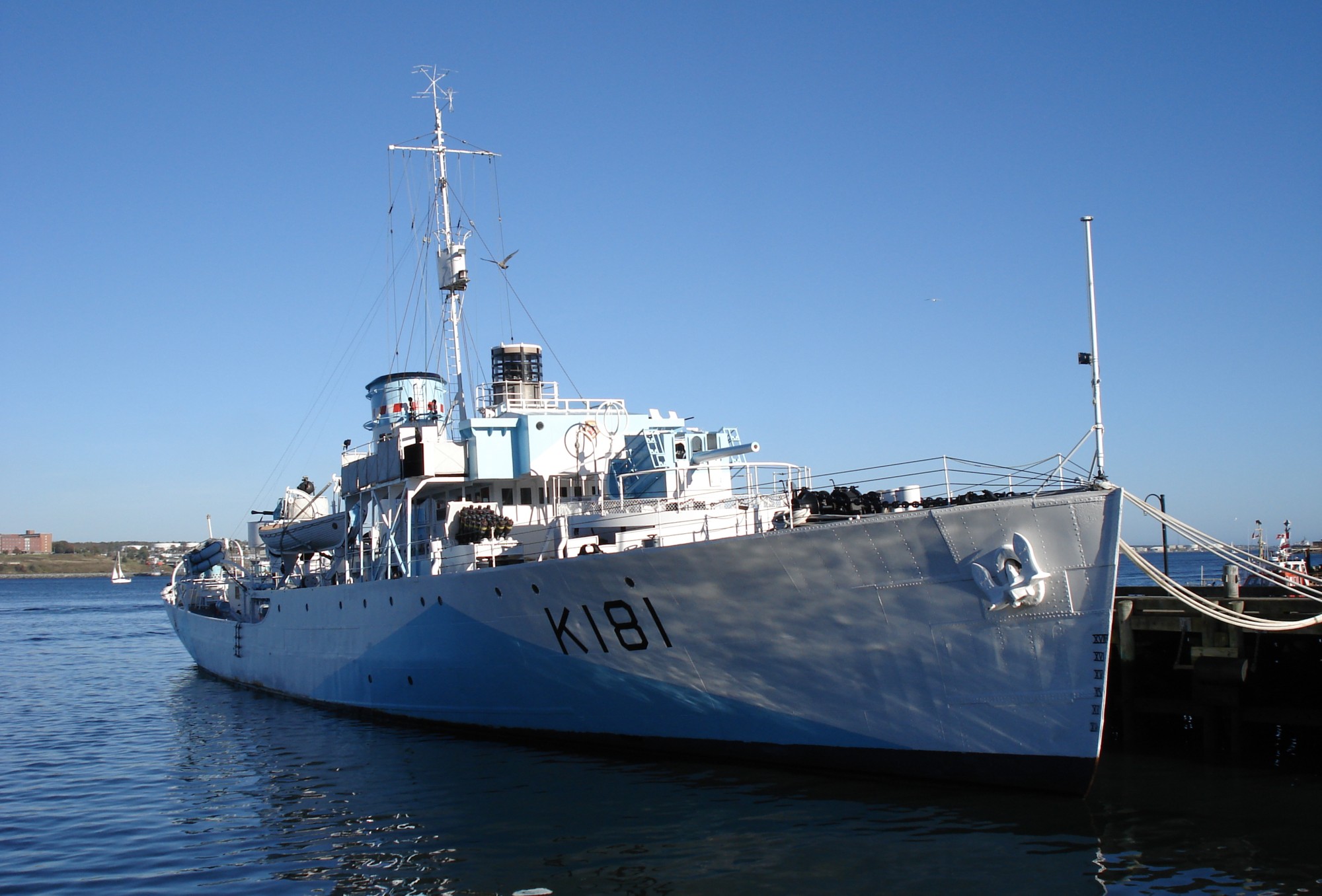
Mid-Ocean Escort Force (MOEF) referred to the organisation of anti-submarine escorts for World War II trade convoys between Canada and Newfoundland, and the British Isles. The allocation of United States, British and Canadian escorts to these convoys reflected preferences of the United States upon United States' declaration of war and the organisation persisted through the winter of 1942–43 despite withdrawal of United States ships from the escort groups. By the summer of 1943, United States Atlantic escorts were focused on the faster CU convoys and the UG convoys between Chesapeake Bay and the Mediterranean Sea; and only British and Canadian escorts remained on the HX, SC and ON convoys.
On the basis of experience during World War I, the Admiralty instituted trade convoys in United Kingdom coastal waters from September 1939. Anti-submarine escorts were allocated on the basis of perceived threat. Early German Type II submarines from bases in Germany were unable to operate effectively beyond European coastal waters. Following acquisition of bases in Norway and France, German Type IX submarines and German Type VII submarines refuelled by German Type XIV submarines operated in the mid-Atlantic beyond the range of patrolling aircraft. Many anti-submarine escorts lacked the endurance to accompany convoys through the mid-Atlantic. HX 129 left Halifax on 27 May 1941 as the first convoy to receive escort for the entire trip. Escorts based in Halifax Harbour handed HX 129 off to escorts based in Newfoundland who subsequently transferred HX 129 to escorts based in Iceland who in turn delivered HX 129 to escorts based in the Western Approaches.
In Newfoundland on 9 August 1941, President Franklin D. Roosevelt agreed to provide American destroyers for the Canada to Iceland portion of HX convoys and westbound ON convoys. HX 150 sailed 16 September 1941 as the first convoy with American escort. ON 18 sailed 24 September as the first westbound convoy with American escort. The Royal Canadian Navy continued to escort the SC convoys and their slower ON counterparts. Canadian escort groups were increased from a nominal strength of four ships to six – typically one Canadian River-class destroyer with five Flower-class corvettes.
The Gleaves-class destroyer Kearny was torpedoed while escorting Convoy SC 48 on 17 October 1941. Clemson-class destroyer Reuben James was torpedoed and sunk on 31 October 1941 while escorting Convoy HX 156. When the United States declared war, American escort groups typically contained five destroyers, although six United States Coast Guard Treasury-class cutters were included within the pool of ships rotating in and out of these escort groups.
As the United States Navy struggled to find enough destroyers to meet escort needs for both the Pacific and the vulnerable Atlantic coastal shipping, the shorter great-circle route from Newfoundland to the British Isles was considered as a means of eliminating meeting point delays and reducing the number of destroyers required for escort of convoys between Canada and the United Kingdom. Initial proposals by the United States on 24 January 1942 produced an agreement in early February for a mid-ocean escort force organisation of fourteen escort groups. American-led escort groups were prefixed with the letter "A"; while "B" indicated British-led escort groups and "C" designated Canadian-led escort groups. Fifteen United States destroyers, fifteen Royal Navy destroyers and twelve Canadian destroyers were to provide the striking power of these escort groups while 52 British and 49 Canadian Flower-class corvettes were to perform the patrolling role. Approximately one-third of the theoretical MOEF escort group strength of three destroyers and seven corvettes was unavailable at any given time. Half of the unavailable ships needed storm or battle damage repairs, and the remainder were undergoing normal refit and training.
Each MOEF escort group worked in a 33-day cycle allowing nine and one-half days with a westbound ON convoy, six days in St. John's, Newfoundland and Labrador, nine and one-half days with an eastbound HX or SC convoy, and eight days' refit in Derry. The shorter routing away from Iceland eliminated the need for most escorts to attempt maintenance in Iceland's poorly equipped Hvalfjörður anchorage; but the United States was required to maintain an additional force of five destroyers in Iceland to escort ships between trans-Atlantic convoys and United States military occupation bases. The Royal Navy continued to provide an eastern local escort force of naval trawlers in the Western Approaches while Canada continued to provide a western local escort force (WLEF) of corvettes, minesweepers, and short-range destroyers between Halifax Harbour and Newfoundland.
Corvettes had adequate endurance for MOEF assignments, but the fuel economy of destroyers was poor at the speeds that convoys operated. The escort group leaders were modern destroyers with adequate endurance but, of the older destroyers allocated to trade convoy escort, only the Clemson subgroup of the Town-class destroyers proved suitable for MOEF assignments. Wickes-class destroyers were useful for the Canadian WLEF and the American Iceland shuttle; but lacked endurance to stay with a trade convoy for the full distance covered by the MOEF Escort Groups. The Admiralty converted some V and W-class destroyers to long range escorts by removing the forward boiler and using the space for additional fuel tanks.
Nineteen modern American destroyers left the Atlantic to escort the battleships New Mexico, Mississippi, Idaho, and North Carolina and the aircraft carriers Yorktown, Wasp, and Hornet to the Pacific. The remaining American destroyers were diverted from MOEF assignments to troop convoys and in response to the U-boat's Second happy time off the American east coast. Escort Groups A-1 and A-2 were disbanded when their modern American destroyer leaders were assigned elsewhere. Escort Groups A-4 and A-5 were redesignated B6 and B7, respectively, when the Royal Navy assigned F-class destroyers Fame and Firedrake as leaders. Escort Group B5 was reassigned to Caribbean trade convoys in March 1942. Beginning in April, the following eleven groups escorted HX convoys, SC convoys and ON convoys through the winter of 1942–43:
Hub AI
Mid-ocean escort force AI simulator
(@Mid-ocean escort force_simulator)
Mid-ocean escort force
Mid-Ocean Escort Force (MOEF) referred to the organisation of anti-submarine escorts for World War II trade convoys between Canada and Newfoundland, and the British Isles. The allocation of United States, British and Canadian escorts to these convoys reflected preferences of the United States upon United States' declaration of war and the organisation persisted through the winter of 1942–43 despite withdrawal of United States ships from the escort groups. By the summer of 1943, United States Atlantic escorts were focused on the faster CU convoys and the UG convoys between Chesapeake Bay and the Mediterranean Sea; and only British and Canadian escorts remained on the HX, SC and ON convoys.
On the basis of experience during World War I, the Admiralty instituted trade convoys in United Kingdom coastal waters from September 1939. Anti-submarine escorts were allocated on the basis of perceived threat. Early German Type II submarines from bases in Germany were unable to operate effectively beyond European coastal waters. Following acquisition of bases in Norway and France, German Type IX submarines and German Type VII submarines refuelled by German Type XIV submarines operated in the mid-Atlantic beyond the range of patrolling aircraft. Many anti-submarine escorts lacked the endurance to accompany convoys through the mid-Atlantic. HX 129 left Halifax on 27 May 1941 as the first convoy to receive escort for the entire trip. Escorts based in Halifax Harbour handed HX 129 off to escorts based in Newfoundland who subsequently transferred HX 129 to escorts based in Iceland who in turn delivered HX 129 to escorts based in the Western Approaches.
In Newfoundland on 9 August 1941, President Franklin D. Roosevelt agreed to provide American destroyers for the Canada to Iceland portion of HX convoys and westbound ON convoys. HX 150 sailed 16 September 1941 as the first convoy with American escort. ON 18 sailed 24 September as the first westbound convoy with American escort. The Royal Canadian Navy continued to escort the SC convoys and their slower ON counterparts. Canadian escort groups were increased from a nominal strength of four ships to six – typically one Canadian River-class destroyer with five Flower-class corvettes.
The Gleaves-class destroyer Kearny was torpedoed while escorting Convoy SC 48 on 17 October 1941. Clemson-class destroyer Reuben James was torpedoed and sunk on 31 October 1941 while escorting Convoy HX 156. When the United States declared war, American escort groups typically contained five destroyers, although six United States Coast Guard Treasury-class cutters were included within the pool of ships rotating in and out of these escort groups.
As the United States Navy struggled to find enough destroyers to meet escort needs for both the Pacific and the vulnerable Atlantic coastal shipping, the shorter great-circle route from Newfoundland to the British Isles was considered as a means of eliminating meeting point delays and reducing the number of destroyers required for escort of convoys between Canada and the United Kingdom. Initial proposals by the United States on 24 January 1942 produced an agreement in early February for a mid-ocean escort force organisation of fourteen escort groups. American-led escort groups were prefixed with the letter "A"; while "B" indicated British-led escort groups and "C" designated Canadian-led escort groups. Fifteen United States destroyers, fifteen Royal Navy destroyers and twelve Canadian destroyers were to provide the striking power of these escort groups while 52 British and 49 Canadian Flower-class corvettes were to perform the patrolling role. Approximately one-third of the theoretical MOEF escort group strength of three destroyers and seven corvettes was unavailable at any given time. Half of the unavailable ships needed storm or battle damage repairs, and the remainder were undergoing normal refit and training.
Each MOEF escort group worked in a 33-day cycle allowing nine and one-half days with a westbound ON convoy, six days in St. John's, Newfoundland and Labrador, nine and one-half days with an eastbound HX or SC convoy, and eight days' refit in Derry. The shorter routing away from Iceland eliminated the need for most escorts to attempt maintenance in Iceland's poorly equipped Hvalfjörður anchorage; but the United States was required to maintain an additional force of five destroyers in Iceland to escort ships between trans-Atlantic convoys and United States military occupation bases. The Royal Navy continued to provide an eastern local escort force of naval trawlers in the Western Approaches while Canada continued to provide a western local escort force (WLEF) of corvettes, minesweepers, and short-range destroyers between Halifax Harbour and Newfoundland.
Corvettes had adequate endurance for MOEF assignments, but the fuel economy of destroyers was poor at the speeds that convoys operated. The escort group leaders were modern destroyers with adequate endurance but, of the older destroyers allocated to trade convoy escort, only the Clemson subgroup of the Town-class destroyers proved suitable for MOEF assignments. Wickes-class destroyers were useful for the Canadian WLEF and the American Iceland shuttle; but lacked endurance to stay with a trade convoy for the full distance covered by the MOEF Escort Groups. The Admiralty converted some V and W-class destroyers to long range escorts by removing the forward boiler and using the space for additional fuel tanks.
Nineteen modern American destroyers left the Atlantic to escort the battleships New Mexico, Mississippi, Idaho, and North Carolina and the aircraft carriers Yorktown, Wasp, and Hornet to the Pacific. The remaining American destroyers were diverted from MOEF assignments to troop convoys and in response to the U-boat's Second happy time off the American east coast. Escort Groups A-1 and A-2 were disbanded when their modern American destroyer leaders were assigned elsewhere. Escort Groups A-4 and A-5 were redesignated B6 and B7, respectively, when the Royal Navy assigned F-class destroyers Fame and Firedrake as leaders. Escort Group B5 was reassigned to Caribbean trade convoys in March 1942. Beginning in April, the following eleven groups escorted HX convoys, SC convoys and ON convoys through the winter of 1942–43: