
Recent from talks
Midewiwin
Knowledge base stats:
Talk channels stats:
Members stats:
Midewiwin
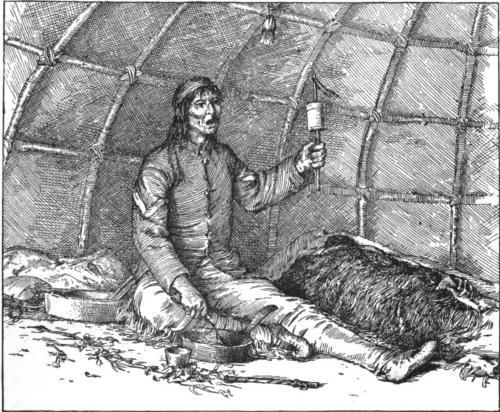
The Midewiwin (in syllabics: ᒥᑌᐧᐃᐧᐃᓐ, also spelled Midewin and Medewiwin) or the Grand Medicine Society is a religious society of some of the Indigenous peoples of the Maritimes, New England[citation needed] and Great Lakes regions in North America. Its practitioners are called Midew, and the practices of Midewiwin are referred to as Mide. Occasionally, male Midew is called Midewinini, which is sometimes translated into English as "medicine man".
Due to the body-part medial de' meaning 'heart' in the Anishinaabe language, Midewiwin is sometimes translated as 'The Way of the Heart'.[page needed] Minnesota archaeologist Fred K. Blessing shares a definition he received from Thomas Shingobe, a Mida (a Midewiwin person) of the Mille Lacs Indian Reservation in 1969, who told him that "the only thing that would be acceptable in any way as an interpretation of 'Mide' would be 'Spiritual Mystery'."[page needed] Fluent speakers of Anishinaabemowin often caution that many words and concepts have no direct translation in English.[page needed][page needed]
According to historian Michael Angel, the Midewin is a "flexible, tenacious tradition that provided an institutional setting for the teaching of the world view (religious beliefs) of the Ojibwa people".[page needed] Commonly among the Anishinaabeg, Midewin is ascribed to Wenaboozho (Onaniboozh) as its founder. However, among the Abenakis, Midewiwin is ascribed to Mateguas, who bestowed the Midewiwin upon his death to comfort his grieving brother Gluskab, who is still alive.[citation needed] Walter James Hoffman recorded that according to the Mille Lacs Indians chief Bayezhig ('Lone One'), Midewiwin has its origin as:
This event is called Gwiiwizens wedizhichigewinid—Deeds of a Little-boy.
Mide societies keep wiigwaasabak (birch bark scrolls) that preserve their teachings. They have degrees of initiations and hold ceremonies. They are often associated with the Seven Fires Society, and other Indigenous groups or organizations. The Miigis shell, or cowry shell, is used in some ceremonies, along with bundles, sacred items, etc. There are many oral teachings, symbols, stories, history, and wisdom passed along and preserved from one generation to the next by these groups.
Whiteshell Provincial Park (Manitoba) is named after the whiteshell (cowry) used in Midewiwin ceremonies. This park contains some petroforms that are over 1000 years old, or possibly older, and therefore may predate some aboriginal groups that came later to the area. The Midew society is commemorated in the name of the Midewin National Tallgrass Prairie (Illinois).
The Mide practitioners are initiated and ranked by degrees. Much like the apprentice system, masonic degrees, or an academic degree program, a practitioner cannot advance to the next higher degree until completing the required studies, experiences and ceremonies required of that degree. Only after successful completion may a candidate be considered for advancement to the next degree. Of course, from Anishinaabe perspective, there is no level system that can equate to Native Way; it is a projection of thinking. In other words, it is only a general representation in English of complex abstract ideas in Anishinaabemowin.
The accounts regarding the extended Fourth Degrees vary from region to region. All Midewiwin groups claim the extended Fourth Degrees are specialized forms of the Fourth Degree. Depending on the region, these extended Fourth Degree Midew can be called "Fifth Degree" up to "Ninth Degree." In parallel, if the Fourth Degree Midew is to a doctorate degree, the Extended Fourth Degree Midew is to a post-doctorate degree. The Jiisakiwinini is widely referred to by Elders as the "highest" degree of all the medicine practitioners in the Mide, as it is spiritual medicine as opposed to physical/plant based medicine.
Hub AI
Midewiwin AI simulator
(@Midewiwin_simulator)
Midewiwin
The Midewiwin (in syllabics: ᒥᑌᐧᐃᐧᐃᓐ, also spelled Midewin and Medewiwin) or the Grand Medicine Society is a religious society of some of the Indigenous peoples of the Maritimes, New England[citation needed] and Great Lakes regions in North America. Its practitioners are called Midew, and the practices of Midewiwin are referred to as Mide. Occasionally, male Midew is called Midewinini, which is sometimes translated into English as "medicine man".
Due to the body-part medial de' meaning 'heart' in the Anishinaabe language, Midewiwin is sometimes translated as 'The Way of the Heart'.[page needed] Minnesota archaeologist Fred K. Blessing shares a definition he received from Thomas Shingobe, a Mida (a Midewiwin person) of the Mille Lacs Indian Reservation in 1969, who told him that "the only thing that would be acceptable in any way as an interpretation of 'Mide' would be 'Spiritual Mystery'."[page needed] Fluent speakers of Anishinaabemowin often caution that many words and concepts have no direct translation in English.[page needed][page needed]
According to historian Michael Angel, the Midewin is a "flexible, tenacious tradition that provided an institutional setting for the teaching of the world view (religious beliefs) of the Ojibwa people".[page needed] Commonly among the Anishinaabeg, Midewin is ascribed to Wenaboozho (Onaniboozh) as its founder. However, among the Abenakis, Midewiwin is ascribed to Mateguas, who bestowed the Midewiwin upon his death to comfort his grieving brother Gluskab, who is still alive.[citation needed] Walter James Hoffman recorded that according to the Mille Lacs Indians chief Bayezhig ('Lone One'), Midewiwin has its origin as:
This event is called Gwiiwizens wedizhichigewinid—Deeds of a Little-boy.
Mide societies keep wiigwaasabak (birch bark scrolls) that preserve their teachings. They have degrees of initiations and hold ceremonies. They are often associated with the Seven Fires Society, and other Indigenous groups or organizations. The Miigis shell, or cowry shell, is used in some ceremonies, along with bundles, sacred items, etc. There are many oral teachings, symbols, stories, history, and wisdom passed along and preserved from one generation to the next by these groups.
Whiteshell Provincial Park (Manitoba) is named after the whiteshell (cowry) used in Midewiwin ceremonies. This park contains some petroforms that are over 1000 years old, or possibly older, and therefore may predate some aboriginal groups that came later to the area. The Midew society is commemorated in the name of the Midewin National Tallgrass Prairie (Illinois).
The Mide practitioners are initiated and ranked by degrees. Much like the apprentice system, masonic degrees, or an academic degree program, a practitioner cannot advance to the next higher degree until completing the required studies, experiences and ceremonies required of that degree. Only after successful completion may a candidate be considered for advancement to the next degree. Of course, from Anishinaabe perspective, there is no level system that can equate to Native Way; it is a projection of thinking. In other words, it is only a general representation in English of complex abstract ideas in Anishinaabemowin.
The accounts regarding the extended Fourth Degrees vary from region to region. All Midewiwin groups claim the extended Fourth Degrees are specialized forms of the Fourth Degree. Depending on the region, these extended Fourth Degree Midew can be called "Fifth Degree" up to "Ninth Degree." In parallel, if the Fourth Degree Midew is to a doctorate degree, the Extended Fourth Degree Midew is to a post-doctorate degree. The Jiisakiwinini is widely referred to by Elders as the "highest" degree of all the medicine practitioners in the Mide, as it is spiritual medicine as opposed to physical/plant based medicine.
Recent media