
Recent from talks
Mina Loy
Knowledge base stats:
Talk channels stats:
Members stats:
Mina Loy
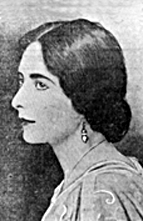
Mina Loy (born Mina Gertrude Löwy; 27 December 1882 – 25 September 1966) was a British-born artist, writer, poet, playwright, novelist, painter, designer of lamps, and bohemian. She was one of the last of the first-generation modernists to achieve posthumous recognition. Her poetry was admired by T. S. Eliot, Ezra Pound, William Carlos Williams, Basil Bunting, Gertrude Stein, Francis Picabia, and Yvor Winters, among others.
Loy was born in Hampstead, London. She was the daughter of a Hungarian Jewish tailor, Sigmund Felix Löwy, who had moved to London to evade persistent antisemitism in Budapest, and an English Protestant mother, Julia Bryan. Loy reflected on their relationship, and the production of her identity, in great detail in her mock-epic Anglo-Mongrels and the Rose (1923–1925). The marriage of Löwy and Bryan was fraught. Unknown to Loy, as biographer Carolyn Burke records, her mother married her father under the pressure of disgrace as she was already seven months pregnant with the child that would be Mina; this situation was mirrored later in Loy's life when she rushed into a marriage with Stephen Haweis after becoming pregnant out of wedlock. Löwy and Bryan had three daughters in total, with Mina being the oldest.
In much of her poetry and writing, Loy describes her mother as overbearingly Evangelical Victorian. As Burke records: "Like most Evangelicals, for whom the imagination was a source of sin, Julia distrusted her child's ability to invent." In reference to her mother, Loy recalled that she was troubled by the fact of "the very author of my being, being author of my fear." Loy found it hard to identify with her mother, who not only punished her continually for her "sinfulness," but also espoused fervent support of the British Empire, rampant antisemitism (which included her husband), and nationalistic jingoism.
Loy's formal art education began late in 1897 at St. John's Wood School where she remained for about two years. She later called it "the worst art school in London" and "a haven of disappointment". Loy's father pushed for her to go to the art school in the hope that it would make her more marriageable. Around this time, Loy became fascinated with both Dante Gabriel Rossetti and Christina Rossetti, and after much convincing was able to persuade her father to purchase her Dante's Complete Works and reproductions of his paintings as well as a red Moroccan leather-bound version of Christina's poems. She also became passionate about the Pre-Raphaelites, beginning with the work of William Morris and later turning to Edward Burne-Jones (her favourite work of which, at the time, was Love Among the Ruins). Loy had to be careful as to how she expressed herself due to her mother's control. For example, Loy described that when her mother found a drawing she had done of the naked Andromeda bound to a rock her mother, scandalised and disgusted, tore up the work and called her daughter "a vicious slut".
In 1900 Loy attended the Munich Künstlerinnenverein, or the Society of Female Artists' School, which was connected with the fine art school of Munich University, it was there that she claimed she learned draughtsmanship.
Upon returning from the relative freedom she found in Munich to the stifling environment of her family home in London, Loy suffered from "headaches, respiratory problems, and generalized weakness" which was then diagnosed as neurasthenia – "a catch-all term for a variety of psychosomatic complaints suffered by artistic or intellectual women and a few sensitive men" during that time period.
Around the age of eighteen, Loy convinced her parents to allow her to continue her education in Paris with a chaperone – a woman called Mrs. Knight. After much persuasion, she was allowed to move to Montparnasse, which in 1902 had not yet been urbanised, and attend the Académie Colarossi as an art student. Unlike the segregated classes at the Munich Künstlerinnenverein, these art classes were mixed. It was here, through an English friend of a similar social standing named Madeline Boles, that Loy first came into contact with the English painter Stephen Haweis who Loy later described as enacting the "parasitic drawing-out of one's vitality to recharge, as it were, his own deficient battery of life." According to Burke's biography, Haweis was unpopular with his fellow students, being considered a "poseur," and Boles in particular took him under her wing. Haweis, whose father was the well-known Reverend Hugh Reginald Haweis and his mother Mary Eliza Haweis, a writer who wrote, amongst other things, Chaucer for Children: A Golden Key, was an aesthete of sorts and "despite being very short[,] he managed to condescend to his listeners from a height." He began to exert himself over Loy, recognising her beauty and desirability, and played the role of the misunderstood eccentric which led Loy to feel guilty for disliking him and distrusting him as he borrowed more and more money from her without paying her back. Later she would reflect that Haweis loomed over her and she became, in Loy's own words, "as sullenly involved as with my mother's sadistic hysterics." One night he convinced her to stay over and, in what she would later describe as a state of hypnosis, she was seduced by him. Waking up next morning in his bed, semi-naked, Loy was horrified and repulsed.
A few months after this, she realised that she was pregnant, something which terrified her as it bound her, as she later described, even closer to "the being on earth whom she would have least chosen." Being only twenty-one, she faced a difficult situation and, fearing rejection from her family and disinheritance, which would leave her penniless, she sought her parents' approval to marry Haweis, which they agreed to due to his respectable social status as the son of a preacher. Reflecting on this in later life, and how her upbringing influenced her in the decisions she made, Loy remarked that "If anyone I disliked insisted upon my doing anything I was averse to I would automatically comply, so systematically had they obfuscated my instinct of self-preservation."
Hub AI
Mina Loy AI simulator
(@Mina Loy_simulator)
Mina Loy
Mina Loy (born Mina Gertrude Löwy; 27 December 1882 – 25 September 1966) was a British-born artist, writer, poet, playwright, novelist, painter, designer of lamps, and bohemian. She was one of the last of the first-generation modernists to achieve posthumous recognition. Her poetry was admired by T. S. Eliot, Ezra Pound, William Carlos Williams, Basil Bunting, Gertrude Stein, Francis Picabia, and Yvor Winters, among others.
Loy was born in Hampstead, London. She was the daughter of a Hungarian Jewish tailor, Sigmund Felix Löwy, who had moved to London to evade persistent antisemitism in Budapest, and an English Protestant mother, Julia Bryan. Loy reflected on their relationship, and the production of her identity, in great detail in her mock-epic Anglo-Mongrels and the Rose (1923–1925). The marriage of Löwy and Bryan was fraught. Unknown to Loy, as biographer Carolyn Burke records, her mother married her father under the pressure of disgrace as she was already seven months pregnant with the child that would be Mina; this situation was mirrored later in Loy's life when she rushed into a marriage with Stephen Haweis after becoming pregnant out of wedlock. Löwy and Bryan had three daughters in total, with Mina being the oldest.
In much of her poetry and writing, Loy describes her mother as overbearingly Evangelical Victorian. As Burke records: "Like most Evangelicals, for whom the imagination was a source of sin, Julia distrusted her child's ability to invent." In reference to her mother, Loy recalled that she was troubled by the fact of "the very author of my being, being author of my fear." Loy found it hard to identify with her mother, who not only punished her continually for her "sinfulness," but also espoused fervent support of the British Empire, rampant antisemitism (which included her husband), and nationalistic jingoism.
Loy's formal art education began late in 1897 at St. John's Wood School where she remained for about two years. She later called it "the worst art school in London" and "a haven of disappointment". Loy's father pushed for her to go to the art school in the hope that it would make her more marriageable. Around this time, Loy became fascinated with both Dante Gabriel Rossetti and Christina Rossetti, and after much convincing was able to persuade her father to purchase her Dante's Complete Works and reproductions of his paintings as well as a red Moroccan leather-bound version of Christina's poems. She also became passionate about the Pre-Raphaelites, beginning with the work of William Morris and later turning to Edward Burne-Jones (her favourite work of which, at the time, was Love Among the Ruins). Loy had to be careful as to how she expressed herself due to her mother's control. For example, Loy described that when her mother found a drawing she had done of the naked Andromeda bound to a rock her mother, scandalised and disgusted, tore up the work and called her daughter "a vicious slut".
In 1900 Loy attended the Munich Künstlerinnenverein, or the Society of Female Artists' School, which was connected with the fine art school of Munich University, it was there that she claimed she learned draughtsmanship.
Upon returning from the relative freedom she found in Munich to the stifling environment of her family home in London, Loy suffered from "headaches, respiratory problems, and generalized weakness" which was then diagnosed as neurasthenia – "a catch-all term for a variety of psychosomatic complaints suffered by artistic or intellectual women and a few sensitive men" during that time period.
Around the age of eighteen, Loy convinced her parents to allow her to continue her education in Paris with a chaperone – a woman called Mrs. Knight. After much persuasion, she was allowed to move to Montparnasse, which in 1902 had not yet been urbanised, and attend the Académie Colarossi as an art student. Unlike the segregated classes at the Munich Künstlerinnenverein, these art classes were mixed. It was here, through an English friend of a similar social standing named Madeline Boles, that Loy first came into contact with the English painter Stephen Haweis who Loy later described as enacting the "parasitic drawing-out of one's vitality to recharge, as it were, his own deficient battery of life." According to Burke's biography, Haweis was unpopular with his fellow students, being considered a "poseur," and Boles in particular took him under her wing. Haweis, whose father was the well-known Reverend Hugh Reginald Haweis and his mother Mary Eliza Haweis, a writer who wrote, amongst other things, Chaucer for Children: A Golden Key, was an aesthete of sorts and "despite being very short[,] he managed to condescend to his listeners from a height." He began to exert himself over Loy, recognising her beauty and desirability, and played the role of the misunderstood eccentric which led Loy to feel guilty for disliking him and distrusting him as he borrowed more and more money from her without paying her back. Later she would reflect that Haweis loomed over her and she became, in Loy's own words, "as sullenly involved as with my mother's sadistic hysterics." One night he convinced her to stay over and, in what she would later describe as a state of hypnosis, she was seduced by him. Waking up next morning in his bed, semi-naked, Loy was horrified and repulsed.
A few months after this, she realised that she was pregnant, something which terrified her as it bound her, as she later described, even closer to "the being on earth whom she would have least chosen." Being only twenty-one, she faced a difficult situation and, fearing rejection from her family and disinheritance, which would leave her penniless, she sought her parents' approval to marry Haweis, which they agreed to due to his respectable social status as the son of a preacher. Reflecting on this in later life, and how her upbringing influenced her in the decisions she made, Loy remarked that "If anyone I disliked insisted upon my doing anything I was averse to I would automatically comply, so systematically had they obfuscated my instinct of self-preservation."
Recent media