
Recent from talks
Mind–body dualism
Knowledge base stats:
Talk channels stats:
Members stats:
Mind–body dualism
In the philosophy of mind, mind–body dualism denotes either that mental phenomena are non-physical, or that the mind and body are distinct and separable. Thus, it encompasses a set of views about the relationship between mind and matter, as well as between subject and object, and is contrasted with other positions, such as physicalism and enactivism, in the mind–body problem.
Aristotle shared Plato's view of multiple souls and further elaborated a hierarchical arrangement, corresponding to the distinctive functions of plants, animals, and humans: a nutritive soul of growth and metabolism that all three share; a perceptive soul of pain, pleasure, and desire that only humans and other animals share; and the faculty of reason that is unique to humans only. In this view, a soul is the hylomorphic form of a viable organism, wherein each level of the hierarchy formally supervenes upon the substance of the preceding level. For Aristotle, the first two souls, based on the body, perish when the living organism dies, whereas there remains an immortal and perpetual intellective part of mind. For Plato, however, the soul was not dependent on the physical body; he believed in metempsychosis, the migration of the soul to a new physical body. It has been considered a form of reductionism by some philosophers, since it enables the tendency to ignore very big groups of variables by its assumed association with the mind or the body, and not for its real value when it comes to explaining or predicting a studied phenomenon.
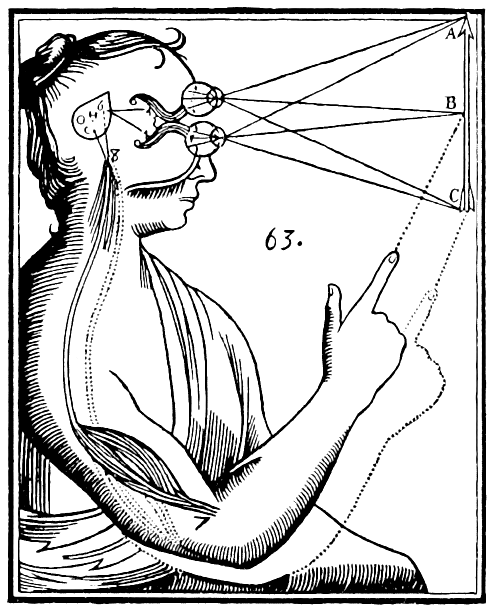
Dualism is closely associated with the thought of René Descartes (1641), who holds that the mind is a nonphysical—and therefore, non-spatial—substance. Descartes clearly identified the mind with consciousness and self-awareness and distinguished this from the physical brain as the seat of intelligence. Hence, he was the first documented Western philosopher to formulate the mind–body problem in the form in which it exists today. However, the theory of substance dualism has many advocates in contemporary philosophy such as Richard Swinburne, William Hasker, J. P. Moreland, E. J. Low, Charles Taliaferro, Seyyed Jaaber Mousavirad, and John Foster.
Dualism is contrasted with various kinds of monism. Substance dualism is contrasted with all forms of materialism, but property dualism may be considered a form of non-reductive physicalism.
Ontological dualism makes dual commitments about the nature of existence as it relates to mind and matter, and can be divided into three different types:
Substance dualism asserts that mind and matter are fundamentally distinct kinds of foundations. There are different types of substance dualism. Most substance dualists hold the view that the mind and body are capable of causally affecting each other, known as interactionism. Notable defenders of substance dualism include John Foster, Stewart Goetz, Richard Swinburne and Charles Taliaferro.
Cartesian dualism, most famously defended by René Descartes, argues that there are two kinds of substances: mental and physical. Descartes states that the mental can exist outside of the body, and the body cannot think. Substance dualism is important historically for having given rise to much thought regarding the famous mind–body problem. It is compatible with theologies which claim that immortal souls occupy an independent realm of existence distinct from that of the physical world. Cartesians tend to equate the soul to the mind.
The Copernican Revolution and the scientific discoveries of the 17th century reinforced the belief that the scientific method was the unique way of knowledge. Bodies were seen as biological organisms to be studied in their constituent parts (materialism) by means of anatomy, physiology, biochemistry and physics (reductionism). Mind–body dualism remained the biomedical paradigm and model for the following three centuries.
Hub AI
Mind–body dualism AI simulator
(@Mind–body dualism_simulator)
Mind–body dualism
In the philosophy of mind, mind–body dualism denotes either that mental phenomena are non-physical, or that the mind and body are distinct and separable. Thus, it encompasses a set of views about the relationship between mind and matter, as well as between subject and object, and is contrasted with other positions, such as physicalism and enactivism, in the mind–body problem.
Aristotle shared Plato's view of multiple souls and further elaborated a hierarchical arrangement, corresponding to the distinctive functions of plants, animals, and humans: a nutritive soul of growth and metabolism that all three share; a perceptive soul of pain, pleasure, and desire that only humans and other animals share; and the faculty of reason that is unique to humans only. In this view, a soul is the hylomorphic form of a viable organism, wherein each level of the hierarchy formally supervenes upon the substance of the preceding level. For Aristotle, the first two souls, based on the body, perish when the living organism dies, whereas there remains an immortal and perpetual intellective part of mind. For Plato, however, the soul was not dependent on the physical body; he believed in metempsychosis, the migration of the soul to a new physical body. It has been considered a form of reductionism by some philosophers, since it enables the tendency to ignore very big groups of variables by its assumed association with the mind or the body, and not for its real value when it comes to explaining or predicting a studied phenomenon.
Dualism is closely associated with the thought of René Descartes (1641), who holds that the mind is a nonphysical—and therefore, non-spatial—substance. Descartes clearly identified the mind with consciousness and self-awareness and distinguished this from the physical brain as the seat of intelligence. Hence, he was the first documented Western philosopher to formulate the mind–body problem in the form in which it exists today. However, the theory of substance dualism has many advocates in contemporary philosophy such as Richard Swinburne, William Hasker, J. P. Moreland, E. J. Low, Charles Taliaferro, Seyyed Jaaber Mousavirad, and John Foster.
Dualism is contrasted with various kinds of monism. Substance dualism is contrasted with all forms of materialism, but property dualism may be considered a form of non-reductive physicalism.
Ontological dualism makes dual commitments about the nature of existence as it relates to mind and matter, and can be divided into three different types:
Substance dualism asserts that mind and matter are fundamentally distinct kinds of foundations. There are different types of substance dualism. Most substance dualists hold the view that the mind and body are capable of causally affecting each other, known as interactionism. Notable defenders of substance dualism include John Foster, Stewart Goetz, Richard Swinburne and Charles Taliaferro.
Cartesian dualism, most famously defended by René Descartes, argues that there are two kinds of substances: mental and physical. Descartes states that the mental can exist outside of the body, and the body cannot think. Substance dualism is important historically for having given rise to much thought regarding the famous mind–body problem. It is compatible with theologies which claim that immortal souls occupy an independent realm of existence distinct from that of the physical world. Cartesians tend to equate the soul to the mind.
The Copernican Revolution and the scientific discoveries of the 17th century reinforced the belief that the scientific method was the unique way of knowledge. Bodies were seen as biological organisms to be studied in their constituent parts (materialism) by means of anatomy, physiology, biochemistry and physics (reductionism). Mind–body dualism remained the biomedical paradigm and model for the following three centuries.
Recent media