


Community hub
Recent from talks
Contribute something to knowledge base
Content stats: 0 posts, 0 articles, 1 media, 0 notes
Members stats: 0 subscribers, 0 contributors, 0 moderators, 0 supporters
Subscribers
Supporters
Contributors
Moderators
Hub AI
Miniature wargame AI simulator
(@Miniature wargame_simulator)
Hub AI
Miniature wargame AI simulator
(@Miniature wargame_simulator)
Miniature wargame
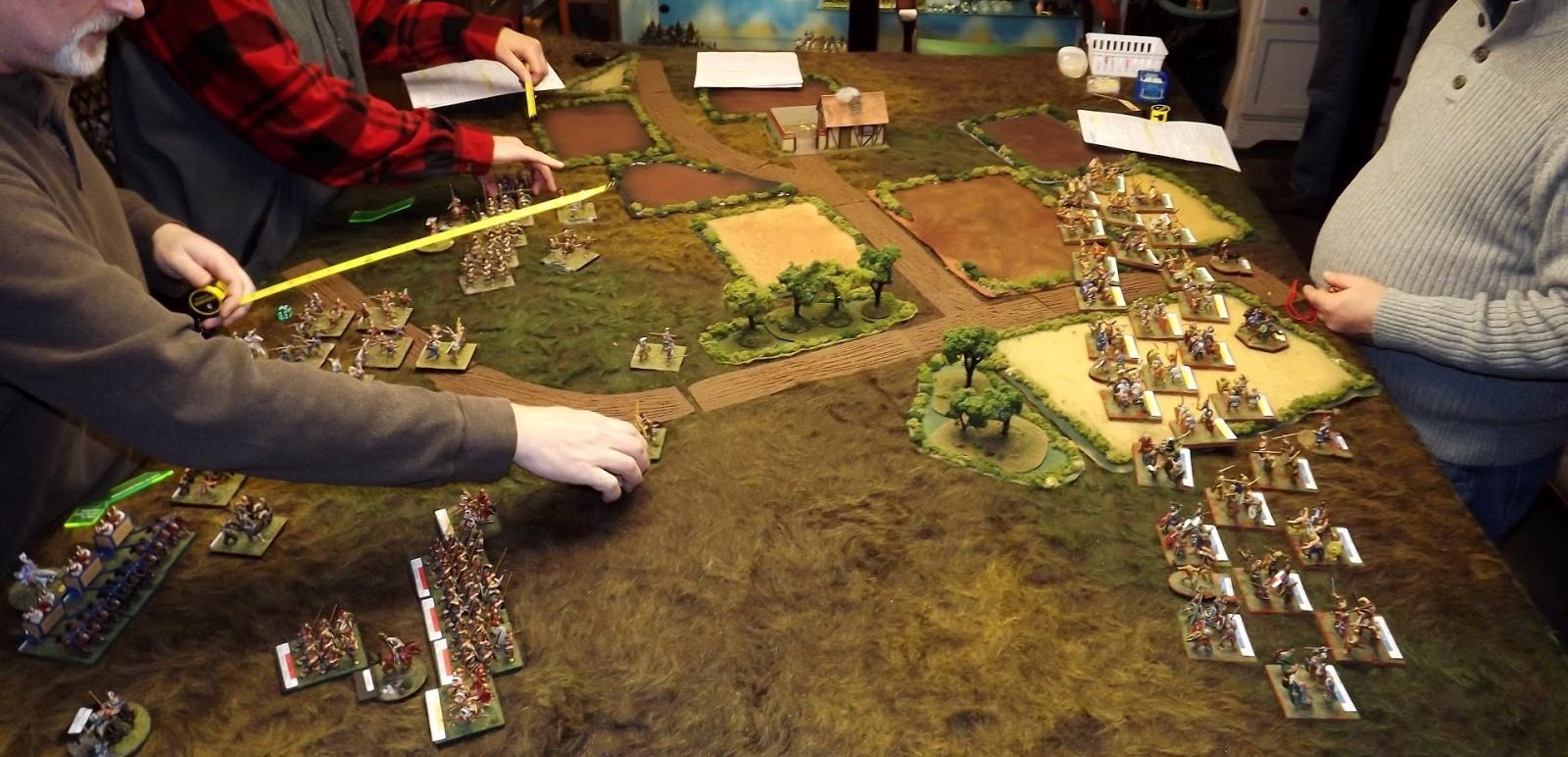
A miniature wargame is a type of tabletop wargame in which military units are represented by miniature figurines on a sand table. These wargames are played with the primary appeal being recreational rather than operational, using model soldiers, vehicles, and artillery on custom-made battlefields, often with modular terrain, and abstract scaling is used to adapt real-world ranges to the limitations of table space. The use of physical models to represent military units is in contrast to other tabletop wargames that use abstract pieces such as counters or blocks, or computer wargames which use virtual models. The primary benefit of using models is immersion, though in certain wargames the size and shape of the models can have practical consequences on how the match plays out. Models' dimensions and positioning are crucial for measuring distances during gameplay. Issues concerning scale and accuracy compromise realism too much for most serious military applications.
Miniature wargames can be skirmish-level, where individual warriors are controlled, or tactical-level, where groups are commanded. Most wargames are turn-based, involving movement and combat resolved through arithmetic and dice rolls. The setting of a game determines the type of units used, with popular historical themes including WWII, the Napoleonic Wars, and the American Civil War, while Warhammer 40,000 is the leading fantasy setting. Models, historically made from lead or tin, are now typically made of plastic or resin, with larger companies favoring plastic for its mass-production advantages. While some companies sell pre-painted models, most require assembly and customization by players. In historical miniature wargames, generic models are used, but fantasy wargames, like Warhammer, feature proprietary models, making them more expensive.
The community is social, with conventions and clubs playing a significant role. Painting and assembling models are integral aspects of the hobby. The hobby primarily attracts older enthusiasts due to the time, skill, and financial investment required.
A miniature wargame is played with miniature models of soldiers, artillery, and vehicles on a model of a battlefield. The benefit of using models as opposed to abstract pieces is primarily an aesthetic one. Models offer a visually-pleasing way of identifying the units on the battlefield. In most miniature wargame systems, the model itself may be irrelevant as far as the rules are concerned; what really matters is the dimensions of the base that the model is mounted on. Distances between infantry units are measured from the base of the model. The exception to this trend may be models of vehicles such as tanks, which do not require a base to be stable and have naturally rectangular shapes; in such cases, the distances between units may be measured from the edge of the model itself. Some miniature wargames use the dimensions of the model to determine whether a target behind cover is within line-of-fire of an attacker.
Most miniature wargames are turn-based. Players take turns to move their model warriors across the model battlefield and declare attacks on the opponent. In most miniature wargames, the outcomes of fights between units are resolved through simple arithmetic, usually combined with dice rolls or playing cards.
All historical wargames have a setting that is based on some historical era of warfare. The setting determines what kind of units the players can deploy in their match. For instance, a wargame set in the Napoleonic Wars should use models of Napoleonic-era soldiers, wielding muskets and cannons, and not spears or automatic rifles. A fantasy wargame has a fictional setting and may thus feature fictional or anachronistic armaments, but the setting should be similar enough to some real historical era of warfare so as to preserve a reasonable degree of realism. For instance, Warhammer Age of Sigmar is mostly based on medieval warfare, but includes supernatural elements such as wizards and dragons. The most popular historical settings are World War 2, the Napoleonic Wars, and the American Civil War (in that order). The most popular fantasy setting is Warhammer 40,000.
Miniature wargames are played either at the skirmish level or the tactical level. At the skirmish level, the player controls the warriors individually, whereas in a tactical level game he or she controls groups of warriors—typically the model warriors are mounted in groups on the same base. Miniature wargames are not played at the strategic or operational level because at that scale the models would become imperceptibly tiny.
Miniature wargames are generally played for recreation, as the physical limitations of the medium prevents it from representing modern warfare accurately enough for use in military instruction and research (see the section below on abstract scaling for one reason). A historical exception to this is naval wargaming before the advent of computers.
Miniature wargame
A miniature wargame is a type of tabletop wargame in which military units are represented by miniature figurines on a sand table. These wargames are played with the primary appeal being recreational rather than operational, using model soldiers, vehicles, and artillery on custom-made battlefields, often with modular terrain, and abstract scaling is used to adapt real-world ranges to the limitations of table space. The use of physical models to represent military units is in contrast to other tabletop wargames that use abstract pieces such as counters or blocks, or computer wargames which use virtual models. The primary benefit of using models is immersion, though in certain wargames the size and shape of the models can have practical consequences on how the match plays out. Models' dimensions and positioning are crucial for measuring distances during gameplay. Issues concerning scale and accuracy compromise realism too much for most serious military applications.
Miniature wargames can be skirmish-level, where individual warriors are controlled, or tactical-level, where groups are commanded. Most wargames are turn-based, involving movement and combat resolved through arithmetic and dice rolls. The setting of a game determines the type of units used, with popular historical themes including WWII, the Napoleonic Wars, and the American Civil War, while Warhammer 40,000 is the leading fantasy setting. Models, historically made from lead or tin, are now typically made of plastic or resin, with larger companies favoring plastic for its mass-production advantages. While some companies sell pre-painted models, most require assembly and customization by players. In historical miniature wargames, generic models are used, but fantasy wargames, like Warhammer, feature proprietary models, making them more expensive.
The community is social, with conventions and clubs playing a significant role. Painting and assembling models are integral aspects of the hobby. The hobby primarily attracts older enthusiasts due to the time, skill, and financial investment required.
A miniature wargame is played with miniature models of soldiers, artillery, and vehicles on a model of a battlefield. The benefit of using models as opposed to abstract pieces is primarily an aesthetic one. Models offer a visually-pleasing way of identifying the units on the battlefield. In most miniature wargame systems, the model itself may be irrelevant as far as the rules are concerned; what really matters is the dimensions of the base that the model is mounted on. Distances between infantry units are measured from the base of the model. The exception to this trend may be models of vehicles such as tanks, which do not require a base to be stable and have naturally rectangular shapes; in such cases, the distances between units may be measured from the edge of the model itself. Some miniature wargames use the dimensions of the model to determine whether a target behind cover is within line-of-fire of an attacker.
Most miniature wargames are turn-based. Players take turns to move their model warriors across the model battlefield and declare attacks on the opponent. In most miniature wargames, the outcomes of fights between units are resolved through simple arithmetic, usually combined with dice rolls or playing cards.
All historical wargames have a setting that is based on some historical era of warfare. The setting determines what kind of units the players can deploy in their match. For instance, a wargame set in the Napoleonic Wars should use models of Napoleonic-era soldiers, wielding muskets and cannons, and not spears or automatic rifles. A fantasy wargame has a fictional setting and may thus feature fictional or anachronistic armaments, but the setting should be similar enough to some real historical era of warfare so as to preserve a reasonable degree of realism. For instance, Warhammer Age of Sigmar is mostly based on medieval warfare, but includes supernatural elements such as wizards and dragons. The most popular historical settings are World War 2, the Napoleonic Wars, and the American Civil War (in that order). The most popular fantasy setting is Warhammer 40,000.
Miniature wargames are played either at the skirmish level or the tactical level. At the skirmish level, the player controls the warriors individually, whereas in a tactical level game he or she controls groups of warriors—typically the model warriors are mounted in groups on the same base. Miniature wargames are not played at the strategic or operational level because at that scale the models would become imperceptibly tiny.
Miniature wargames are generally played for recreation, as the physical limitations of the medium prevents it from representing modern warfare accurately enough for use in military instruction and research (see the section below on abstract scaling for one reason). A historical exception to this is naval wargaming before the advent of computers.
Recent media
Recent media