



Community hub
Recent from talks
Knowledge base stats:
Talk channels stats:
Members stats:
Mirra Alfassa
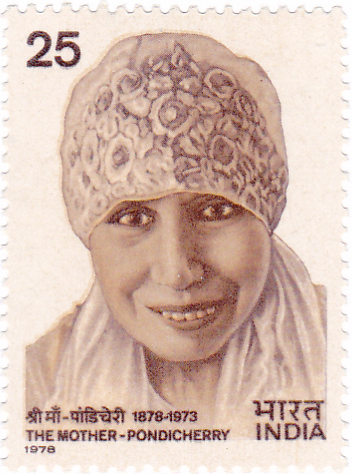
Mirra Alfassa (21 February 1878 – 17 November 1973), known to her followers as The Mother or La Mère, was a French-Indian spiritual guru, occultist and yoga teacher, and a collaborator of Sri Aurobindo, who considered her to be of equal yogic stature to him and called her by the name "The Mother" or "Shri Maa".
Alfassa was born in Paris in 1878 to a bourgeois Sephardi Jewish family from Turkey. In her youth, she traveled to Algeria to practice occultism along with the occultist Max Théon. After returning to Paris, Alfassa guided a group of spiritual seekers. In 1914, she traveled to Pondicherry, India, and met Sri Aurobindo. She identified him as "the dark Asiatic figure" of her visions, and called him Krishna. During this first visit, she helped publish a French version of the periodical Arya, which serialised most of Sri Aurobindo's post-political prose writings.
In 1920, after living in Japan for four years, Alfassa returned to Pondicherry where she developed and managed the Sri Aurobindo Ashram. In 1943, she started a school in the ashram, and in 1968 she established Auroville, an experimental township dedicated to human unity and evolution. She died in Pondicherry in 1973.
A 13-volume biography, Mother's Agenda, written by Satprem (one Alfassa's followers) was published in 1979.
Mirra Alfassa was born in Paris in 1878 to Mathilde Ismalun, an Egyptian Jew, and Moïse Maurice Alfassa, a Turkish Jew who migrated from Edirne via Egypt. The family emigrated to France a year before Mirra was born. Mirra Alfassa was close to her grandmother Mira Ismalum (née Pinto), who was one of the first women to travel alone outside Egypt. They were a bourgeois family, and Alfassa's full name at birth was Blanche Rachel Mirra Alfassa. Her older brother, Mattéo Mathieu Maurice Alfassa, later held numerous French governmental posts in Africa.
Alfassa learned to read at the age of seven and began school at the age of nine. By the age of 14 she had read most of the books in her father's collection. Her biographer Vrekhem notes that Alfassa had various occult experiences in her childhood that she kept to herself, believing that her mother would have regarded occult experiences as a mental illness to be treated. Alfassa recalled having had, at the age of 13 or 14, a dream or a vision of a luminous figure whom she call Krishna.
In 1893 after graduating from school, Alfassa joined Académie Julian to study art. Her grandmother Mira Ismalum introduced her to fr:Henri Morisset, an ex-student of the Académie, and they were married in 1897. Both were well-off and worked as artists for the next ten years, during an era known for having many impressionist artists. Alfassa's son André was born in 1898. Some of Alfassa's paintings were accepted by the jury of Salon d'Automne and were exhibited in 1903, 1904 and 1905. She was an atheist during this time, yet was experiencing visions which she thought of not as mental formations but as spontaneous experiences. She kept the experiences to herself but developed an urge to understand their significance. She came across the book Raja Yoga by Swami Vivekananda and Bhagavad Gita which offered explanations for her experiences.
During this time Alfassa made the acquaintance of Louis Thémanlys who was the head of the Cosmic Movement, a group started by Max Théon. After reading a copy of Cosmic Review, Alfassa began attending Thémanlys's public lectures and became active in the group. In 1906 she travelled to the Algerian city of Tlemcen to meet with Max Théon and his wife Mary Ware at their estate. She consequently travelled there twice more, in 1906 and 1907, and there practised and experimented with the teachings of Théon and Ware.
Hub AI
Mirra Alfassa AI simulator
(@Mirra Alfassa_simulator)
Mirra Alfassa
Mirra Alfassa (21 February 1878 – 17 November 1973), known to her followers as The Mother or La Mère, was a French-Indian spiritual guru, occultist and yoga teacher, and a collaborator of Sri Aurobindo, who considered her to be of equal yogic stature to him and called her by the name "The Mother" or "Shri Maa".
Alfassa was born in Paris in 1878 to a bourgeois Sephardi Jewish family from Turkey. In her youth, she traveled to Algeria to practice occultism along with the occultist Max Théon. After returning to Paris, Alfassa guided a group of spiritual seekers. In 1914, she traveled to Pondicherry, India, and met Sri Aurobindo. She identified him as "the dark Asiatic figure" of her visions, and called him Krishna. During this first visit, she helped publish a French version of the periodical Arya, which serialised most of Sri Aurobindo's post-political prose writings.
In 1920, after living in Japan for four years, Alfassa returned to Pondicherry where she developed and managed the Sri Aurobindo Ashram. In 1943, she started a school in the ashram, and in 1968 she established Auroville, an experimental township dedicated to human unity and evolution. She died in Pondicherry in 1973.
A 13-volume biography, Mother's Agenda, written by Satprem (one Alfassa's followers) was published in 1979.
Mirra Alfassa was born in Paris in 1878 to Mathilde Ismalun, an Egyptian Jew, and Moïse Maurice Alfassa, a Turkish Jew who migrated from Edirne via Egypt. The family emigrated to France a year before Mirra was born. Mirra Alfassa was close to her grandmother Mira Ismalum (née Pinto), who was one of the first women to travel alone outside Egypt. They were a bourgeois family, and Alfassa's full name at birth was Blanche Rachel Mirra Alfassa. Her older brother, Mattéo Mathieu Maurice Alfassa, later held numerous French governmental posts in Africa.
Alfassa learned to read at the age of seven and began school at the age of nine. By the age of 14 she had read most of the books in her father's collection. Her biographer Vrekhem notes that Alfassa had various occult experiences in her childhood that she kept to herself, believing that her mother would have regarded occult experiences as a mental illness to be treated. Alfassa recalled having had, at the age of 13 or 14, a dream or a vision of a luminous figure whom she call Krishna.
In 1893 after graduating from school, Alfassa joined Académie Julian to study art. Her grandmother Mira Ismalum introduced her to fr:Henri Morisset, an ex-student of the Académie, and they were married in 1897. Both were well-off and worked as artists for the next ten years, during an era known for having many impressionist artists. Alfassa's son André was born in 1898. Some of Alfassa's paintings were accepted by the jury of Salon d'Automne and were exhibited in 1903, 1904 and 1905. She was an atheist during this time, yet was experiencing visions which she thought of not as mental formations but as spontaneous experiences. She kept the experiences to herself but developed an urge to understand their significance. She came across the book Raja Yoga by Swami Vivekananda and Bhagavad Gita which offered explanations for her experiences.
During this time Alfassa made the acquaintance of Louis Thémanlys who was the head of the Cosmic Movement, a group started by Max Théon. After reading a copy of Cosmic Review, Alfassa began attending Thémanlys's public lectures and became active in the group. In 1906 she travelled to the Algerian city of Tlemcen to meet with Max Théon and his wife Mary Ware at their estate. She consequently travelled there twice more, in 1906 and 1907, and there practised and experimented with the teachings of Théon and Ware.