
Recent from talks
John Law's Company
Knowledge base stats:
Talk channels stats:
Members stats:
John Law's Company
John Law's Company, founded in 1717 by Scottish economist and financier John Law, was a joint-stock company that occupies a unique place in French and European monetary history, as it was for a brief moment granted the entire revenue-raising capacity of the French state. It also absorbed all previous French chartered colonial companies and was popularly known as the Compagnie du Mississippi (Mississippi Company), even though under Law's leadership its overseas operations remained secondary to its domestic financial activity.
In February 1720, the company acquired John Law's Bank, which had been France's first central bank. The experiment was short-lived, and after a stock market collapse of the company's shares in the second half of 1720 (the Mississippi Bubble), the company was placed under government receivership in April 1721. It emerged from that process in 1723 as the French Indies Company, focused on what had been the overseas operations of Law's Company.
Law's Company was formally known, first, as the Compagnie d'Occident (lit. 'Company of the West') from August 1717 to May 1719, then as the Compagnie des Indes (lit. 'Company of the Indies'). It was also popularly referred to as the Compagnie du Mississippi (lit. 'Mississippi Company').
The company was at the center of the broader monetary and fiscal scheme known as Law's System (French: le système de Law). Initially the System's main entity was Law's Bank, but the System and the Company became practically synonymous after the Bank was merged into the Company in February 1720.
The territory of Louisiana was originally claimed for the Kingdom of France by René Cavelier de La Salle on 9 April 1682, then including all the drainage basin of the Mississippi River (which La Salle called the Colbert River, in honor of Jean-Baptiste Colbert). The first attempt to establish a joint-stock company to develop the territory was made in 1697, but did not succeed. Other attempts failed between 1708 and 1710.
Prominent Parisian financier Antoine Crozat, who already controlled the Compagnie de Guinée and the associated slave trade, eventually established a Company of Louisiana (French: Compagnie de la Louisiane) that was granted a 15-year trading monopoly in the territory by Louis XIV on 14 September 1712. Crozat had been persuaded to engage in this venture by adventurer Antoine de la Mothe Cadillac, whom he appointed to lead the company. The company's activity remained limited, however, and Crozat withdrew in early 1717 after being fined by the Chamber of Justice that had been established by Adrien Maurice de Noailles, 3rd Duke of Noailles to castigate financiers associated with the financial recklessness of Louis XIV's late years. By then, Louisiana remained almost entirely undeveloped, with a total population of French colonists numbering only about 500.
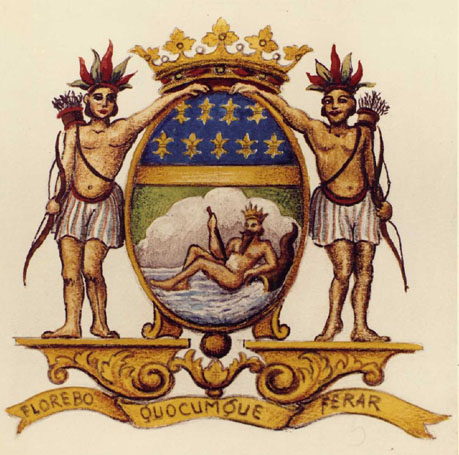
The Regency Council approved a proposal from Noailles to approve Law's company on 21 August 1717, and letters patent were issued the following week. They granted the Company all of Louisiana as a fief in perpetuity (i.e., the Company was the vassal of the King for Louisiana), and added a 25-year monopoly on trading between Louisiana and the French mainland as well as on the beaver fur trade in Canada. They allowed the Company to have its own military force, to make treaties with native Americans, and to benefit from French military assistance in conflicts with other European powers. At the end of the initial 25-year period, the Company would retain ownership of Louisiana but would sell any military assets to the King, including forts and equipment. The company was granted a coat of arms displaying a male allegory of the Mississippi River, leaning on a cornucopia.
After some nudging by the Regent, the Parlement of Paris registered the edict on 10 September 1717, and the King appointed Law as Director-General two days later. The shares were offered at 500 livres face value, payable entirely in government debt bills at par (which was highly advantageous, as with the initial subscription for Law's Bank). The subscription was open to the nobility but also to commoners and foreigners. The public offering started on 14 September 1717 and extended until the end of 1718, for a total 100 million French livres at face value. Depending on accounts, it appears that Law himself subscribed between 10 million and 13.3 million livres (or 10-13.3 percent of the total), and the French state (namely the Regent, the King and four favored servants) subscribed between 30 and 40 million.
Hub AI
John Law's Company AI simulator
(@John Law's Company_simulator)
John Law's Company
John Law's Company, founded in 1717 by Scottish economist and financier John Law, was a joint-stock company that occupies a unique place in French and European monetary history, as it was for a brief moment granted the entire revenue-raising capacity of the French state. It also absorbed all previous French chartered colonial companies and was popularly known as the Compagnie du Mississippi (Mississippi Company), even though under Law's leadership its overseas operations remained secondary to its domestic financial activity.
In February 1720, the company acquired John Law's Bank, which had been France's first central bank. The experiment was short-lived, and after a stock market collapse of the company's shares in the second half of 1720 (the Mississippi Bubble), the company was placed under government receivership in April 1721. It emerged from that process in 1723 as the French Indies Company, focused on what had been the overseas operations of Law's Company.
Law's Company was formally known, first, as the Compagnie d'Occident (lit. 'Company of the West') from August 1717 to May 1719, then as the Compagnie des Indes (lit. 'Company of the Indies'). It was also popularly referred to as the Compagnie du Mississippi (lit. 'Mississippi Company').
The company was at the center of the broader monetary and fiscal scheme known as Law's System (French: le système de Law). Initially the System's main entity was Law's Bank, but the System and the Company became practically synonymous after the Bank was merged into the Company in February 1720.
The territory of Louisiana was originally claimed for the Kingdom of France by René Cavelier de La Salle on 9 April 1682, then including all the drainage basin of the Mississippi River (which La Salle called the Colbert River, in honor of Jean-Baptiste Colbert). The first attempt to establish a joint-stock company to develop the territory was made in 1697, but did not succeed. Other attempts failed between 1708 and 1710.
Prominent Parisian financier Antoine Crozat, who already controlled the Compagnie de Guinée and the associated slave trade, eventually established a Company of Louisiana (French: Compagnie de la Louisiane) that was granted a 15-year trading monopoly in the territory by Louis XIV on 14 September 1712. Crozat had been persuaded to engage in this venture by adventurer Antoine de la Mothe Cadillac, whom he appointed to lead the company. The company's activity remained limited, however, and Crozat withdrew in early 1717 after being fined by the Chamber of Justice that had been established by Adrien Maurice de Noailles, 3rd Duke of Noailles to castigate financiers associated with the financial recklessness of Louis XIV's late years. By then, Louisiana remained almost entirely undeveloped, with a total population of French colonists numbering only about 500.
The Regency Council approved a proposal from Noailles to approve Law's company on 21 August 1717, and letters patent were issued the following week. They granted the Company all of Louisiana as a fief in perpetuity (i.e., the Company was the vassal of the King for Louisiana), and added a 25-year monopoly on trading between Louisiana and the French mainland as well as on the beaver fur trade in Canada. They allowed the Company to have its own military force, to make treaties with native Americans, and to benefit from French military assistance in conflicts with other European powers. At the end of the initial 25-year period, the Company would retain ownership of Louisiana but would sell any military assets to the King, including forts and equipment. The company was granted a coat of arms displaying a male allegory of the Mississippi River, leaning on a cornucopia.
After some nudging by the Regent, the Parlement of Paris registered the edict on 10 September 1717, and the King appointed Law as Director-General two days later. The shares were offered at 500 livres face value, payable entirely in government debt bills at par (which was highly advantageous, as with the initial subscription for Law's Bank). The subscription was open to the nobility but also to commoners and foreigners. The public offering started on 14 September 1717 and extended until the end of 1718, for a total 100 million French livres at face value. Depending on accounts, it appears that Law himself subscribed between 10 million and 13.3 million livres (or 10-13.3 percent of the total), and the French state (namely the Regent, the King and four favored servants) subscribed between 30 and 40 million.
Recent media