
Recent from talks
Mississippian culture
Knowledge base stats:
Talk channels stats:
Members stats:
Mississippian culture
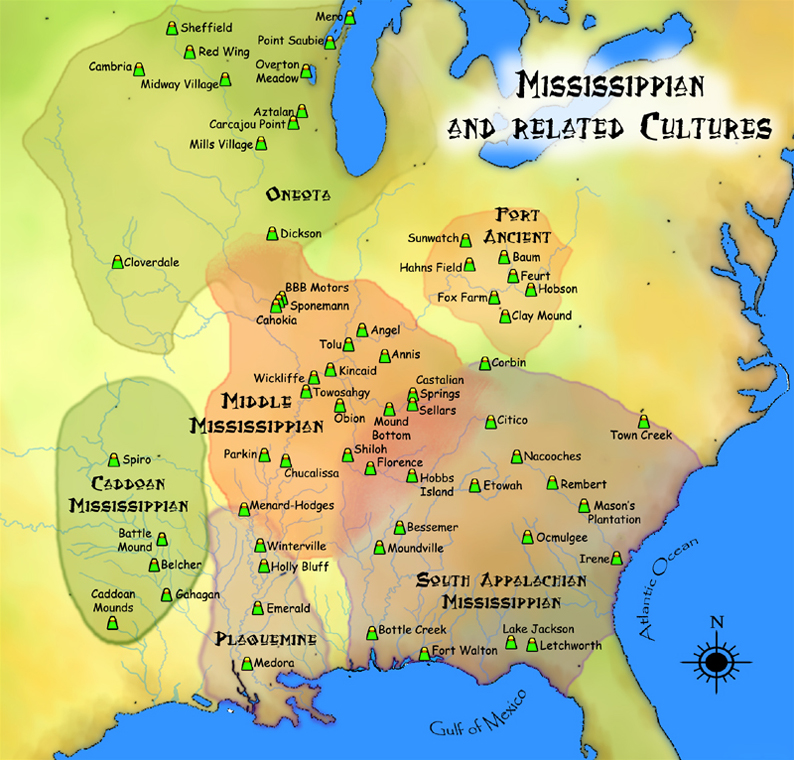
The Mississippian culture was a collection of Native American societies that flourished in what is now the Midwestern, Eastern, and Southeastern United States from approximately 800 to 1600 CE, varying regionally. It was known for building large, earthen platform mounds, and often other shaped mounds as well. It was composed of a series of urban settlements and satellite villages linked together by loose trading networks. The largest city was Cahokia, believed to be a major religious center, located in what is present-day southern Illinois.
The Mississippian way of life began to develop in the Mississippi River Valley (for which it is named). Cultures in the tributary Tennessee River Valley may have also begun to develop Mississippian characteristics at this point. Almost all dated Mississippian sites predate 1539–1540 (when Hernando de Soto explored the area), with notable exceptions being Natchez communities. These maintained Mississippian cultural practices into the 18th century.
A number of cultural traits are recognized as being characteristic of the Mississippians. Although not all Mississippian peoples practiced all of the following activities, they were distinct from their ancestors in the adoption of some or all of these traits.
The Mississippians had no writing system or stone architecture. They worked naturally occurring metal deposits, such as hammering and annealing copper for ritual objects such as Mississippian copper plates and other decorations, but did not smelt iron or practice bronze metallurgy.
The Mississippian stage is usually divided into three or more chronological periods. Each period is an arbitrary historical distinction varying regionally. At a particular site, each period may be considered to begin earlier or later, depending on the speed of adoption or development of given Mississippian traits. The "Mississippian period" should not be confused with the "Mississippian culture". The Mississippian period is the chronological stage, while Mississippian culture refers to the cultural similarities that characterize this society.
The term Middle Mississippian is also used to describe the core of the classic Mississippian culture area. This area covers the central Mississippi River Valley, the lower Ohio River Valley, and most of the Mid-South area, including western and central Kentucky, western Tennessee, and northern Alabama and Mississippi. Sites in this area often contain large ceremonial platform mounds, residential complexes and are often encircled by earthen ditches and ramparts or palisades.
Middle Mississippian cultures, especially the Cahokia polity located near East St. Louis, Illinois, were very influential on neighboring societies. High-status artifacts, including stone statuary and elite pottery associated with Cahokia, have been found far outside of the Middle Mississippian area. These items, especially the pottery, were also copied by local artists.
The term South Appalachian Province was originally used by W. H. Holmes in 1903 to describe a regional ceramic style in the southeast involving surface decorations applied with a carved wooden paddle. By the late 1960s, archaeological investigations had shown the similarity of the culture that produced the pottery and the midwestern Mississippian pattern defined in 1937 by the Midwestern Taxonomic System.
Hub AI
Mississippian culture AI simulator
(@Mississippian culture_simulator)
Mississippian culture
The Mississippian culture was a collection of Native American societies that flourished in what is now the Midwestern, Eastern, and Southeastern United States from approximately 800 to 1600 CE, varying regionally. It was known for building large, earthen platform mounds, and often other shaped mounds as well. It was composed of a series of urban settlements and satellite villages linked together by loose trading networks. The largest city was Cahokia, believed to be a major religious center, located in what is present-day southern Illinois.
The Mississippian way of life began to develop in the Mississippi River Valley (for which it is named). Cultures in the tributary Tennessee River Valley may have also begun to develop Mississippian characteristics at this point. Almost all dated Mississippian sites predate 1539–1540 (when Hernando de Soto explored the area), with notable exceptions being Natchez communities. These maintained Mississippian cultural practices into the 18th century.
A number of cultural traits are recognized as being characteristic of the Mississippians. Although not all Mississippian peoples practiced all of the following activities, they were distinct from their ancestors in the adoption of some or all of these traits.
The Mississippians had no writing system or stone architecture. They worked naturally occurring metal deposits, such as hammering and annealing copper for ritual objects such as Mississippian copper plates and other decorations, but did not smelt iron or practice bronze metallurgy.
The Mississippian stage is usually divided into three or more chronological periods. Each period is an arbitrary historical distinction varying regionally. At a particular site, each period may be considered to begin earlier or later, depending on the speed of adoption or development of given Mississippian traits. The "Mississippian period" should not be confused with the "Mississippian culture". The Mississippian period is the chronological stage, while Mississippian culture refers to the cultural similarities that characterize this society.
The term Middle Mississippian is also used to describe the core of the classic Mississippian culture area. This area covers the central Mississippi River Valley, the lower Ohio River Valley, and most of the Mid-South area, including western and central Kentucky, western Tennessee, and northern Alabama and Mississippi. Sites in this area often contain large ceremonial platform mounds, residential complexes and are often encircled by earthen ditches and ramparts or palisades.
Middle Mississippian cultures, especially the Cahokia polity located near East St. Louis, Illinois, were very influential on neighboring societies. High-status artifacts, including stone statuary and elite pottery associated with Cahokia, have been found far outside of the Middle Mississippian area. These items, especially the pottery, were also copied by local artists.
The term South Appalachian Province was originally used by W. H. Holmes in 1903 to describe a regional ceramic style in the southeast involving surface decorations applied with a carved wooden paddle. By the late 1960s, archaeological investigations had shown the similarity of the culture that produced the pottery and the midwestern Mississippian pattern defined in 1937 by the Midwestern Taxonomic System.
Recent media