
Recent from talks
Mitochondrial Eve
Knowledge base stats:
Talk channels stats:
Members stats:
Mitochondrial Eve
In human genetics, the Mitochondrial Eve (more technically known as the Mitochondrial-Most Recent Common Ancestor, shortened to mt-Eve or mt-MRCA) is the matrilineal most recent common ancestor (MRCA) of all living humans. In other words, she is defined as the most recent woman from whom all living humans descend in an unbroken line purely through their mothers and through the mothers of those mothers, back until all lines converge on one woman.
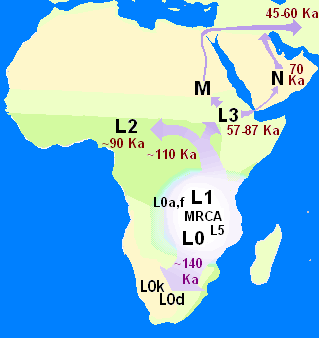
In terms of mitochondrial haplogroups, the mt-MRCA is situated at the divergence of macro-haplogroup L into L0 and L1–6. As of 2013, estimates on the age of this split ranged at around 155,000 years ago, consistent with a date later than the speciation of Homo sapiens but earlier than the recent out-of-Africa dispersal.
The male analog to the "Mitochondrial Eve" is the "Y-chromosomal Adam" (or Y-MRCA), the individual from whom all living humans are patrilineally descended. As the identity of both matrilineal and patrilineal MRCAs is dependent on genealogical history (pedigree collapse), they need not have lived at the same time. As of 2015, estimates of the age of the Y-MRCA range around 200,000 to 300,000 years ago, roughly consistent with the emergence of anatomically modern humans.
The name "Mitochondrial Eve" alludes to the biblical Eve, which has led to repeated misrepresentations or misconceptions in journalistic accounts on the topic. Popular science presentations of the topic usually point out such possible misconceptions by emphasizing the fact that the position of mt-MRCA is neither fixed in time (as the position of mt-MRCA moves forward in time as mitochondrial DNA (mtDNA) lineages become extinct), nor does it refer to a "first woman", nor the only living female of her time, nor the first member of a "new species".
Early research using molecular clock methods was done during the late 1970s to early 1980s. Allan Wilson, Mark Stoneking, Rebecca L. Cann and Wesley Brown found that mutation in human mtDNA was unexpectedly fast, at 0.02 substitution per base (1%) in a million years, which is 5–10 times faster than in nuclear DNA. Related work allowed for an analysis of the evolutionary relationships among gorillas, chimpanzees (common chimpanzee and bonobo) and humans. With data from 21 human individuals, Brown published the first estimate on the age of the mt-MRCA at 180,000 years ago in 1980. A statistical analysis published in 1982 was taken as evidence for recent African origin (a hypothesis which at the time was competing with Asian origin of H. sapiens).
By 1985, data from the mtDNA of 145 women of different populations, and of two cell lines, HeLa and GM 3043, derived from an African American and a ǃKung respectively, were available. After more than 40 revisions of the draft, the manuscript was submitted to Nature in late 1985 or early 1986 and published on 1 January 1987. The published conclusion was that all current human mtDNA originated from a single population from Africa, at the time dated to between 140,000 and 200,000 years ago.
The dating for "Eve" was a blow to the multiregional hypothesis, which was debated at the time, and a boost to the theory of the recent origin model.
Cann, Stoneking and Wilson did not use the term "Mitochondrial Eve" or even the name "Eve" in their original paper. It is however used by Cann in an article entitled "In Search of Eve" in the September–October 1987 issue of The Sciences. It appears in the October 1987 article in Science by Roger Lewin, headlined "The Unmasking of Mitochondrial Eve". The biblical connotation was very clear from the start. The accompanying research news in Nature had the title "Out of the garden of Eden".
Hub AI
Mitochondrial Eve AI simulator
(@Mitochondrial Eve_simulator)
Mitochondrial Eve
In human genetics, the Mitochondrial Eve (more technically known as the Mitochondrial-Most Recent Common Ancestor, shortened to mt-Eve or mt-MRCA) is the matrilineal most recent common ancestor (MRCA) of all living humans. In other words, she is defined as the most recent woman from whom all living humans descend in an unbroken line purely through their mothers and through the mothers of those mothers, back until all lines converge on one woman.
In terms of mitochondrial haplogroups, the mt-MRCA is situated at the divergence of macro-haplogroup L into L0 and L1–6. As of 2013, estimates on the age of this split ranged at around 155,000 years ago, consistent with a date later than the speciation of Homo sapiens but earlier than the recent out-of-Africa dispersal.
The male analog to the "Mitochondrial Eve" is the "Y-chromosomal Adam" (or Y-MRCA), the individual from whom all living humans are patrilineally descended. As the identity of both matrilineal and patrilineal MRCAs is dependent on genealogical history (pedigree collapse), they need not have lived at the same time. As of 2015, estimates of the age of the Y-MRCA range around 200,000 to 300,000 years ago, roughly consistent with the emergence of anatomically modern humans.
The name "Mitochondrial Eve" alludes to the biblical Eve, which has led to repeated misrepresentations or misconceptions in journalistic accounts on the topic. Popular science presentations of the topic usually point out such possible misconceptions by emphasizing the fact that the position of mt-MRCA is neither fixed in time (as the position of mt-MRCA moves forward in time as mitochondrial DNA (mtDNA) lineages become extinct), nor does it refer to a "first woman", nor the only living female of her time, nor the first member of a "new species".
Early research using molecular clock methods was done during the late 1970s to early 1980s. Allan Wilson, Mark Stoneking, Rebecca L. Cann and Wesley Brown found that mutation in human mtDNA was unexpectedly fast, at 0.02 substitution per base (1%) in a million years, which is 5–10 times faster than in nuclear DNA. Related work allowed for an analysis of the evolutionary relationships among gorillas, chimpanzees (common chimpanzee and bonobo) and humans. With data from 21 human individuals, Brown published the first estimate on the age of the mt-MRCA at 180,000 years ago in 1980. A statistical analysis published in 1982 was taken as evidence for recent African origin (a hypothesis which at the time was competing with Asian origin of H. sapiens).
By 1985, data from the mtDNA of 145 women of different populations, and of two cell lines, HeLa and GM 3043, derived from an African American and a ǃKung respectively, were available. After more than 40 revisions of the draft, the manuscript was submitted to Nature in late 1985 or early 1986 and published on 1 January 1987. The published conclusion was that all current human mtDNA originated from a single population from Africa, at the time dated to between 140,000 and 200,000 years ago.
The dating for "Eve" was a blow to the multiregional hypothesis, which was debated at the time, and a boost to the theory of the recent origin model.
Cann, Stoneking and Wilson did not use the term "Mitochondrial Eve" or even the name "Eve" in their original paper. It is however used by Cann in an article entitled "In Search of Eve" in the September–October 1987 issue of The Sciences. It appears in the October 1987 article in Science by Roger Lewin, headlined "The Unmasking of Mitochondrial Eve". The biblical connotation was very clear from the start. The accompanying research news in Nature had the title "Out of the garden of Eden".
Recent media